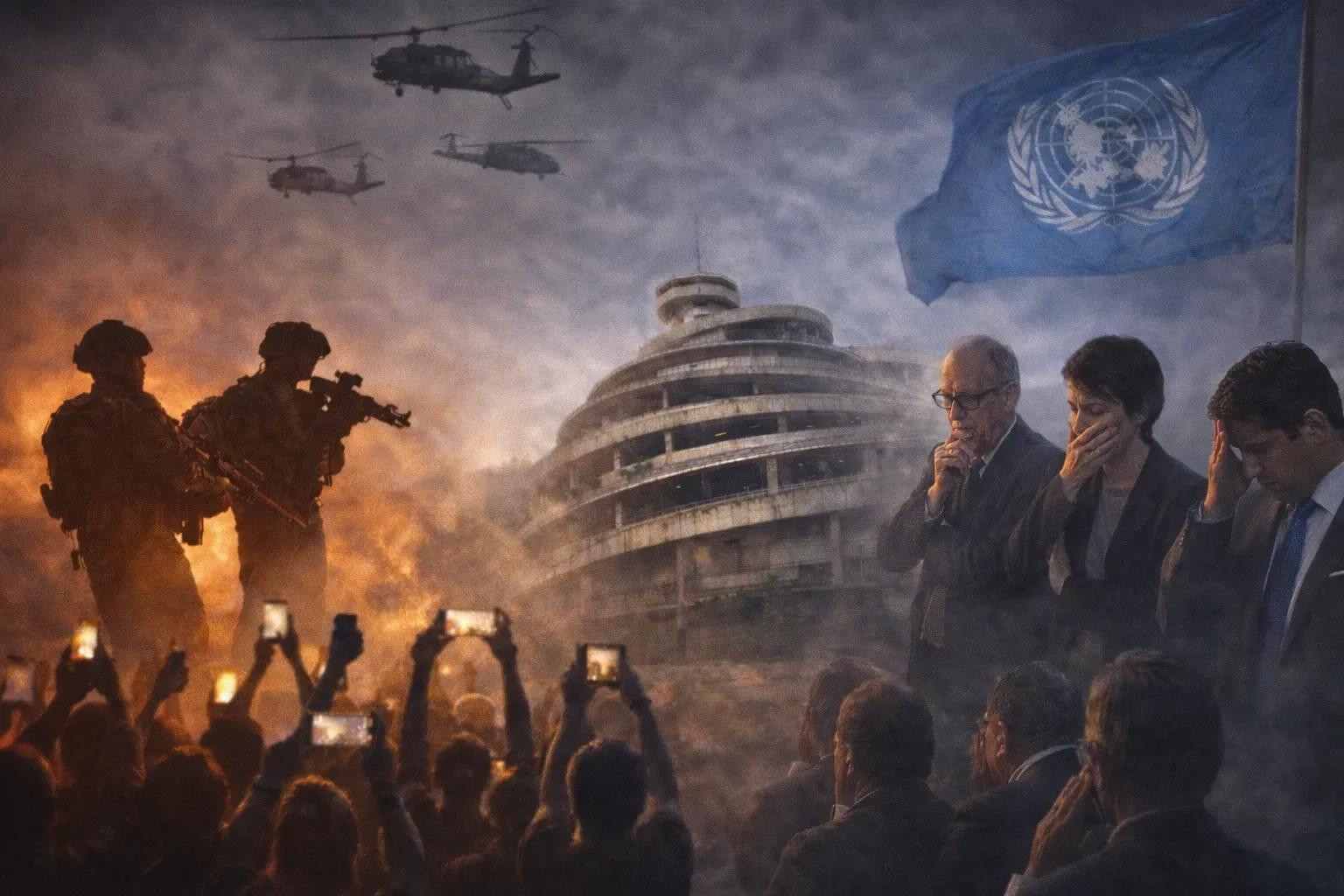
The Helicoide, a brutalist building in Caracas that was initially conceived as a shopping center, has been transformed since the early 1980s into the headquarters of the Bolivarian Intelligence Service (SEBIN) and one of the most infamous detention centers in Venezuela. Since then, activists, released prisoners, and human rights organizations have testified that torture, mistreatment, inhumane conditions, and extreme isolation of political detainees were practiced inside its walls.
Testimonies especially multiplied after the massive protests of 2014 and 2017 when thousands of anti-government protesters were arbitrarily detained.
International reports documenting serious violations
a) UN Report — 2019-2022
The United Nations High Commissioner for Human Rights, Michelle Bachelet, presented several reports on Venezuela between 2019 and 2022. These documents denounced extrajudicial executions of thousands of people, arbitrary detentions, torture, and a strategy of criminalizing the opposition and critics of the government, both inside and outside El Helicoide.
The UN Human Rights Council endorsed these documents, leading to the establishment of the Independent International Fact-Finding Mission on Venezuela.
b) United Nations Missions — 2022
In September 2022, a UN mission concluded that abuses committed by Venezuelan intelligence agencies, including acts of torture, sexual violence, enforced disappearances, and systematic repression, "may amount to crimes against humanity."
c) Amnesty International and other organizations
Amnesty International, in its 2025 report, stated that acts of enforced disappearance, torture, and repression are part of a systematic state policy of attacks against the civilian population since at least 2014, framing these events as crimes under international law.
d) Inter-American Commission on Human Rights (IACHR)
The IACHR has presented cases concerning arbitrary detentions, torture, and requests for in loco visits to El Helicoide before the Inter-American Court of Human Rights, highlighting the continuity of repression mechanisms in Venezuela.
The international bureaucracy or the pragmatic praxis of states?
Concrete progress on international sanctions or legal transformations within Venezuela has been limited. The International Criminal Court itself closed its office in Caracas in 2025, citing a lack of real cooperation from the regime and few verifiable advances on accountability.
This raises a crucial question for understanding global policy towards state crimes:
Is the "bureaucratic" work of the United Nations and multilateral courts, which document, report, and recommend, more useful, or the pragmatic and direct intervention of powerful states acting decisively—though also motivated by geopolitical and economic interests—as a motor for change?
A paradigmatic example in this debate is the intervention of governments like that of the United States, whose pressure—sometimes accompanied by use of force or economic conditioning—had more tangible impacts on the release of political prisoners or the dismantling of repressive structures than the exhortations or recommendations of multilateral organizations. In the recent case of El Helicoide, after dictator Nicolás Maduro was captured and detained in New York, a change within the regime began in Venezuela, where they had to comply with a series of conditions set by the United States. Among these are economic conditions, like the authorization to privatize oil, and in the last hours, the definitive closure of El Helicoide accompanied by the release of political prisoners.
A global dilemma in the 21st century
The existence of abundant and well-founded reports on serious human rights violations contrasts with the perception of slowness or ineffectiveness of many international mechanisms to transform these complaints into effective justice within the countries that commit them.
Meanwhile, state actors with military or diplomatic power—though also motivated by their own calculations—can achieve different, rapid, and concrete results.
This clash between international legality and geopolitical pragmatism still shapes one of the most relevant dilemmas of contemporary international politics, especially in scenarios where the lives and freedom of thousands of people are at stake.

Comments