The scene took place on November 11, 1947. The debate of a project was underway with which the Labour government of Clement Attlee sought to limit the power of the House of Lords. Winston Churchill, leader of the Conservative opposition, uttered a phrase destined to travel far beyond Westminster:
"Many forms of government have been tried, and will be tried in this world of sin and suffering. No one pretends that democracy is perfect or all-wise. Indeed, it has been said that democracy is the worst form of government, except for all the others that have been tried from time to time..."
[Read: The Power in Decay: The Fragility of Presidential Approval]
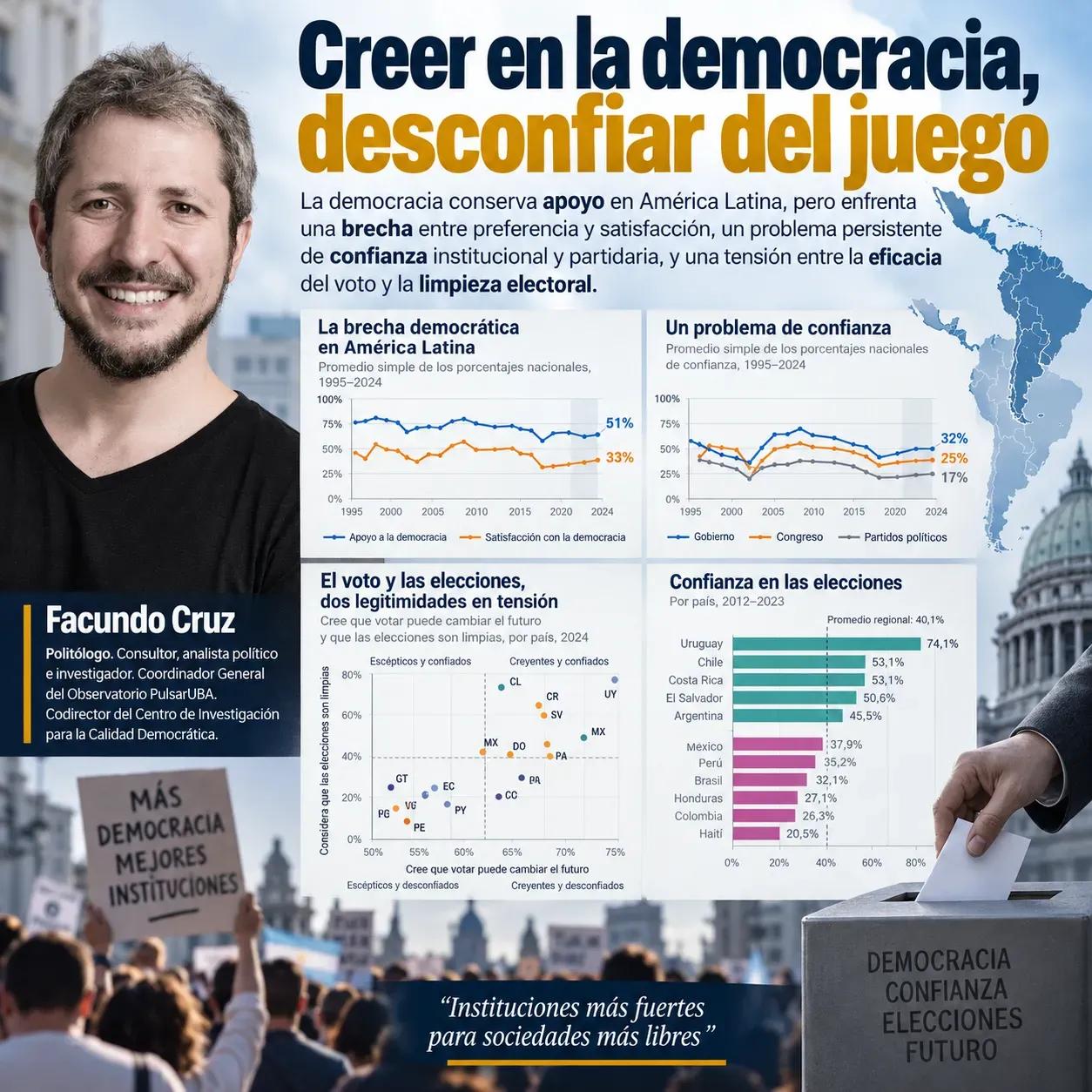
Democracy can function poorly and still be the preferred system of government. The best game in town. Almost 80 years later, the paradox still holds in Latin America. Support for democracy and trust in the effectiveness of the vote show a civic commitment that, with ups and downs, still survives. However, the current picture presents three red flags: a gap between support and satisfaction; widespread distrust in political actors; and a tension between the effectiveness of the vote and the integrity of elections.
Support vs satisfaction, an explicit gap
The data from Latinobarometer show a tension between preferences and evaluations of the current political regime. On one hand, support for democracy is rising. On the other, satisfaction with its functioning is declining. A tribute to Churchill.
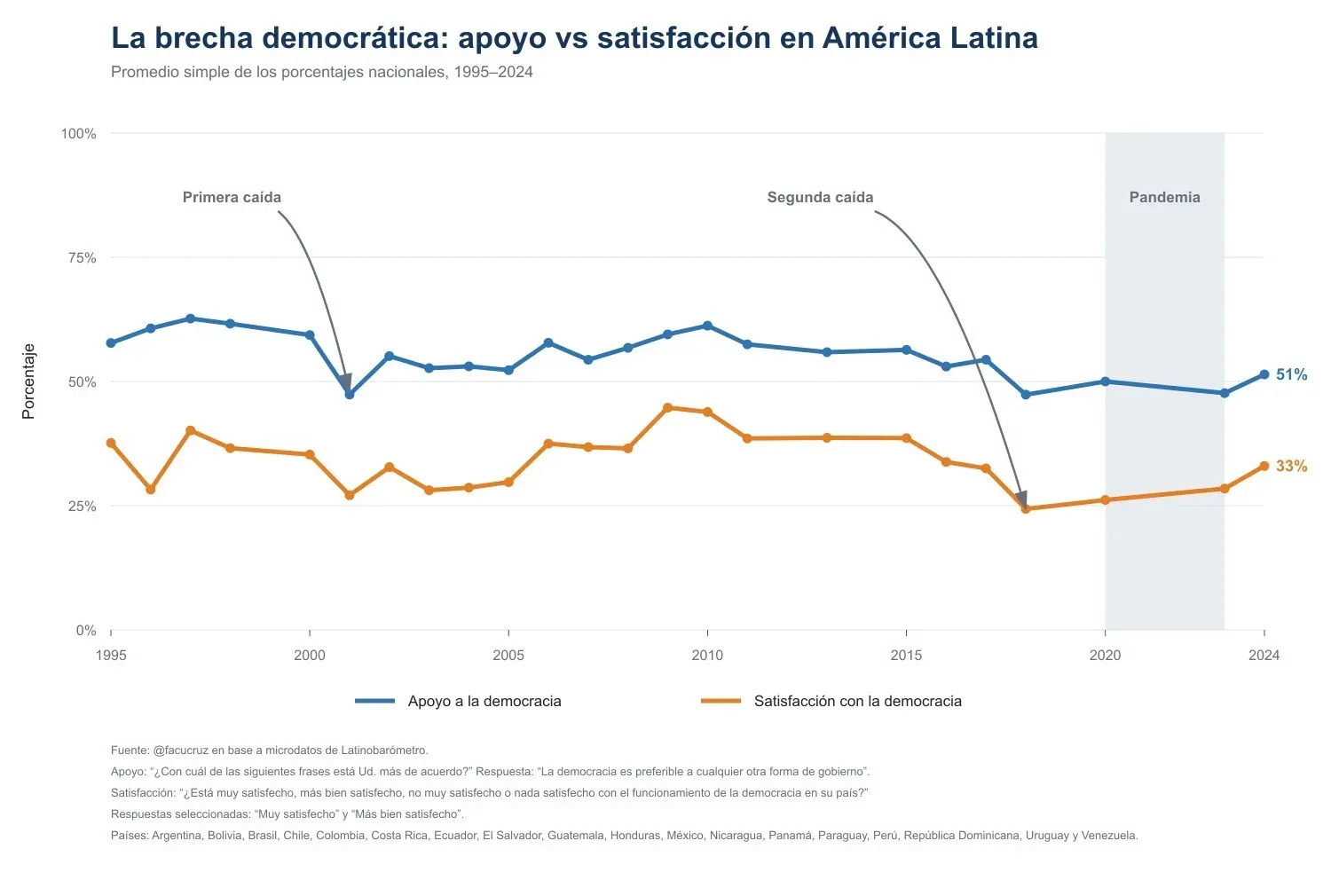
As seen in the first graph, the two curves travel together, though they never touch. The first sharp drop came between 2000 and 2001: support fell from 59% to 47% (-12 pp.), while satisfaction dropped from 35% to 27% (-8 pp.). Starting in 2009, there was a recovery: support again surpassed 60% and satisfaction hovered around 44%. Perhaps the last moment of relative regional enthusiasm captured in the series.
The second drop was more prolonged. Between 2015 and 2018, support fell from 56% to 47% (-9 pp.), while satisfaction plummeted from 39% to 24% (-15 pp.). Support nearly touched the same floor as in 2001 and took longer to recover. Satisfaction fell even further.
The distance between both variables helps to size the gap. At the moment of greatest enthusiasm, around 2009, the distance shrank to 15 points. In 2018, it widened again to 23 and reached 24 during the pandemic. The preference for democracy endured better than the evaluation of its functioning. In 2024, the recovery of satisfaction reduced the distance to 18 points: 51% supported democracy and only 33% expressed satisfaction. The gap narrowed, although it still spans the region.
This lies at the heart of much of the current Latin American tension with the prevailing political regime. We prefer democracy as a form of government, but the concrete experience we have with it leaves us mostly unsatisfied. Two sides of the same coin. While we choose it as a rule for organizing power, we question how it is exercised.
However, the regional average tells only part of the story. Opening this gap by countries reveals very different intensities and trajectories.
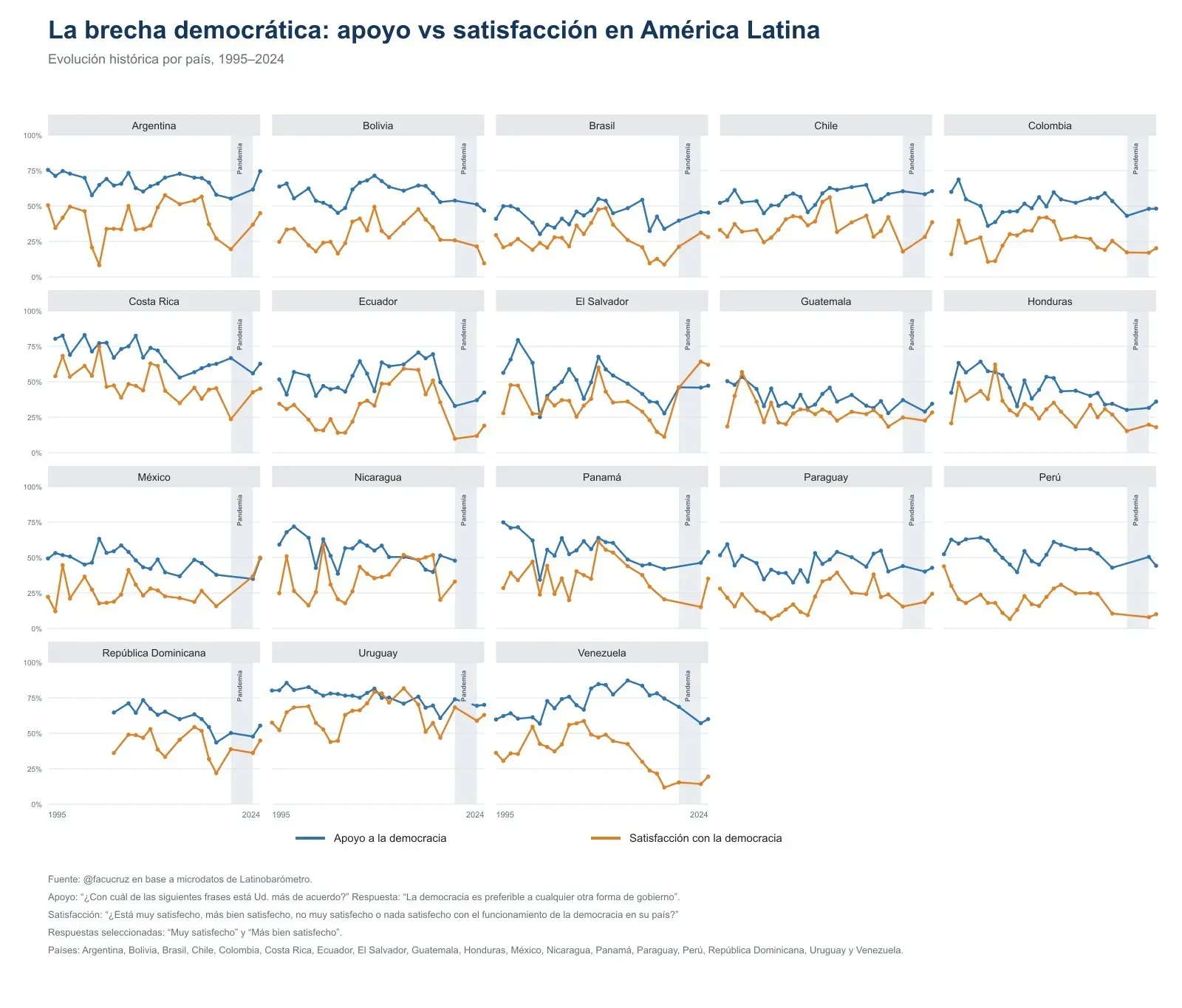
While, for example, Uruguay maintains high levels in both dimensions, countries like Peru and Venezuela carry a persistent distance between the valuation of democracy and the assessment of its functioning. Latin America shares a democratic tension of dissimilar trajectories.
A multidimensional trust problem
The dissatisfaction with the functioning of democracy finds a first explanation in low institutional and party trust. The following graph offers some clues in this regard.
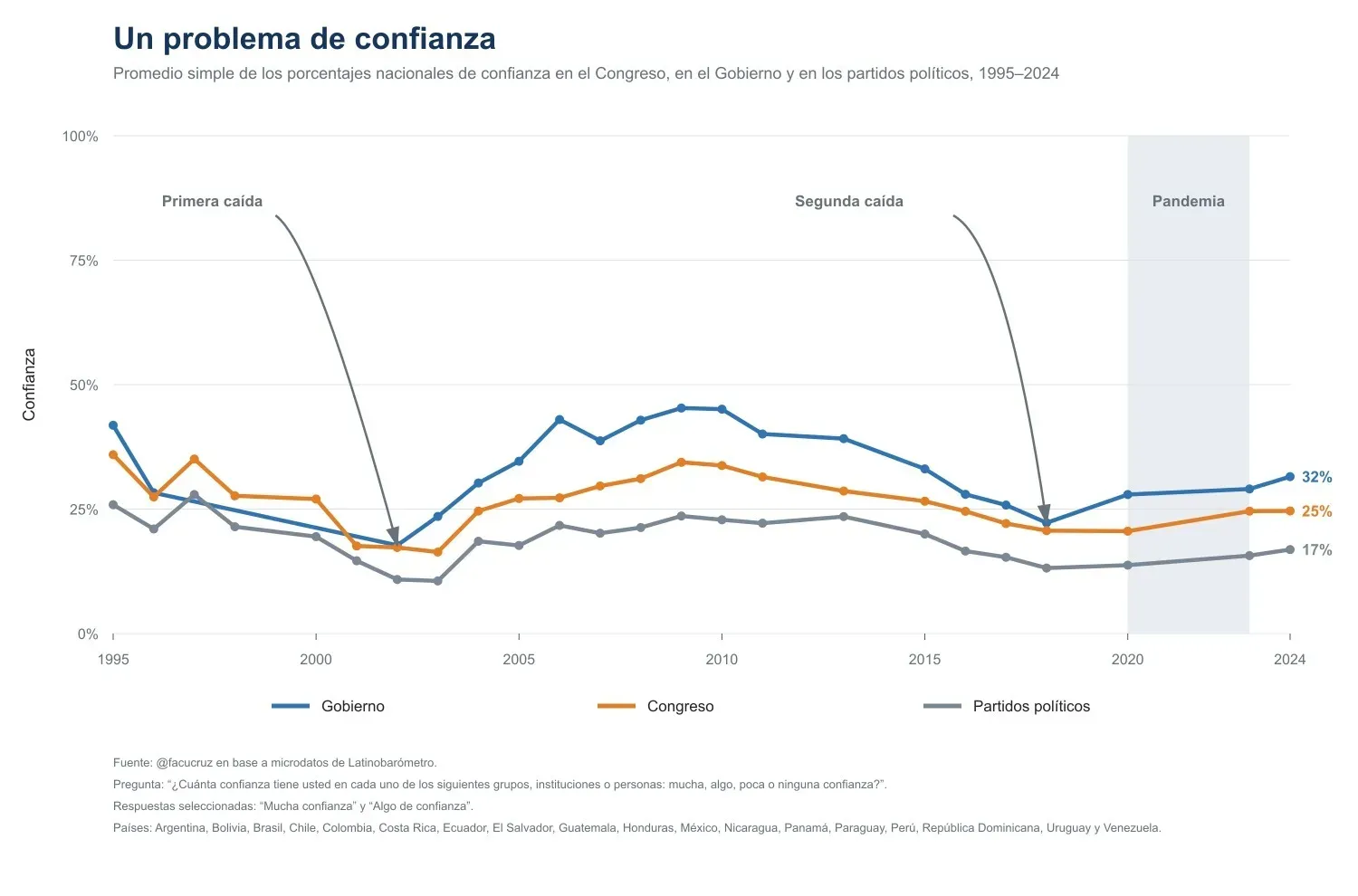
The same data from Latinobarometer indicate that institutional functioning, those who decide and those who represent currently arouse more distrust than trust in Latin America. The trajectory resembles quite a bit to that of regional democratic satisfaction: it falls at the beginning of the 21st century, recovers for several years, and deteriorates again before the pandemic. The curves speak to each other. When the evaluation of the regime improves, trust in those who translate it into decisions also grows. When that trust erodes, dissatisfaction accompanies the decline.
The first crisis fully takes shape between 1995 and 2002, when trust in government dropped from 42% to 18% (-24 pp.) and Congress from 36% to 17% (-19 pp.). Political parties, always lower than either of the two political institutions, fell from 26% to 11% (-15 pp.). After hitting rock bottom, recovery began in 2004 and reached its peak around the 2009-2010 biennium. A new moment of regional enthusiasm, coinciding with what was recorded in support and satisfaction with democracy.
[Read: Five years after the pandemic, what changed in political terms?]
It lasted little. The second drop extended over almost a decade. Between 2010 and 2018, trust in government reduced from 45% to 22% (-23 pp.); in Congress, from 34% to 21% (-13 pp.); and in the parties, from 23% to 13% (-10 pp.). During the pandemic, disillusionment remained. The latest snapshot from 2024 shows that the three variables recovered some of the lost ground, although they remain far from reaching half of those surveyed: government reached 32%; Congress, 25%; and parties, only 17%.
The taste once again turns bittersweet. Democratic satisfaction and trust in political actors began to rise, although the former did so at a faster pace. Latin American democracy still has support and starts to recover a nascent —albeit minority— positive valuation. The trust in those who make it work remains further behind.
We live on elections
Finally, the legitimacy of origin of Latin American democracies also raises some warning signals. Elections are the engine of democracy, and its social support can be read from two angles. The first refers to the outcome: how much it is believed that the vote can change the future. The second points to its management: how much trust is aroused by the integrity of the process. The same 2024 picture clearly exposes the distance between both axes. On average, 62% believe that voting can change the future, while only 34% consider the elections clean. A distance of 28 points between the expectation placed on the outcome and the trust generated by its administration.
In this sense, the vote still retains the capacity to produce hope. But the process responsible for receiving it, counting it, and converting it into power arouses many more doubts. LAPOP data complements this point. Trust in elections fell from 44% in 2012 to 38% in 2023 (with a temporary uptick to 42% in 2021). The erosion is gradual and highlights in some specific regions of the continent.
The map of countries shows this clearly.
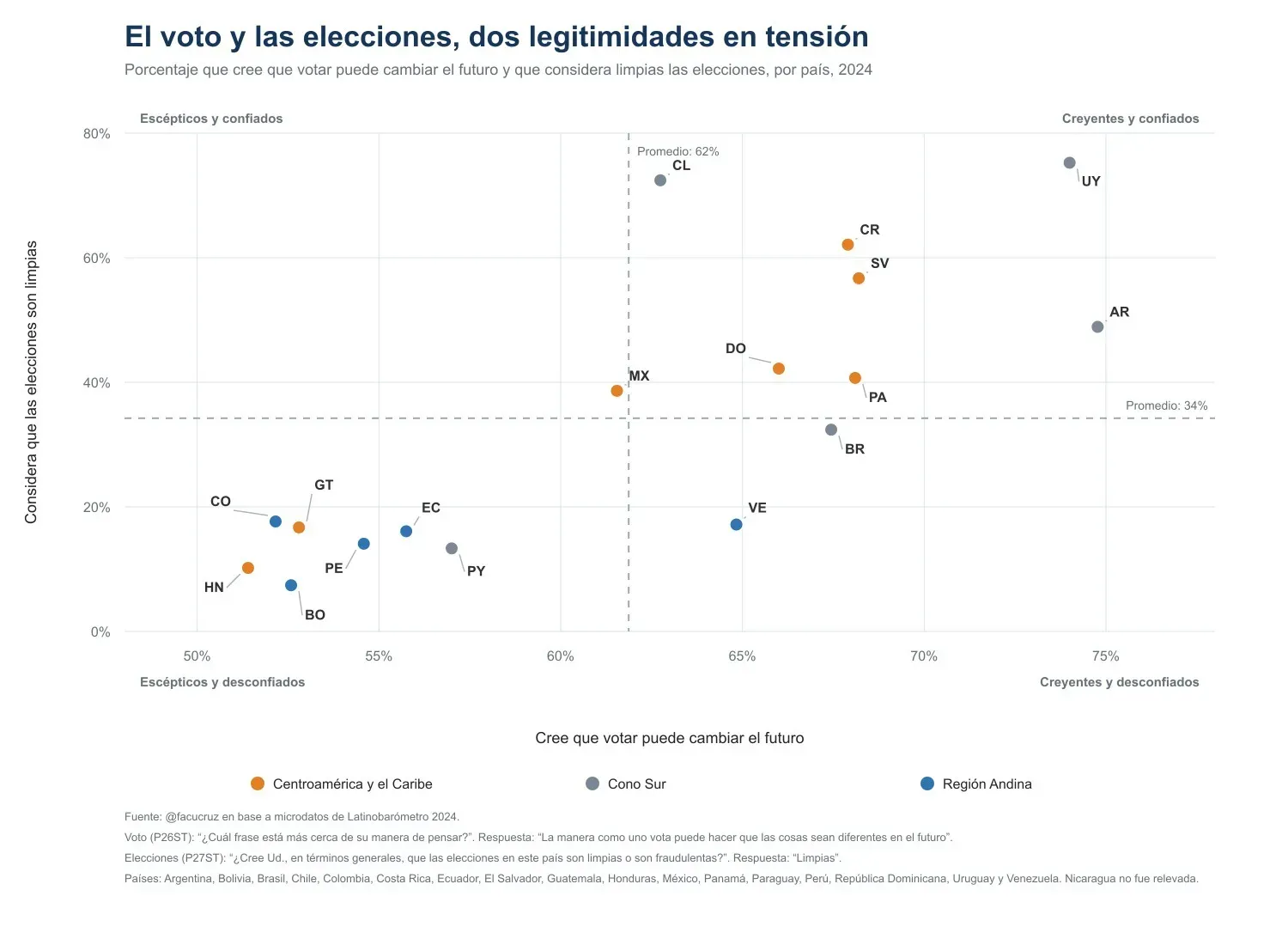
Bolivia, Colombia, Ecuador, Guatemala, Honduras, Paraguay, and Peru show levels of trust below the average in both dimensions: they concentrate more skeptics and more distrustful in relative terms. Argentina, Chile, Costa Rica, El Salvador, Panama, the Dominican Republic, and Uruguay form the group of believers and the trusted. Between both poles, isolated cases arise. Mexico shows electoral trust above average, combined with a more moderate valuation of the outcome of the vote. In contrast, Brazil and Venezuela maintain their faith in the vote while expressing strong doubts about the integrity of the process.
Thus, 14 of the 17 countries concentrate on two poles. On one, the vote retains power, and elections inspire trust. On the other, the democratic engine fails doubly, as it is hard to believe that the urns can change direction, and also that the votes are counted cleanly.
So, is democracy still the best game in town? Data says yes, but with a couple of 'buts.' There is a significant civic commitment as democracy remains the preferred form of government and a majority still believes their vote can change the future. There are players who play and believe.
However, doubts arise when the game begins. The questioning falls on the functioning of the political regime, on the integrity of elections, on the performance of institutions, and on the ability of actors to represent and govern. Normative preferences coexist with dissatisfaction, distrust, and skepticism.
A gap, a problem, and a tension that generate alerts. And here lies the Latin American challenge: to prevent democracy from surviving only due to the lack of concrete alternatives. Let the preferred game not change to another.
Facundo Cruz is Political Scientist. Consultant, political analyst, and researcher. General Coordinator of the Observatory PulsarUBA. Co-director of the Center for Research for Democratic Quality.

Comments