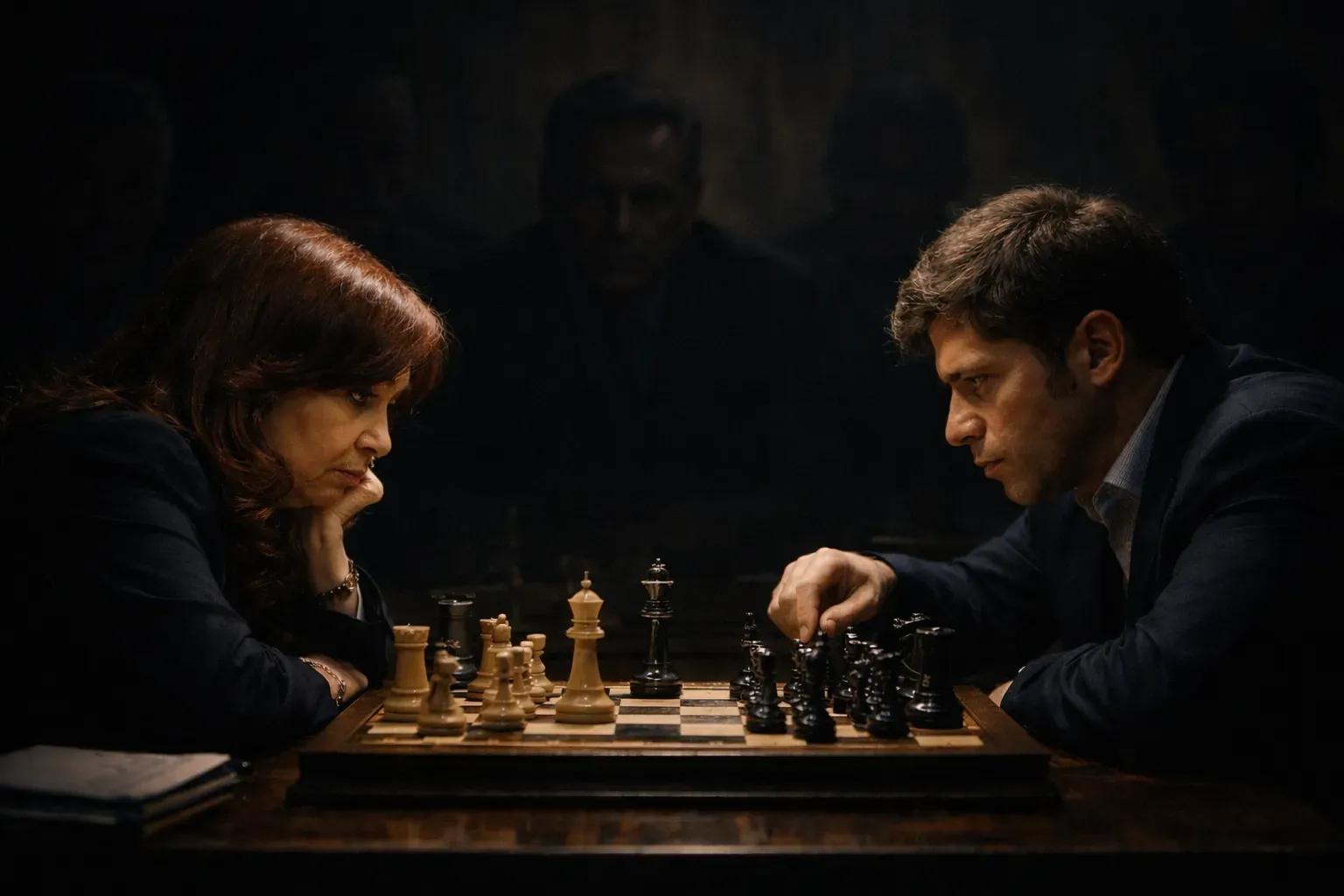
Axel Kicillof began discussing something that, read coldly, sounds uncomfortable but politically rational: if Peronism cannot guarantee today the recovery of the Nation, at least it must shield the province of Buenos Aires. This is the logic behind the assessment to advance the Buenos Aires election of 2027, a move that in La Plata is seen as an opportunity and in the universe of Cristina Fernández de Kirchner as a strategic mistake.
The idea does not arise from a technical whim but from a power reading. In the governor's environment, they argue that “winning well” the province before the national election would give significant support to a possible presidential candidacy of Kicillof. The reasoning is simple: if Buenos Aires proves to be the great opposition bastion again, the governor would enter the national discussion with a concrete asset, not with a promise. Moreover, in La Plata they believe that the real muscle of Peronism still lies with the mayors, and giving them centrality in a separated provincial election makes them protagonists of their own victory and, afterwards, partners in a broader national project.
In other words, Kicillof seems to be thinking in two stages. First, securing the territory that Peronism still controls with greater electoral density. Then, using that victory as a platform to contest the country. It is not a heroic plan; it is a defensive plan. But precisely because of that, it is realistic. Because it stems from an admission that hardline Kirchnerism does not want to verbalize: today, at best, Peronism is in a stage of reconstruction.
The problem: the strategy clashes head-on with Cristina's perspective.
For the former president and La Cámpora, decoupling divides efforts, fragments the electoral strength of Peronism, and ultimately weakens the national fight. For the leaders closest to CFK, safeguarding Buenos Aires is not enough if Congress is simultaneously relinquished, along with the ability to halt the government's reforms.
Kicillof is thinking like a governor who wants to project himself. Cristina, as a political leader, continues to view the complete system. One prioritizes the territorial device; the other, the concentration of national effort. One believes that a won province can push a presidential candidacy; the other believes that a separated province can turn into a trap: win at the local level, lose at the national level, all while creating the illusion of having succeeded.
It is no coincidence that the mayors closest to the MDF repeat that “we must secure the province and the municipalities” and that “we cannot risk everything”. That phrase exposes the most uncomfortable truth of the debate: the decoupling does not arise so much from a national ambition as from an instinct for territorial survival. Faced with a complex national scenario, many mayors prefer to decouple from the drag of an uncertain presidential election and preserve their local power. This strengthens Kicillof as a Buenos Aires strategist, but it also feeds Cristina's suspicion that Peronism could end up managing its retreat instead of organizing its return to power.
Furthermore, the discussion is not just political: it is also tied to institutional reforms that the Buenos Aires Legislature will need to discuss, such as PASO, the Single Ballot, and the reelection of mayors. This means that the electoral calendar does not depend solely on strategic will, but on a legal and operational engineering that is still open. Even Cronos warns that decoupling entails higher costs, greater logistical complexity, and more than one trip to the polls for the electorate.
Thus, the discussion does not only revolve around a date. It revolves around a much deeper question: what does Peronism want to be in 2027? If the answer is to return to the Casa Rosada, Cristina maintains that energies cannot be dispersed. If the answer is to preserve its main stronghold and from there rebuild, Kicillof has arguments to advance.
Deep down, the governor's strategy contains a silent confession: before recovering the Nation, perhaps today the achievable goal is not to lose the province. And that is precisely what CFK rejects. For Kirchnerism, accepting that logic is to start thinking as a defensive force. For Kicillof, however, it may be the only serious way to start thinking big again.

Comments