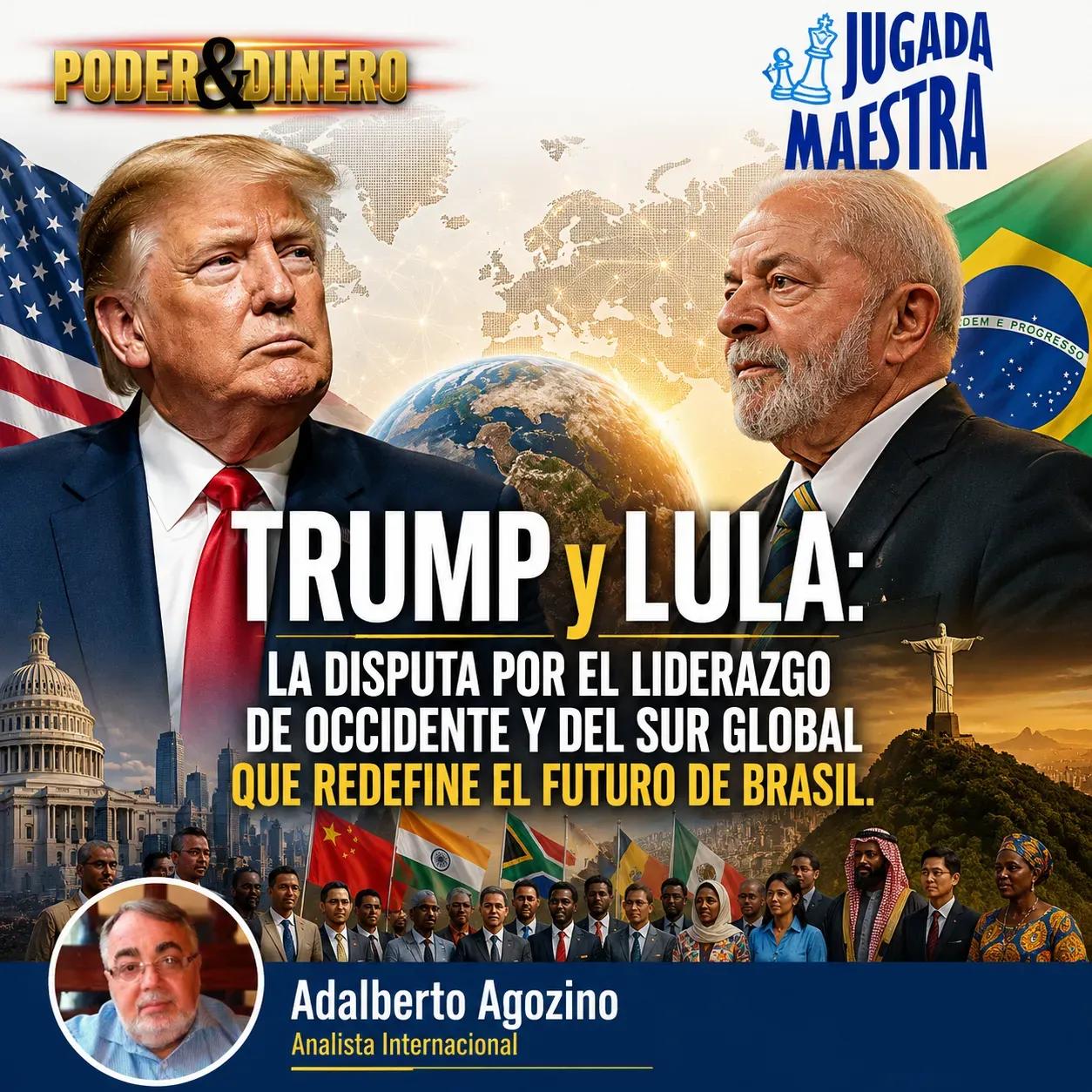
The relations between the United States and Brazil are going through one of their most delicate moments since the reestablishment of Brazilian democracy. What for decades constituted a relationship characterized by a combination of economic cooperation, specific differences, and ongoing dialogue has transformed into a scenario of increasing political, commercial, and diplomatic confrontation, the outcome of which could influence both the balance of regional power and the configuration of international alliances in the coming years.
The recent decision by the Donald Trump Administration to revoke the visa of the Brazilian ambassador in Washington, Maria Luiza Ribeiro Viotti, constitutes the most visible episode of an escalation that has been developing for months. Washington justified the measure as a response to the Brazilian Government's delay in granting approval to the designated American ambassador to Brasilia, while the Planalto Palace denounced a deliberate policy of hostility and an attempt to interfere in the electoral process scheduled for October.
However, reducing the conflict to a mere protocol disagreement would mean ignoring the true dimensions of a much more complex dispute. The diplomatic controversy is merely the most recent expression of a confrontation whose origins are simultaneously ideological, economic, and geopolitical.
The personal differences between Donald Trump and Luiz Inácio Lula da Silva are evident. Both represent practically antagonistic political projects. While Trump has built much of his political identity on economic nationalism, the defense of American unilateralism, and a transactional conception of international relations, Lula advocates for multilateralism, the strengthening of international organizations, and the strategic autonomy of emerging powers.
However, doctrinal divergences, no matter how deep, are not enough to explain the deterioration of bilateral ties. International politics rarely responds solely to affinities or ideological differences. The permanent interests of states often prevail over the personal preferences of their leaders.
From this perspective, the main concern for Washington does not reside exclusively in the social-populist orientation of the Brazilian Government, but in Brazil's growing aspiration to act as an autonomous power pole within the international system.
During his various terms, Lula has sought to consolidate Brazil's image as a middle power capable of maintaining simultaneously fluid relations with the United States, Europe, China, Russia, India, Africa, and the Middle East. This strategy, known in Brazilian diplomacy as autonomy through diversification, aims to reduce dependence on any major power and expand Brazil's international maneuvering space.
This orientation is particularly uncomfortable for a U.S. Administration that considers competition with China as the organizing axis of contemporary world politics. From Washington's perspective, strategic allies should align with American interests on technological, commercial, industrial, and security issues. Brazil, on the other hand, resists accepting this logic of blocs.
Lula's approach towards China is probably the most sensitive element of this dispute.
Over the last decade, the Asian giant has become Brazil's main trading partner. Exports of soybeans, iron ore, oil, meat, and other agro-industrial products increasingly depend on the Chinese market, while investments from Beijing cover strategic sectors such as infrastructure, electricity, mining, ports, telecommunications, and new technologies.
Far from considering this relationship a problem, Lula presents it as a historic opportunity to diversify Brazil's international partnerships and reduce excessive dependence on Western markets.
This vision is also projected in the strengthening of the BRICS, a grouping that Brazil considers one of the main instruments for building a more multipolar international order. The promotion of alternative financial mechanisms, the push for new credit institutions, and the pursuit of greater trade exchanges in national currencies are interpreted by numerous U.S. sectors as initiatives aimed at reducing Washington's global economic influence.
The U.S. concern is not solely due to the growth of bilateral trade between Brazil and China. What truly modifies strategic calculations is the possibility that Brazil could become a player capable of articulating common positions among the major emerging economies, granting greater negotiating power to the so-called Global South against Western powers.
The economic dimension of the conflict also explains much of the growing tension. The new tariffs imposed by the United States on various Brazilian products were officially justified by alleged unfair trade practices and the operation of Brazil’s electronic payment system Pix, whose expansion has significantly reduced the participation of American companies in that market. Brazil rejected these accusations and maintained that the measures are essentially political rather than commercial decisions.
For Lula's Government, the controversy surrounding Pix symbolizes something much more important than a simple regulatory disagreement. It represents the defense of a technological innovation developed by Brazilian public institutions that has transformed the national financial system and become an international reference. The advocacy of this model has been incorporated by the president as part of a broader narrative about Brazil’s capacity to develop its own solutions without depending on large foreign technology corporations.
Additionally, there is a growing dispute over sectors considered strategic for the economy of the 21st century. The competition for critical minerals, rare earths, artificial intelligence, digital infrastructure, and supply chains makes Brazil an increasingly relevant actor due to the magnitude of its natural resources and industrial potential. From this perspective, Brazilian foreign policy ceases to be an exclusively regional matter and becomes a significant variable within the global competition between the United States and China.
The confrontation between Trump and Lula also acquires an electoral dimension that is impossible to ignore. The proximity of Brazil's presidential elections has transformed each diplomatic incident into an instrument of internal political dispute. The Brazilian Government claims that certain decisions made from Washington—including the revocation of the ambassador's visa, sanctions against Brazilian authorities, and diplomatic pressures linked to the process of appointing the new American ambassador—are part of a strategy aimed at influencing the political climate before the elections. This interpretation is repeatedly reflected in the official statements issued by the Planalto Palace.
Although the Trump Administration categorically rejects this accusation and presents its decisions as responses based on the principle of diplomatic reciprocity and concrete trade differences, the political context makes it inevitable that each movement be read in electoral terms. The traditional prudence that characterized relations between Washington and Brasília for decades has given way to an unusually harsh language, where public accusations replace diplomatic discretion.
In this scenario, Lula has demonstrated a remarkable ability to transform a potentially adverse situation into a political asset. Far from adopting a defensive position, the Brazilian president has sought to convert the confrontation with Trump into evidence that Brazil is being subjected to external pressures precisely because it has chosen to defend its own national interests.
This is not a novel strategy in the history of Latin American politics. The appeal to national sovereignty in the face of foreign interference has been one of the most effective rhetorical resources for strengthening the legitimacy of governments facing internal difficulties for decades. However, in the Brazilian case, it acquires particular characteristics due to the economic and political magnitude of the country.
Brazil is not a small economy that exclusively depends on the American market. Its demographic weight, industrial capacity, diversification of export markets, and the growing prominence of Asia provide it with a considerably larger margin of maneuver than that of most Latin American countries. This reality allows Lula to maintain a firm discourse toward Washington without facing, at least in the short term, the economic costs that such a confrontation would imply for more vulnerable economies.
At the same time, the president has sought to politically associate his main electoral adversary, Flávio Bolsonaro, with pressures from the United States. According to this narrative, Trump’s explicit support for the Bolsonaro family would show that certain sectors of the opposition are prioritizing their political interests over the permanent interests of the Brazilian state. The objective is to present the October election not only as a competition between economic or ideological projects but also as a decision about the defense of national sovereignty. The Brazilian Government has insisted on linking Washington’s actions to a supposed attempt to electorally favor the bolsonarist candidate.
This narrative also finds fertile ground in a significant portion of the Brazilian public, historically sensitive to any perception of foreign tutelage over national affairs. Brazil’s international identity has been built over decades around the idea of autonomy, independence, and a universalist vocation. From the foreign policy developed by the Baron of Rio Branco to the autonomy doctrines formulated during the second half of the 20th century, Brazilian diplomacy has sought to avoid automatic alignments with any power. Lula now revives that tradition to strengthen his internal legitimacy.
This does not mean that the president ignores the risks arising from a prolonged deterioration of relations with the United States. The American economy continues to be a major trading partner, a relevant source of investments, and a decisive actor in sectors such as technological innovation, finance, and scientific cooperation. A sustained conflict could generate uncertainty for numerous Brazilian productive sectors and affect growth prospects.
Likewise, the Trump Administration also does not obtain obvious benefits from a prolonged confrontation with the largest Latin American economy. Brazil is an indispensable actor in diverse issues such as South American stability, global food security, energy transition, Amazon preservation, the supply of critical minerals, and South Atlantic governance. Turning this relationship into a permanent conflict would weaken U.S. influence precisely in a region where China increases its economic, financial, and technological presence year after year.
Therefore, behind the grandiloquent statements and diplomatically charged gestures persists a paradox. Both governments need to preserve a functional relationship, but at the same time, they consider it politically profitable to showcase firmness against each other. Trump reinforces to his electorate the image of a president willing to defend American interests uncompromisingly against any trading partner. Lula, for his part, projects the figure of a head of state capable of resisting the pressures of the world's leading power and asserting Brazil's autonomy in an increasingly competitive international scenario.
In short, the confrontation between Donald Trump and Luiz Inácio Lula da Silva transcends the struggle between a conservative leader and a progressive one. It expresses the transition towards an international system where emerging powers demand greater margins of autonomy while the United States tries to preserve its leadership capacity in the face of the rise of new centers of power, especially China. Brazil occupies a unique position in this dispute: too important to be treated as a secondary actor and still insufficiently powerful to impose the rules of international engagement on its own.
Aware of this reality, Lula has chosen to transform external pressure into a central element of his electoral narrative. By presenting each sanction, each tariff, and each diplomatic friction as evidence of the need to defend Brazilian sovereignty, he tries to convert the conflict with Washington into a factor of national cohesion. Whether this strategy will effectively contribute to ensuring his continuity in the Planalto Palace will ultimately depend on the response of an electorate that will have to decide not only between two political projects but also between two opposing visions of the place Brazil should occupy in the world of the 21st century.
Adalberto Agozino is a Doctor in Political Science, International Analyst, and Professor at the University of Buenos Aires.

Comments