A philosopher friend once told me that Trump was just like Hugo Chávez, but on the right. Both say something in the morning and claim the opposite at night, threaten with a bombing at noon and extend a hand for a peace agreement in the afternoon. Both have been masters of the reality show.
During the 14 seasons of The Apprentice on NBC, the host's favorite phrase was: “You’re fired!”
On April 7, 2002, Chávez staged his most famous reality show in Aló, Presidente No. 101, during the oil strike: he took a referee's whistle, blew it loudly, and began: “Edgar Paredes, Out, fired! Juan Fernández, Out, fired!”
Perhaps that gag firing the PDVSA executives inspired Trump to coin his favorite phrase for his reality show.
Only Trump and Chávez can say things like: “I own the Miss Universe pageant, I know many misses, Venezuela is a wonderful country” or “María Isabel, wait for me tonight at the house, to give you what’s yours…”
What could this strategy serve for? To confuse the enemy, so they don’t see you coming.
The historian Irving Gatell never tires of warning his followers: -Don’t pay attention to what Trump says, pay attention to what he does.
A list of his statements uttered in recent months, during the war in Iran and following Maduro's ousting in Venezuela and the transition, is a gem for a discourse analysis work.
But for now, analysts wonder: -Who do we believe? How do we understand the United States' politics towards the Middle East and particularly towards Venezuela?
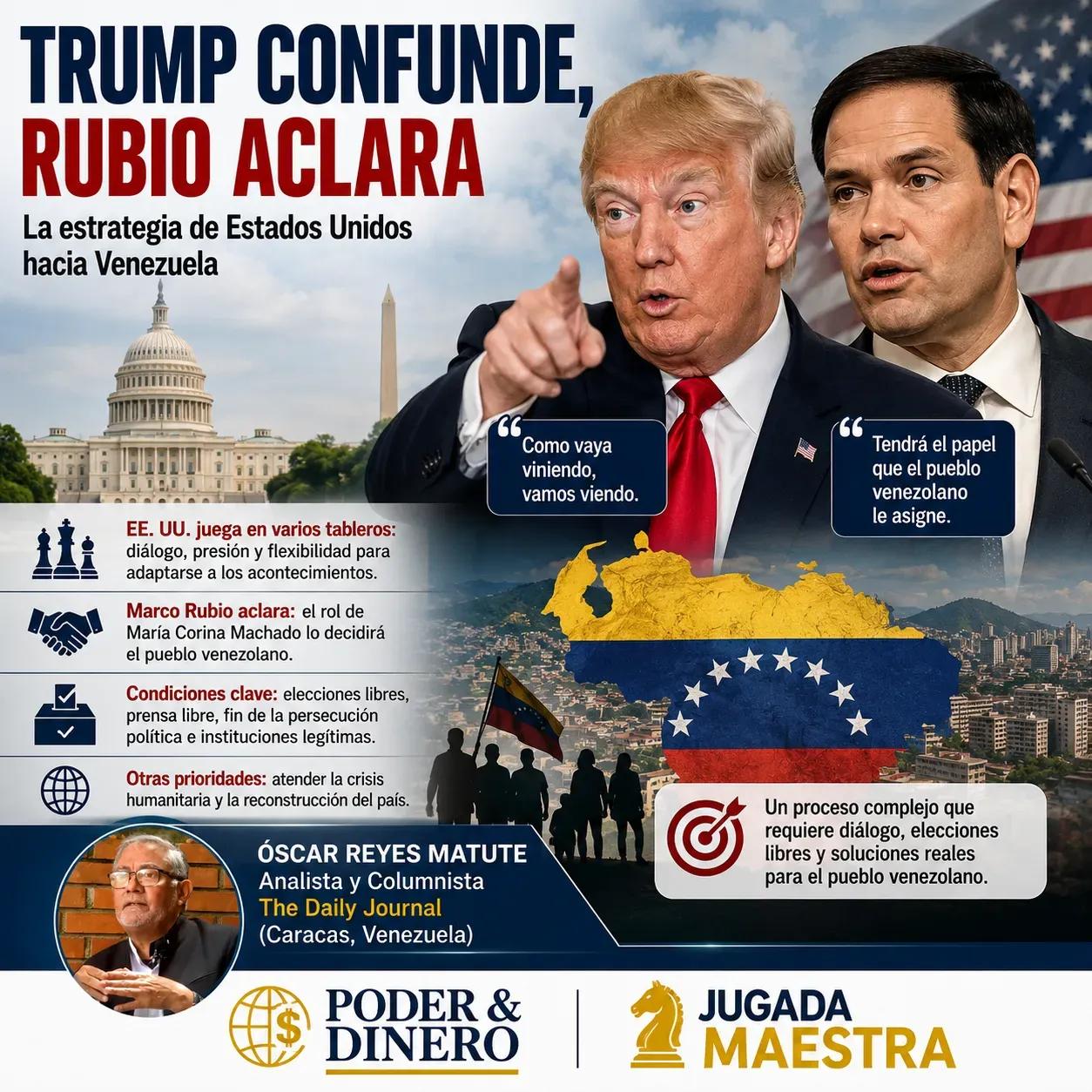
1.- The USA plays on multiple boards. It is always ready for a course change if events require it: “We’ll see how it goes.” Thus, if a dialogue with the National Assembly from 2015 is called, they can say: “Ms. Machado has no support in Venezuela, she cannot be on this commission.” Journalists try to bite the bullet: “Is Ms. Machado going to participate in the transition?” “They are not prepared to hold elections.”
2.- Marco Rubio clarifies. Last week, during the ASEAN conference in Manila, the Secretary of State was asked the same question: “Will Ms. Machado have a role in the reconstruction?” Rubio responded: “She will have the role that the Venezuelan people assign her.” In other words, the decision of her role will be determined by Venezuela, not the USA.
In that same conference, Rubio clarified:
3.- They cannot go to elections with this Electoral Power, they cannot go to elections with this TSJ, they need a free press and to not persecute opponents. I would add that not even those who burned flags of the USA and Israel in Plaza Bolívar, the new opposing madurismo. But just in case, the head of the Presidency is fortifying herself by appointing new generals of her trust. Can anyone really believe she did it without consulting Rubio?
If one wants to know the United States' project for the coming decades (Republican version), one shouldn't read the NY Times: they should go directly to Marco Rubio's speech on February 14, 2026, during the opening of the 62nd Munich Security Conference. Everything is there. But that deserves a separate analysis, let's continue with Venezuela.
Why can't Ms. Machado be on that commission? Because she cannot be both judge and party. If Ms. Machado returns to Venezuela and leads the transition, she will begin to prosecute the interim government, and the negotiation will become murky.
Remember that in Venezuela there are opponents, chavistas, and now maduristas burning flags. All must fit in a transition. The argument that she has the moral superiority to lead the transition is only made by her.
From what Rubio says, it follows that if the table is set properly and there are elections, she will be able to participate, she won’t need Edmundo González, and if she wins, well, she wins.
Her, Enrique Márquez, Lorenzo Mendoza, or some dark horse that shows up, we don’t know, we aren’t writing the script.
4.- Other priorities: It is a simultaneous, very complex process, as Rubio explained.
Meanwhile, now that volunteers from around the world have started to leave, it is legitimate to immediately ask questions like:
i.- What do we do with those 6,000 people on the streets and in shelters? What will they eat?
ii.- Do they have water in La Guaira? The water bottles run out in a day. Immediately, an emergency redistribution system with tank trucks from the surviving depots to the tents, shelters, and homes should be established.
iii.- La Guaira has no choice but to build seawater desalination plants for its citizens. And the best in the world at doing this are the Israelis.
We would have to see the same ones from Plaza Bolívar burning flags of the USA and Israel in front of those desalination plants.
They would be pelted with stones.
Óscar Reyes-Matute lives in Caracas. He is a philosopher, graduated from Andrés Bello Catholic University (UCAB), and completed graduate studies in Political Science at Simón Bolívar University (USB).
He was a Fulbright Visiting Scholar at New York University (NYU), in the area of American Studies. He also served as a professor of Political Philosophy at Andrés Bello Catholic University (UCAB) and at Central University of Venezuela (UCV). He is currently a doctoral candidate in Social Sciences at UCV.
He has published academic works at universities in Venezuela and Europe, as well as articles in various newspapers.
Since 2008 he has been dedicated to the study of Kabbalah at the Bnei Baruch Institute, in Petah Tikva (Israel), under the guidance of Michael Laitman, while developing his work as a screenwriter for film and television.
Additionally, he is a lyric tenor. And there’s a curious detail: after a glass of wine, he can surprise everyone by singing "Nessun Dorma."
Comments