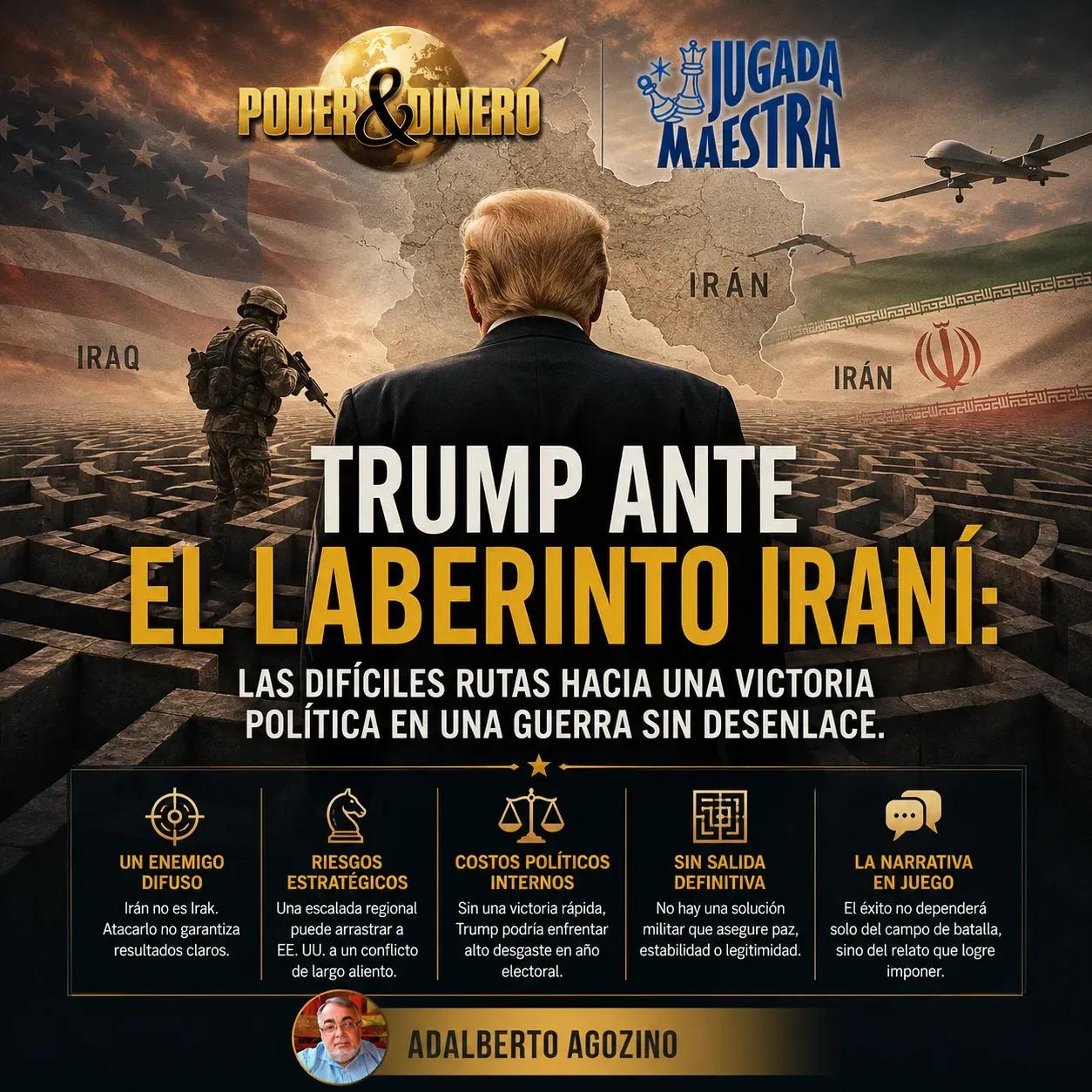
The famous definition of war formulated by the Prussian theorist Carl von Clausewitz continues to hold extraordinary relevance in contemporary conflicts. War, wrote the German strategist, constitutes an act of force aimed at compelling the adversary to fulfill our will. From that perspective, the fundamental issue facing President Donald Trump today is not how many military targets have been destroyed or how many operations have been successful, but whether the United States has truly succeeded in imposing its will on the Islamic Republic of Iran.
This question has become the central axis of the conflict facing Washington, backed by Israel, with the Iranian regime. The initial objectives seemed clear: to prevent Tehran from developing nuclear weapons, to halt the advance of its long-range ballistic missile program, and to reduce or eliminate its support for armed organizations that make up the so-called “axis of resistance”, including Hamas, Hezbollah, and the Houthi rebels in Yemen.
However, the evolution of military operations added a new strategic priority. The disruption of navigation in the Strait of Hormuz transformed the freedom of maritime transit into an objective as important as the previous ones. The safe reopening of this maritime route, through which a decisive proportion of global energy trade circulates, has become a central issue for Western economies, for Asian countries dependent on Gulf oil, and for the Arab allies of the United States themselves.
What began as a campaign aimed at changing Iranian strategic behavior has evolved into a broader and more complex confrontation, whose effects extend far beyond the battlefield. The repercussions reach energy markets, global supply chains, regional political balances, and the very architecture of international security built after the end of the Cold War.
Historical experience shows that wars rarely conclude exactly as conceived by those who initiated them. In this case, Iranian resistance has revealed a considerable ability to adapt. Despite the damage suffered by military infrastructures, industrial facilities, and logistical systems, Tehran has managed to preserve sufficient capabilities to maintain the confrontation and avoid a decisive defeat.
Since the Islamic Revolution of 1979, Iranian strategic doctrine has been based precisely on survival against technologically superior adversaries. Iranian leaders have assumed for decades that they could never compete with the United States in conventional terms. As a consequence, they built a defensive system supported by the dispersion of assets, asymmetric warfare, proxy forces, long-range missiles, and a notable ability to absorb damage without collapsing politically.
This resilience has greatly complicated Washington's calculations. American and Israeli air superiority can destroy specific targets, degrade military capabilities, and limit Iranian freedom of action. However, converting those tactical successes into political capitulation poses a much more complex challenge.
Diplomatic negotiations have reflected this reality. For months, various international actors have attempted to facilitate partial agreements or compromise formulas capable of reducing tensions. Gulf Arab countries, European governments, and Asian powers have explored various initiatives aimed at avoiding an irreversible escalation.
But talks have repeatedly collided with what the great theorist of international relations Hans Morgenthau defined as vital interests. For Israel, the possibility of Iran achieving military nuclear capability constitutes an existential threat. For Iran, completely renouncing its nuclear program is equivalent to accepting a permanent limitation of its strategic sovereignty and its deterrent capacity against much more powerful adversaries.
When a negotiation affects interests perceived as essential for the survival of a state, the margins for compromise are drastically reduced. It is precisely this dynamic that explains the repeated diplomatic blockages observed during the conflict.
In the face of this situation, Trump has several options, although none offers guarantees of absolute success.
The first consists of redefining the very concept of victory. This strategy, used in various contemporary conflicts, would allow the White House to present a prolonged freeze of the Iranian nuclear program, accompanied by strengthened international inspection mechanisms and guarantees on navigation in Hormuz, as a sufficient achievement.
From a political standpoint, this option would have obvious advantages. It would reduce military costs, alleviate global economic tensions, and allow the American president to argue that he has managed to temporarily halt Iranian nuclear ambitions without embarking on an indefinite war.
However, such an agreement would leave numerous uncertainties open. Iran could retain some of its technological capabilities, maintain knowledge accumulated over decades, and preserve an infrastructure susceptible to being reactivated in the future. The hardliners in Israel would also consider any agreement that did not completely eliminate Iran’s nuclear potential as insufficient.
The second option involves intensifying economic and diplomatic pressure while maintaining limited military pressure. This alternative would aim to gradually wear down the Iranian regime by exacerbating internal economic difficulties and increasing the political cost of confrontation.
Proponents of this strategy argue that financial sanctions, combined with selective military operations and international isolation, could ultimately generate divisions within the Iranian elite. The goal would not be immediate military victory but a gradual transformation of Tehran's strategic calculations.
However, recent history offers reasons for skepticism. Decades of sanctions have not caused the collapse of the Islamic Republic. On the contrary, the regime has demonstrated a remarkable ability to adapt to economic restrictions and turn external pressure into an argument for national cohesion.
The third possibility is to significantly expand conventional military operations. This strategy would seek to systematically destroy Iran's nuclear, missile, and military infrastructure until it forces the regime to accept the conditions imposed by Washington and Jerusalem.
Although this option has supporters within some strategic sectors in the United States and Israel, its risks are considerable. A prolonged campaign could trigger attacks on regional energy facilities, increase instability across the Middle East, and provoke an escalation that is difficult to control.
Moreover, American experience in conflicts like Iraq and Afghanistan demonstrates that military superiority does not necessarily guarantee favorable political outcomes. The destruction of material capabilities may not automatically translate into a change in the adversary's political will.
Finally, there is the most dangerous scenario: an extreme escalation that introduces strategic or tactical-nuclear weapons. Although some analysts have mentioned this possibility as a last resort to destroy deeply buried facilities, the consequences would be unpredictable.
The use of nuclear weapons, even low-yield ones, would break an international taboo maintained since 1945. The diplomatic, political, and humanitarian repercussions would be enormous. Furthermore, far from guaranteeing a clear victory, it could trigger an international crisis of historical dimensions and profoundly alter the global security system.
Therefore, most specialists consider this option to represent more of a theoretical deterrent tool than a politically viable alternative.
The real challenge for Trump is to find a balance between victory expectations and the limitations imposed by the strategic reality. In modern conflicts, especially those related to nuclear programs, absolute victory is often an illusion. The norm is to reach imperfect agreements that allow each party to proclaim some degree of success while avoiding a greater catastrophe.
The evolution of war seems to point precisely towards that logic. None of the involved actors have managed to fully impose their will. The United States and Israel maintain overwhelming military superiority, but they have not succeeded in bending Iranian resistance. Iran has demonstrated survival capacity, although it has also failed to expel Western pressure or fully guarantee its strategic objectives.
In that context, the most likely outcome does not involve an unconditional surrender of either party, but rather a complex negotiation in which each actor seeks to preserve their fundamental interests while presenting the result to their public opinion as a victory.
The decisive question for Trump will be to determine what level of concessions he is willing to accept to declare his mission accomplished. As so often in the history of international politics, the outcome will not depend solely on who possesses more military power, but on who can most convincingly define what winning really means.
Adalberto Agozino holds a PhD in Political Science, is an International Analyst and a Lecturer at the University of Buenos Aires.

Comments