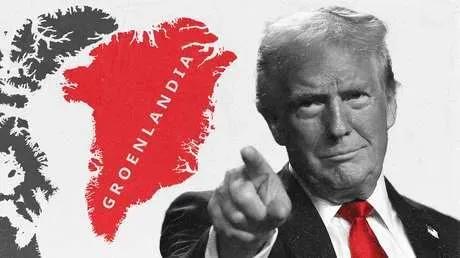
The speech of the President of the United States, Donald Trump, at the World Economic Forum in Davos was not a classical economic intervention, but rather a declaration of geopolitical principles. Under the guise of a reflection on global security and prosperity, Trump placed Greenland at the center of his strategic vision, directly linking it to the future of Europe, NATO, and the international order that emerged after World War II. The bluntness of the message—along with its openly transactional tone—calls for an analysis that transcends the current situation and delves into the historical roots and strategic consequences of a claim that many believed to be banished from Western political discourse: the acquisition of sovereign territory among allies.
The idea of Greenland as a strategic piece for the United States is not new. In the mid-19th century, Washington had already explored the possibility of acquiring the island from Denmark, and after World War II, the U.S. military presence was consolidated with the establishment of the Thule Air Base, now integrated into the early warning system and missile defense. In the logic of the Cold War, Greenland was conceived as an advanced bastion against the Soviet Union, a key position in controlling the North Atlantic and accessing the Arctic. Trump revives that strategic tradition but does so by stripping it of the multilateral framework that characterized U.S. policy for decades.
In Davos, the president spoke not of strengthened cooperation or new formulas within NATO, but rather of ownership and control. By stating that to defend Greenland "one must own it", Trump introduced a proprietary logic into an international system that, at least in its formal discourse, is governed by respect for sovereignty and territorial integrity. This assertion not only challenges Denmark and Greenlandic authorities but directly calls into question Europe as a whole, suggesting that the continent lacks the real capacity to guarantee its own security in the far north.
From a strategic point of view, Greenland occupies a unique position in the new global scenario. The progressive melting of the Arctic opens previously inaccessible maritime routes, reduces distances between Asia, Europe, and North America, and exposes vast natural resources, from rare earths to hydrocarbons. In this context, controlling the island implies direct influence over the North Atlantic, emerging polar routes, and the defense architecture of the northern hemisphere. Trump expressed it bluntly: for him, Greenland is not a peripheral territory but a central platform from which to project power against Russia and China.
The historical dimension of the argument is key to understanding its scope. During the post-war period, the United States built its global leadership by combining military power with a web of alliances and multilateral norms. NATO was the pillar of that system in Europe, and Denmark, as a founding member, was part of that consensus. By implicitly questioning the alliance's ability to protect a strategic territory without it being handed over to the United States, Trump erodes one of the symbolic foundations of NATO: collective defense among equals.
This tension is reflected in the European reaction. Leaders such as Emmanuel Macron and Ursula von der Leyen interpreted Trump’s words not just as a territorial threat but as an attempt to redefine the transatlantic relationship in terms of subordination. The implicit message is clear: the United States guarantees security but demands compensations that are no longer limited to military spending or trade concessions, but which extend to matters of sovereignty. Within this framework, Trump’s proposal serves as a catalyst for a broader debate on European strategic autonomy, a long-discussed aspiration that has so far been difficult to realize.
The case of Greenland also raises questions about international law and the precedent it could set. If a Western power legitimizes the idea of acquiring the territory of an ally for strategic reasons, with what moral authority could it oppose similar movements in other regions of the world? This question resonates in European foreign ministries and fuels the concern that the Davos discourse marks a turning point in the Western narrative on the international order.
From the U.S. perspective, Trump’s stance reflects a realist and unilateral view of power. National security, in his discourse, does not allow for gray areas or shared solutions when vital interests are at stake. Thus, Greenland appears as a natural extension of the U.S. defensive perimeter, a territory whose formal ownership should align with a strategic reality that, according to Trump, already exists de facto. This reading deliberately ignores the political and cultural dimension of Greenland, as well as the right of its inhabitants to decide their future.
The strategic implications of this approach are profound. In the short term, the controversy undermines NATO's cohesion and feeds distrust among allies. In the medium term, it may accelerate European efforts to reduce their dependence on the United States in defense matters, even if that autonomy is difficult to achieve. And in the long term, it contributes to normalizing a logic of territorial competition among great powers, even within the Western world.
Trump's speech in Davos, far from being an isolated outburst, fits into a broader reconfiguration of the international order. Greenland thus becomes both a symbol and a symptom: a symbol of the growing centrality of the Arctic in 21st-century geopolitics and a symptom of a rupture in the way the United States conceives its relationship with Europe. In a forum intended for consensus and cooperation, Trump made it clear that his vision of the world is governed by control, force, and national primacy. The consequences of that message, like the Arctic ice that is slowly melting, are just beginning to become visible.
Adalberto Agozino holds a Ph.D. in Political Science, is an International Analyst, and a Lecturer at the University of Buenos Aires.

Comments