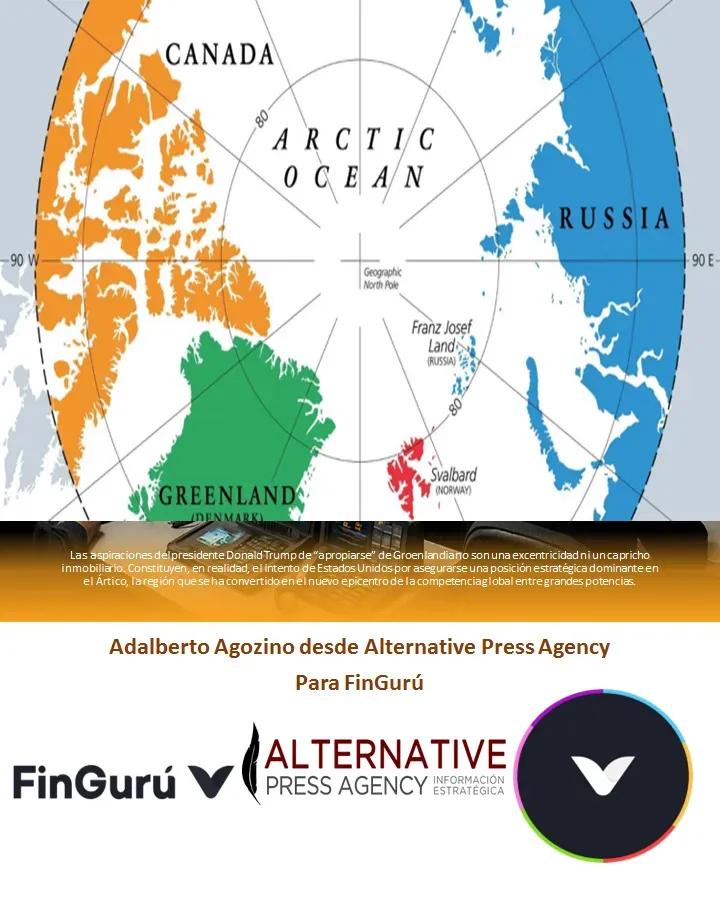
The aspirations of President Donald Trump to “acquire” Greenland are neither an eccentricity nor a real estate whim. They actually represent the attempt by the United States to secure a dominant strategic position in the Arctic, the region that has become the new epicenter of global competition among great powers.
The Arctic, the planet's thermostat
The Arctic is a vast circumpolar region of about 140 million square kilometers surrounding the North Pole and includes the Arctic Ocean and the northernmost territories of Russia, the United States (Alaska), Canada, Denmark —through Greenland—, Iceland, Norway, Sweden, and Finland. Its delineation is not only political: it is often drawn from the Arctic Circle or the isotherm of 10 degrees Celsius in July, which marks the threshold between boreal forests and polar tundra.
The word “Arctic” comes from the Greek arktikós, meaning “near the bear,” in reference to the constellation Ursa Major, whose stars point toward the North Star.
From space, the Arctic appears as an immense white dome. But under that immobile appearance hides one of the planet's most dynamic and fragile systems. For the most part, it is an ocean covered by sea ice —a floating crust of ice—, surrounded by extensive areas of permafrost, a permanently frozen marshy soil that encloses enormous quantities of carbon and methane.
This combination makes the region a key piece of the global climate balance. The ice reflects solar radiation into space, regulates ocean and atmospheric currents, and acts as a gigantic natural refrigerator for the Earth.
That’s why scientists describe it as an “early warning system.” When the Arctic raises its temperature —and today it does so up to four times faster than the global average—, the entire planet feels it in the form of more intense heat waves, extreme storms, and changes in rainfall patterns.
A treasure under the ice
The retreat of the ice is transforming this remote region into an increasingly coveted territory. Beneath the seabed and the Arctic continental shelves lies a substantial part of the world’s untapped energy and mineral resources. Widely cited estimates indicate that the Arctic could hold nearly a third of the undiscovered global reserves of oil and gas, in addition to strategic minerals like gold, copper, and rare earths.
This wealth is complemented by a geographical revolution. The melting ice is opening up maritime routes that were impractical until recently. The Northwest Passage, through the Canadian archipelago, and the Northern Sea Route, along the Russian coast, make it possible to shorten thousands of kilometers between Europe and Asia. A ship that today crosses the Suez Canal or navigates around Africa could, in the not-too-distant future, cross the Arctic Ocean, reducing weeks of navigation and millions of dollars in fuel costs.
The polar route is also up to 40% shorter and navigates through deeper waters than the Panama Canal route, allowing for larger cargo transportation, reducing operational costs, and decreasing greenhouse gas emissions.
However, this reconfiguration of trade flows through the northern extreme has collateral effects in distant places like Egypt and Panama, which see their revenues from interoceanic canals threatened.
In a world marked by geopolitical tensions and fragile supply chains, control of these routes is not just a commercial issue: it is a first-order strategic asset in case of armed conflict.
The diplomatic architecture of the North
To manage this transforming space, the Arctic Council was born. Its origins date back to 1991, when the eight Arctic States signed the Arctic Environmental Protection Strategy and became full members. Thirteen more states participate as permanent observers and recognize the sovereignty and jurisdiction of coastal countries. China, Japan, and India, for example, conduct scientific expeditions, although they must request permission to carry them out. China even maintains a scientific base in Norway’s Svalbard archipelago, the northernmost inhabited settlement on the planet.
Five years later, the Ottawa Declaration of 1996 formally created the Council as an intergovernmental forum intended to promote cooperation, coordination, and the participation of Indigenous peoples, especially in matters related to sustainable development and environmental protection.
The Council is neither a military alliance nor an organization with coercive power. For years it symbolized the so-called “Arctic exceptionalism”: the idea that, despite global rivalries, the Arctic should remain a space for scientific and diplomatic cooperation. However, that spirit has been eroding as the ice retreats and geopolitics advances.
The Council's ability to ensure regional cooperation reached its lowest point in 2022, just weeks after the Russian invasion of Ukraine. The other seven members then suspended their participation. By the beginning of 2024, the eight parties agreed to resume contacts, albeit only by videoconference. Although the need to coordinate common policies persists, distrust regarding Russia's expansionist intentions continues to mark the climate.
The impact of climate change
The melting is the engine of almost all the transformations currently shaking the Arctic. The reduction of sea ice, the accelerated melting of Greenland’s ice sheet, and the thawing of permafrost not only alter local ecosystems —from zooplankton to polar bears— but also reconfigure the strategic board.
As the ice disappears, previously inaccessible areas become navigable and exploitable. At the same time, the release of methane and the loss of reflective surfaces amplify global warming, in a vicious circle that makes the Arctic one of the main accelerators of climate change.
The consequences are not limited to the northern extreme. Regions as distant as the Maldives, Bangladesh, or the Netherlands face increasing risks of flooding due to rising sea levels. These repercussions underscore that the problem of the Arctic is global and not merely regional.
A race for sovereignty
The physical opening of the ocean has unleashed a legal and scientific race to define who owns what. In the Arctic, the continental shelves of five countries —Russia, Canada, Denmark, Norway, and the United States— converge like the segments of an orange around the North Pole.
According to the United Nations Convention on the Law of the Sea, each state can claim rights over the seabed if it demonstrates that its continental shelf extends beyond 200 nautical miles.
Russia was the boldest. In 2001 it claimed nearly half of the Arctic Ocean and, in 2007, a scientific expedition placed a Russian flag on the seabed, on the Lomonosov Ridge. Moscow argues that this underwater mountain chain is a natural extension of Siberia and presented its arguments to the UN.
Denmark, through Greenland, is trying to prove the same: that the Lomonosov Ridge is geologically connected to the island and therefore the North Pole could belong to it. Canada is preparing similar studies, while the United States —paradoxically— sees its position limited by not having ratified the Law of the Sea Convention, an omission that leaves Washington at a disadvantage against its rivals.
In parallel, countries are deploying scientific expeditions, icebreakers, satellites, and research bases that serve a dual function: generating knowledge and consolidating presence.
Greenland, the key piece
In this context, Greenland emerges as the strategic pivot of the Arctic. The island, an autonomous territory under Danish sovereignty, projects onto both the North Atlantic and the Arctic Ocean and controls access between North America and Europe. From there, it is possible to monitor maritime traffic, deploy early warning systems, and project military power over an increasingly trafficked region.
It is in this logic —more than in a fantasy of conquest— where Donald Trump's statements about the possibility of the United States “acquiring” Greenland fit. In the new geopolitics of melting ice, whoever controls the Arctic nodes will dominate one of the strategic arteries of the 21st century.
The new polar Mediterranean
As Tim Marshall underscores in Prisoners of Geography, powers cannot escape the tyranny of the map. And the Arctic map is changing. What was a frozen ocean during the Cold War, silently patrolled by nuclear submarines, is heading to become a “polar Mediterranean”: a basin of transit, trade, and strategic rivalry among the United States, Russia, China, and Europe.
The paradox is that this new prominence arises from a climate catastrophe. The melting ice that opens routes and releases resources is the same that threatens to raise sea levels, alter ocean currents, and destabilize the global climate. The Arctic, that frozen extreme of the planet, has thus become the clearest mirror of our time: a place where environmental crisis and geopolitical ambition advance hand in hand.

Comments