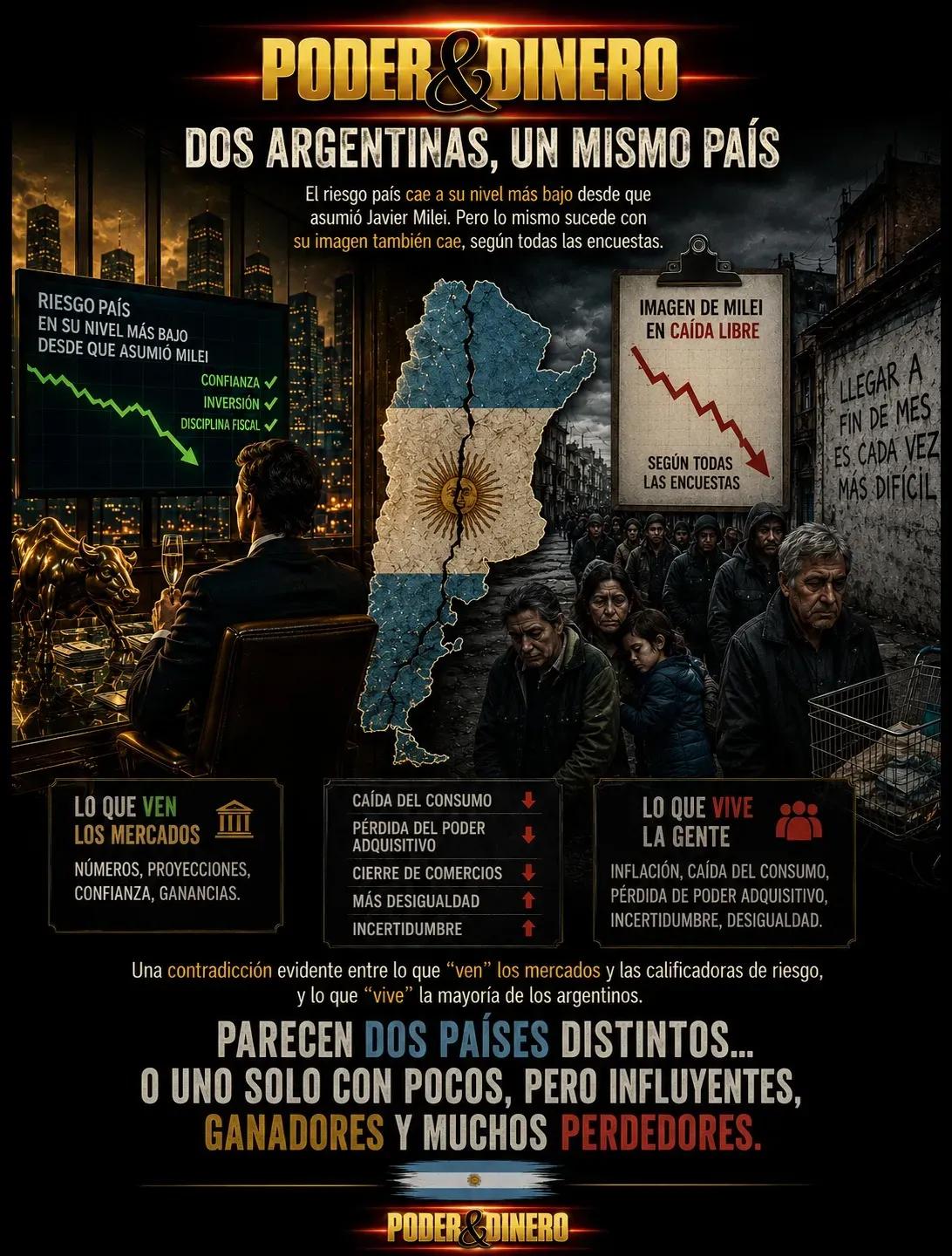
Argentina is going through one of those historical stages in which reality seems to be divided into two completely different planes. On one side, the financial markets celebrate. Country risk is dropping, bonds are recovering, and major international consulting firms are once again talking about "confidence," "macroeconomic order," and "fiscal discipline." For investors and rating agencies, Javier Milei's government represents the political decision that for decades seemed impossible: to cut public spending, deregulate the economy, and break with the traditional logic of permanent deficits.
However, outside the screens of Wall Street and the technical reports from investment banks, another Argentina is experiencing a very different situation. There, financial enthusiasm and a sense of regained stability do not exist. What prevails is daily uncertainty. Empty stores, falling consumption, deteriorating salaries, insufficient pensions, and a growing perception of social fragility create an emotional scenario opposite to the optimism of the markets.
The great Argentine paradox arises precisely from this fracture. How can the financial perception of a country improve while the social perception of its government worsens? The answer reveals something profound about the functioning of contemporary economic power: markets and societies do not necessarily evaluate success with the same parameters anymore.
For the international financial system, adjustment is often interpreted as a sign of rationality. A state that reduces subsidies, limits spending, and prioritizes fiscal balance is considered more "predictable," even if the immediate social cost is extremely high. Markets reward future repayment capacity, not present welfare. They look at numbers, not anguish. They evaluate balances, not collective moods.
Society, on the other hand, measures something else. It measures the ability to get to the end of the month, job stability, access to basic consumption, and expectations of progress. Where investors see fiscal discipline, much of the population perceives loss of rights, deterioration of living standards, and social regression.
This tension is not new in Argentine history, although today it appears especially stark. The country seems to have transformed into a dual economy: a financial Argentina that is reintegrating into the global circuit of capital and a real Argentina that bears the daily weight of adjustment. Both coexist simultaneously but speak different languages and respond to different priorities.
The underlying problem is that no economic stability can be sustained indefinitely without social legitimacy. Markets can celebrate for months or even years, but governability ultimately depends on the collective perception of justice, expectation, and hope. When large sectors feel that the sacrifice has no visible reward, social trust begins to erode, even if financial indicators improve.
The Argentine experience once again demonstrates that the economy is not only a matter of numbers. It is also a matter of perception, belonging, and cost distribution. And perhaps therein lies the true question of this historical moment: can an economic model be considered successful if its main beneficiaries are few, though powerful, while the majority feels that they are losing ground?

Comments