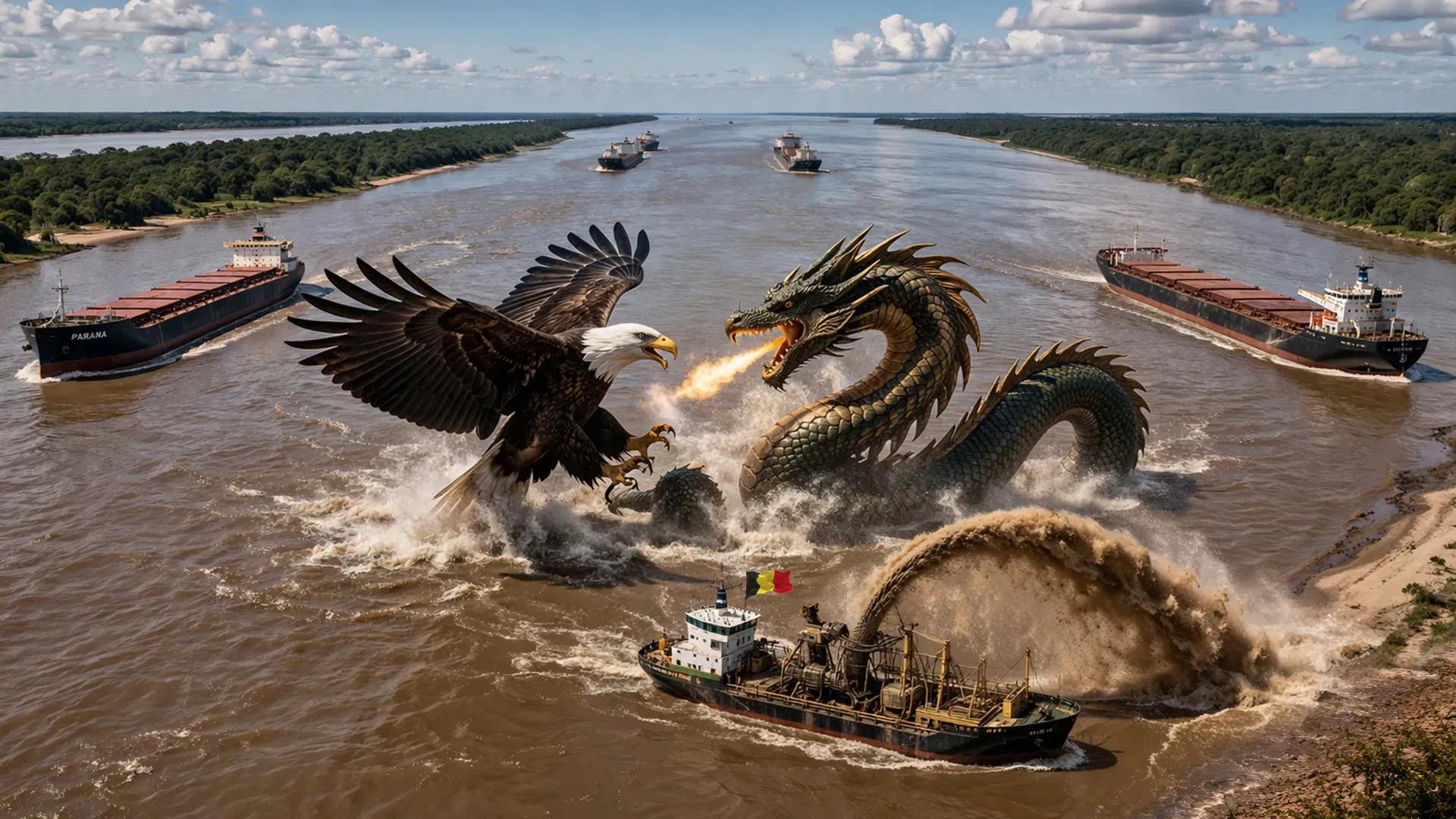
The attempt at reprivatization of the Paraná River driven by the government of Javier Milei —which seeks to return control, management, and planning of one of the world's major waterways back into foreign hands— has revealed, in recent weeks, the real interests at play and the fierce dispute that lurks behind an apparent competition between “Belgian” companies.
What starts to emerge, through the cracks of this confrontation, is who is really operating behind what much of the media presents as a simple commercial bid. Far from being a conflict limited to the business realm, the future of the Paraná River reveals itself as a stage where tensions of global scale are projected.
In an international context marked by the resurgence of war conflicts and the increasing possibility of a new world war, the world is undergoing an era change. The reconfiguration of blocs and the increasingly open confrontation between the main imperialist powers outline a new “division of the world.”
In this framework, it is difficult to maintain that a strategic waterway —through which about 40% of the planet's food security circulates and which constitutes a key objective in any conflict hypothesis— can remain outside the disputes that today govern the international dynamics.
The Paraná River in the spotlight: geopolitics of water
This extensive navigable waterway, through which around 80% of Argentina’s cereal and oilseed production is exported, stretches from kilometer 1238 of the Paraná River —at the Confluence— to its mouth in the natural deep waters of the Río de la Plata exterior.
Recently, a series of reports have surfaced [1] that account for the sharp confrontation that has erupted after learning about the groups that have decided to participate in the bidding. Turbulences have put the continuity of the process at risk again, bringing back the specter of nullity, as was the case in February 2025. A scenario that everyone promised not to repeat, but in which, without a doubt, the interests at play were underestimated.
Of the three companies that reportedly entered the competition —the Belgian Jan de Nul and DEME, and the Brazilian DTA Engenharia— it is already known that the latter would have been eliminated from the competition for not presenting the required guarantees. Three envelopes are evaluated in the process: technical aspects of the offer, the works plan, and, lastly, the economic proposal.
The tenor of the accusations exchanged between the Belgian companies has escalated exponentially, with all sorts of allegations and formal presentations before the National Agency of Ports and Navigation, which will be responsible for awarding the concession. It has become evident that much more than the execution of dredging and buoying tasks of our Paraná River is at stake in this bidding. What is really at stake is how indirectly, formally, but directly, concretely, either the United States or China will exert influence over this strategic waterway.
The dispute has even opened fissures within the government itself, which seems to have divided over this, as reported by the website La Politica Online. [2]
For those who have attempted in one way or another to reduce the discussion to a “logistics costs” problem, reality imposes itself once again. In this global context, and contrary to what happens elsewhere in the world, Argentina must be the only country that seeks to give up exercising sovereignty over a waterway that everyone wants, except for the current government, which seeks to hand it over as soon as possible and put an end to a process that began in 2021, after the end of the previous concession.
Jan de Nul and its new “partner”
As revealed through a note by journalist Mariano Galíndez from the Rosario3 portal [3], the disqualification document presented by the Belgian dredging company Jan de Nul against its competitor Deme exposed that the former counts as a “local partner” the company Servimagnus SA, whose owner is Leonardo Román (son of Ricardo Román, who has an extensive career in the field).
Servimagnus has primarily carried out dredging work in the Buenos Aires territory, but what is relevant in this case is that for over two decades, it has conducted this work together with a heavyweight partner: the state company CCCC (China Communications Construction Company) through its subsidiary Shanghai Dredging Company.
In fact, between 2006 and 2020, it obtained contracts with the provincial port authority and carried out, together with the Chinese company, the dredging of access channels and the interior of ports such as Dock Sud, Buenos Aires, Campana, La Plata, Puerto Madryn, Bahía Blanca, Comodoro Rivadavia, among others.
Also associated with Chinese capital, it dredged the port of Mar del Plata in 2014/2015. And in 2019, as reported by the portal La Nueva Provincia[4], it explored the possibility of providing technical and financial assistance in infrastructure projects for the port of Bahía Blanca.
By the end of last year (December 2025), it was known that Servimagnus began the process of withdrawing what was once one of the most important dredges of the national fleet: the dredge 259-C Mendoza, which had remained abandoned in the port of Mar del Plata for over a decade, with no government attempting to recover it. A true synthesis of the policies that have sought to erase almost 100 years of experience from what was the National Directorate of Port and Navigable Works. A true mockery for those of us who, for years, have been advocating the need to recover the national dredging fleet, given that Argentina had and has all the conditions to autonomously carry out the dredging of its internal rivers and port accesses.
All this that we point out is documented in images in the video “Let’s Recover the Paraná. Let’s Recover our Fleet”[6] that we produced from the Forum for the Recovery of the Paraná in 2022.
This link with the Asian giant we have just described acquires relevance because Chinese companies were expressly excluded from the bidding through a clause in the specifications that prevented the participation of firms directly linked to sovereign states. A clear signal from Milei's government in its policy of alignment with the United States, which closely followed the entire process to ensure that its main competitor would be out of the running. However, as can be inferred, formal exclusion does not prevent it from utilizing “national” companies as true “intermediaries” to channel those interests.
DEME seeking backing for the fight
As the newspaper La Nación titled: “U.S. companies seek to enter the Waterway and the dispute between two giants grows”[7].
Unlike Jan de Nul, DEME formally did not present itself associated with another company. However, it is known that it maintains fluid contacts with American firms, particularly with Great Lakes Dredge & Dock (GLDD), the largest dredging service provider in the United States.
Unlike the logic applied by the national government, in the northern country, all maintenance and channeling tasks are under strict control of the U.S. Army Corps of Engineers, particularly for the Mississippi River, its main water artery. As is logical, the United States considers as strategic infrastructure everything related to the port system and internal transport, which, by the way, is almost entirely carried out using the barge system, unlike here where it is proposed to deepen dredging to 44 feet to allow ships of 80,000 tons to enter 500 km into the continent.
This is why the Jones Act has been in application since 1920, establishing that maritime transportation between U.S. ports can only be performed by vessels built in the country, owned nationally, under American flag, and with local crew. This naturally includes dredging tasks. Therefore, when these services are outsourced, only local companies may participate.
As we have repeatedly pointed out: “Does anyone imagine a Chinese dredge operating in the Mississippi?” What would be a flagrant violation of its sovereignty for the United States seems to present itself in Argentina as the only possible horizon.
In this context, and aware of the current administration's alignment with the United States, DEME formally communicated to the National Agency of Ports and Navigation and to the U.S. ambassador in Argentina, Peter Lamelas, its intention to include American capital, as well as the administrative difficulties to achieve this in the initial stage. A clear signal to strengthen its position and attempt to overpower its competitor, with the libertarian acquiescence.
The hour of the people
Up to this point, we have tried to describe how the dispute for the future of a river that is much more than a mere waterway unfolds “from above.” But, there is also an increasing pressure being exerted “from below” to halt the government's plans in this regard.
In fact, in recent years, a vast movement in defense of the Paraná has emerged, clearly stating the need to regain control and administration of its rivers in Argentine hands, and denouncing the intention to deepen the navigation channel to 44 feet, in the stretch between Timbúes and the mouth of the Río de la Plata, as an “ecocide.”
This movement also denounces the lobby of agro-exporters —mostly foreign— and its spokesperson, the Rosario Stock Exchange, which push for this deepening in search of reducing costs and increasing profits, even at the expense of higher charges for agricultural producers, as suggested by projected rates, which exceed the current ones.
Aquatic crossings along the entire coastline, flag waving events, and paddling activities “for water, life, and sovereignty,” have been some of the ways countless socio-environmental, political, religious, and union organizations have made this sovereign claim visible.
The “Let’s Save the Paraná and its Wetlands” crossing, which concluded on March 21 in Rosario after departing from the Isla del Cerrito (at the Confluence), on the eve of World Water Day, showcased the power and sympathy it awakens along the way. It also opens hopes that, sooner rather than later, this process against national interests and the continuity of life and productive activities that take place in the river ecosystem and its wetlands can be reversed.
All this has been carried out despite the silence of the major media outlets in Buenos Aires and a significant part —with honorable exceptions— of the “opposition” political leadership. Could this have to do with the interests at stake and with unconfessed alignments with one or another imperialism, in tension with some “nostalgic” sovereign proposal...?
For April 11, new activities have been announced throughout the entire coastline, with the aim of continuing the struggle and with the expectation that the nullity of what was done will be declared again, generating conditions to advance, with another policy and another government, on a truly emancipatory path.
Neither Belgian, nor Yankee, nor Chinese, the Argentine Paraná!
(*) Pablo Payró is a member of the Forum for the Recovery of the Paraná. Editor at the infosoberana web portal.
[1]https://www.lanacion.com.ar/economia/hidrovia-recrudece-la-pelea-entre-las-dos-empresas-belgas-que-luchan-por-quedarse-con-el-negocio-nid26032026/
https://www.lanacion.com.ar/editoriales/hidrovia-un-nuevo-fracaso-nid25032026/
[2]https://www.lapoliticaonline.com/economia/hidrovia-se-bajo-la-brasilena-y-la-licitacion-quedo-atrapada-en-la-pelea-entre-santi-caputo-y-karina/
[3]https://www.lapoliticaonline.com/economia/hidrovia-se-bajo-la-brasilena-y-la-licitacion-quedo-atrapada-en-la-pelea-entre-santi-caputo-y-karina/
[4]https://www.lanueva.com/nota/2019-3-23-6-30-16-el-gigante"-chinese-cccc-and-the-company-servimagnus-are-interested-in-the-present-and-future-of-the-bahiense-port
[5]https://comexonline.com.ar/noticias/val/62955/servimagnus-inicio-en-mar-del-plata-una-compleja-operacion-para-retirar-una-draga-inactiva-desde-hace-mas-de-una-decada.html
[6]https://www.youtube.com/watch?v=rs1K6NiGc88&t=3s)
[7]https://www.lanacion.com.ar/economia/empresas-de-estados-unidos-buscan-entrar-en-la-hidrovia-y-crece-la-disputa-entre-dos-gigantes-nid25032026/

Comments