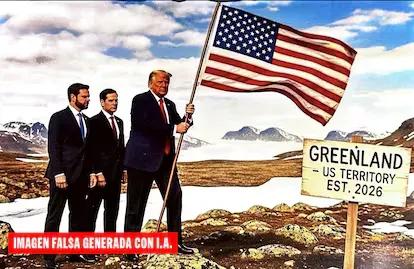
At first glance, Greenland appears to be a cartographic anomaly, a vast, almost empty territory doomed to the white silence of the Arctic. However, this image deceives. Beneath the ice, literally and metaphorically, lies one of the densest strategic knots of the contemporary international system. Greenland is not peripheral: it is a frontier. It is not empty: it is a reserve. It is not landscape: it is latent power.
The famous and ridiculed idea of Donald Trump to "buy" Greenland was not a personal eccentricity or a late real estate delusion. It was, in reality, the clumsy expression of a correct strategic intuition: whoever controls Greenland will not dominate the world, but will control one of the critical hinges of the transitioning global order.
The Arctic as a new competition board
For decades, the Arctic was a frozen space also in political terms, a secondary theater, stabilized by nuclear deterrence during the Cold War and then forgotten in the unipolar illusion of the 1990s. That historical parenthesis has closed. The accelerated melting, a product of climate change, primarily unleashes competition.
The Northern Sea Route and the Northeast Passage shorten distances, reconfigure logistical chains, and alter the geoeconomic balance between Asia, Europe, and North America. In this new map, Greenland occupies an axial position, monitors accesses, hosts sensors, offers strategic depth, and functions as an advanced platform in a space that is no longer marginal but contested.
Resources, territory, and the illusion of neutrality
The Greenlandic subsoil is a mineral encyclopedia: rare earths, uranium, gold, hydrocarbons. In a world transitioning to digitized, electrified, and critical input-dependent economies, these reserves are a first-order geopolitical asset. It is no coincidence that China, with its millennia-old patience and incremental strategy, has deployed an economic and scientific presence that serves as the spearhead of a greater ambition.
The supposed neutrality of the territory is, in this context, a fiction. There is no power vacuum; only unarticulated power. Greenland, although formally part of the Kingdom of Denmark and endowed with autonomy, is caught in a structural tension: aspirations for self-determination, economic dependence, and growing external pressure that exceeds any local framework.
The United States, strategic memory, and late reflexes
Washington has known Greenland since before the Arctic came back into fashion. Thule Air Base is not a relic of the past, but a reminder of the future; radars, missile defense, space surveillance. In terms of continental security, Greenland is an irreplaceable strategic multiplier.
Truman's offer in 1946, the interest of 1867, the purchase of the Danish West Indies: history shows that the United States thinks in long-term terms, even though sometimes it acts with situational clumsiness. Trump did not invent anything; he simply verbalized, without diplomatic subtlety, a structural logic that remains in force.
Greenland as a symptom, not as an exception
Reducing the Greenlandic case to an anecdote or rarity is to lose focus. Greenland is a symptom: the return of hard geopolitics, the erosion of naive multilateralism, the convergence between climate crisis and strategic competition. The melting ice not only raises sea levels; it raises the temperature of the international system.
The relevant question is how to govern a territory that can no longer escape the logics of global power. Can a community of 55,000 inhabitants decide its fate without becoming a chess piece? Can Europe maintain a coherent strategic presence in the Arctic? Can the United States react without falling into explicit imperial impulses? Can China continue to advance without triggering a frontal containment?
When the future is written in ice
Greenland forces us to think uncomfortably. It reminds us that the 21st century will not only be digital, green, or inclusive, but also territorial, material, and conflictual. The Arctic is the accelerated present. And Greenland is a warning.
History teaches that spaces that seem empty often fill with power. We must ask ourselves what type of international order will emerge when the ice no longer conceals the ambitions that today slip beneath its surface.

Comments