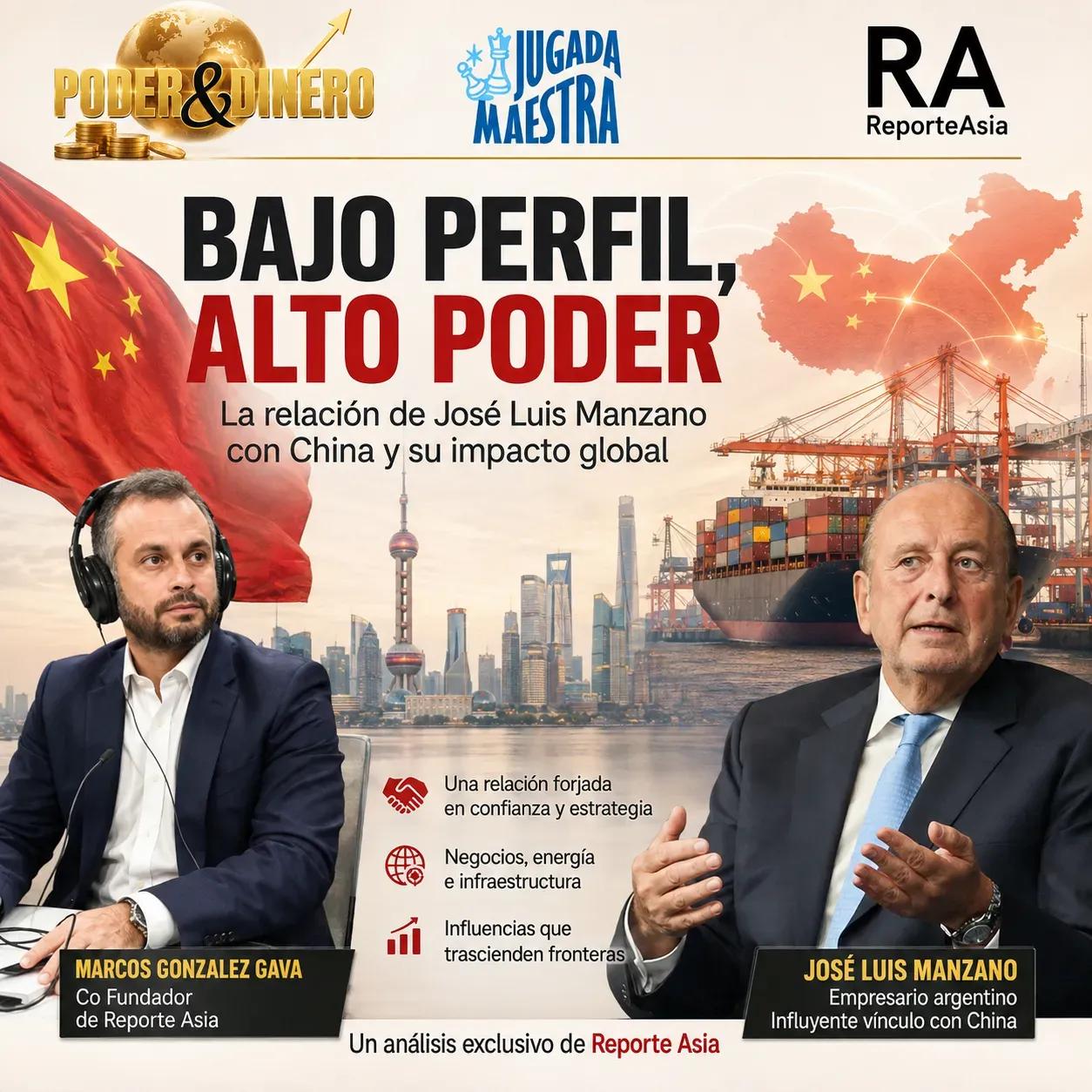
The Mendoza businessman José Luis Manzano, one of the entrepreneurs with the greatest access to power in Argentina - and beyond - shareholder of Grupo América, Edenor, Metrogas, and founder of Integra Capital, has been developing an increasingly intense relationship with China in recent years that spans education, energy, mining, and, in its most sensitive chapter, logistics.
To say that Manzano is one of the closest, and perhaps most knowledgeable, businessmen in Latin America regarding China's interests in the region is not far-fetched. For someone who has traveled to China on business several times, it's possible to have seen him many years ago in the elegant lobby of the Peninsula Hotel in Beijing, always accompanied by representatives of large conglomerates from that country. And although he operates with a very low profile, some of his dealings end up being too tactical to go unnoticed. In fact, Manzano is today a partner of Cosco Shipping Ports at the Port of Chancay in Peru, one of China's most strategic assets for its international trade with Latin America. Only he holds that privileged position, and very few could make it happen.
Now, how did Manzano achieve that unique move? In May 2024, he acquired control of the Peruvian company Volcán Compañía Minera (taking 55% of the Class A shares that were in the hands of the multinational Glencore) through his subsidiary Transition Metals AG. By buying Volcán, Manzano's group also acquired Inversiones Portuarias Chancay (IPCH), a spin-off that the Peruvian company had created to manage the famous "Chinese port" alongside Cosco Shipping Ports, becoming an indirect controlling shareholder of 40% of the share package.
It is difficult to put into words the importance of Chancay for China's trade policy, but it is true that it gave them the logistical foothold in the Pacific that they longed for to consolidate their global economy project One Belt One Road toward the Southern Hemisphere. Inaugurated on November 14, 2024, in the presence of Xi Jinping and former president Dina Boluarte, the port is the gem of Beijing's logistics in the region; it is the hub that allows them to reduce costs (by 15% to 30%) and transportation times (up to two weeks). In its first year of operation, it accumulated total exports of approximately 718 million dollars, concentrated 62% of Peru's agro-exports to China, and positioned itself as the main direct trade route to the Asian market.
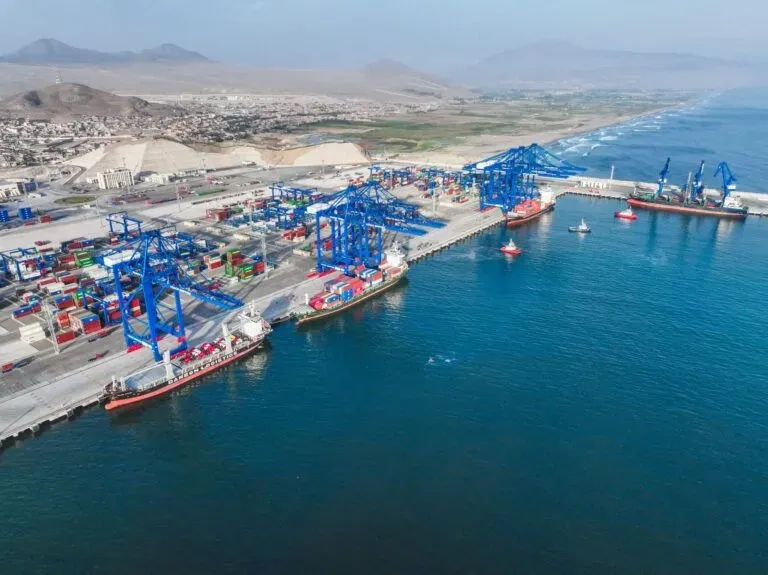
The cost of the first phase of the Megaport of Chancay in Peru was around 1.3 billion dollars.
Manzano's presence in the administration of the Port of Chancay represents a unique power space for a businessman from Latin America, in a logistics node under the direct orbit of the Chinese Communist Party (CCP), as COSCO Shipping is a state-owned company, and all its subsidiaries, even private ones, therefore have a political profile. This is where the concern of the United States about China's presence on those coasts arises. As early as 2024, General Laura Richardson, former head of the Southern Command of the United States Navy, had issued a warning about the megaport and its potential dual use for military purposes. A more recent study by the University of the Air of the United States Air Force again raised the strategic concerns that China's advances in port infrastructures generate for Washington. So much so that in January of this year, it was reported that the United States will invest 1.5 billion dollars to modernize the Naval Base of Callao, located less than 80 kilometers from Chancay.
It is worth noting that Volcán Compañía Minera is one of the world's largest producers of zinc, lead, and silver, with an annual production of 300,000 tons (part of which has a market in China). An additional fact: Integra Capital entered Peru after buying its majority stake from Glencore for 20 million dollars plus additional financing of up to 40 million dollars provided by the Switzerland-based company, where Manzano has declared his permanent residency.
Integra Capital's mining portfolio is completed with Minera Aguilar, Argentina's largest exporter of zinc and lead, with 40,000 tons per year, and lithium projects in Jujuy and Catamarca within the Lithium Triangle, covering more than 400,000 hectares. These are provinces where China has long-term interests in mining and energy and in bi-national infrastructure and logistics projects between Argentina and Chile, such as the Jama Pass and the San Francisco International Pass, respectively.
The Soft Power Facet
Perhaps one of the aspects that gained the most visibility has been Manzano's participation in cultural and educational exchanges with China, for which he has built an interesting framework of soft power. He does this by sponsoring the China Cultural Center in Buenos Aires or through the América media group (which he is part of), which at one time worked with China Daily to launch the first Spanish edition of China Watch. He is also part of the editorial committee of the DangDai magazine, the first bilingual quarterly publication for cultural exchange and journalism between Argentina and China.
Additionally, Manzano, who served as a National Deputy from 1983 to 1991, reaching the presidency of the Justicialist Party bloc, and Minister of the Interior of the Nation from 1991 to 1992 during Carlos Menem's presidency, promoted the opening of the Confucius Institute at the University of Congreso in Mendoza, of which he is president. Far from presenting it as a simple language offer, he framed it as an influence bet in a province with export-oriented aspirations toward the Asian giant, in sectors in which the entrepreneur is involved, such as viticulture, with Altus, a producer of premium quality wines.

Shareholder of Grupo América, Edenor, Metrogas, and Integra Capital, he has been developing an increasingly intense relationship with China in recent years that spans education, energy, mining, finance, and, in its most sensitive chapter, logistics.
His Presence in the Energy Sector: Ideal for Chinese Participation
Considering Manzano's closeness to the elite of Chinese politics and business, his participation in Argentina's energy sector must surely be of great interest to his Eastern interlocutors. It should be noted that Infrastructure & Energy are two business areas where Beijing has been making significant investments. In fact, Chinese state-owned companies control key energy assets in South America following multibillion-dollar acquisitions between 2018 and 2024. Notable purchases include CGE and Chilquinta in Chile by State Grid, the acquisition of Luz del Sur and Chaglla in Peru by China Three Gorges, and the control of Lima's distribution network by China Southern Power Grid (now Pluz Energía).
Brazil is a separate case. There, China has consolidated a strong electrical presence through State Grid, which operates the ultra-high voltage lines Bipolo I and II de Belo Monte (connecting the Amazon with Rio de Janeiro) and has secured a third megaproject for transmission in 2026, and China Three Gorges (CTG), positioned as the second-largest private generator in the country after acquiring the massive hydroelectric complexes Jupiá and Ilha Solteira, along with increasing investments in wind, solar, and battery storage parks, and the operation of ultra-high voltage transmission mega-lines in Brazil.
Thus, considering China's activity in the neighborhood, it is not unreasonable to think that Manzano's business structure could serve, in Argentina's case, as an ideal business platform for the Chinese in the energy sector, from technical provision and equipment to technology transfer and potential capital injections or joint ventures.
Let's review Manzano's asset map in this area:
In addition to Edenor, Argentina's largest electricity distributor, with 3.3 million customers, the group controls Edemsa, the largest electricity distributor in Mendoza, and the Ameghino Hydroelectric Plant, a 60 MW central station. In gas, Manzano is a significant shareholder of Integra Gas Distribution - in partnership with Mercuria Energy Trading - a key player in Metrogas, the main gas distributor in Buenos Aires with over 10 million users, following the recent acquisition of 70% of the company from YPF for 780 million dollars.
The group has also moved forward with a USD 1.4 billion offer for the Shell service station network and the Dock Sud refinery alongside Mercuria Energy Group, an operation that was completed in June 2026 for around USD 1.42 billion.
Mining, Another Sector of Strategic Value for Beijing
Mining is another of the major sectors of the global economy that today sees Argentina as a medium- to long-term supplier. It is a sensitive sector, increasingly geopolitical, and involved in the energy security policies of both the United States and China, a country that imports more than 700 billion dollars a year in mineral and fuel products. Among its purchases, massive iron ore acquisitions are highlighted (exceeding 1.2 billion tons annually) as well as copper, bauxite, lithium, and cobalt to sustain its gigantic heavy and technology industries.
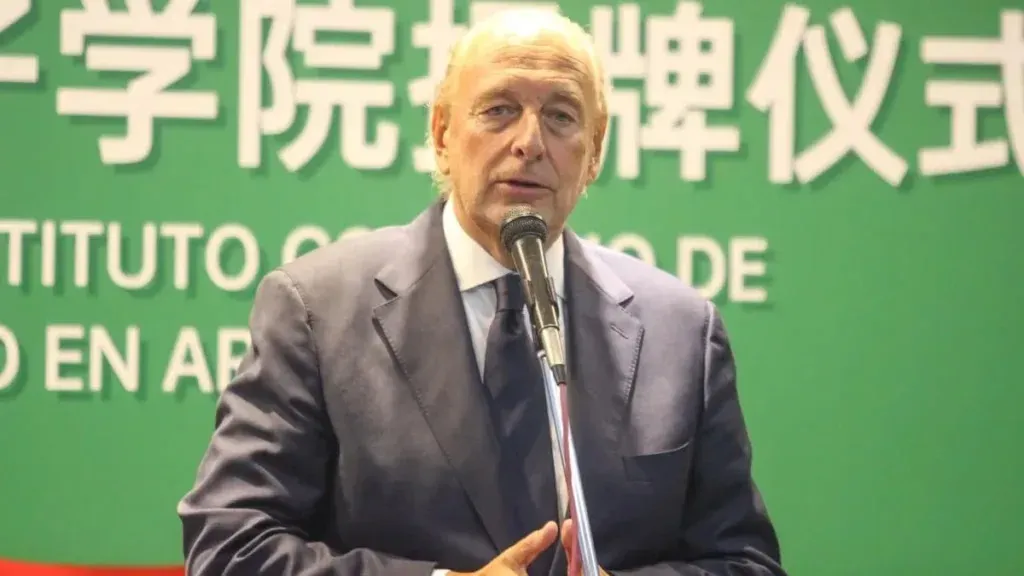
Although they serve to promote Chinese culture, geopolitically, many analysts in the West consider Confucius Institutes to be key tools for the soft power of Chinese diplomacy. Source: DiarioUno.
In this context, Manzano's activities in critical minerals, which are central to the energy transition, developing uranium exploration in Chubut and the Ivana project - uranium and vanadium - in Río Negro, with an estimated investment of USD 160 million, must be analyzed. This is complemented by unconventional hydrocarbons: Manzano and his family are significant shareholders of Phoenix Global Resources, with assets in Vaca Muerta, listed on London (AIM) and Buenos Aires exchanges, focusing on the unconventional Mata Mora deposit - three pads and nine wells drilled in 2022 - and reported reserves of 71.1 MMboe with an average production of 4,553 boepd as of December 2022. Currently, the company has expanded its operations to Río Negro, incorporated artificial intelligence, and projects an investment of USD 6 billion under the RIGI regime to multiply its unconventional production.
He is also a key investor in Interoil, a company listed on the Oslo Stock Exchange with a production of 3,500 bopd between Argentina and Colombia.
A Silent Battleground
Now, with all this said, it is also clear that Manzano is much more than a "pro-China" businessman, or at least, he does not have that profile. His interest in the Asian giant is mixed with projects that take him to other latitudes: for example, he is an active member of the UK-Argentina Chamber of Commerce and the Argentine-American Chamber of Commerce, participates in the Energy Steering Committee of the Institute of the Americas, and is part of its board at the University of California, San Diego.
However, his case condenses a reality that exceeds a single businessman: that of a sector of the Argentine establishment that maintains channels of cooperation with Beijing and considers it a primary partner for the growth of their businesses.
Large Chinese companies always follow the champion, the man of fortune, and especially, the self-made man. Franco Macri, a prominent Argentine businessman who passed away in 2019, was at one time that Number 1 reference for the Chinese in Argentina, serving as a business platform from which Beijing expanded into various segments of the economy, from automotive with Chery to railways with the Belgrano Cargas project, among others.
Many other businessmen with those characteristics have undertaken large projects with China in the region; that's why it is not surprising that Manzano's business structure, and he himself, are considered of strategic value for Beijing analysts in their deployment in the Latin American markets, especially now that several bidding documents in Argentina limit the involvement of companies with majority state participation, complicating matters especially for the Xi Jinping government conglomerates. In this situation, local business paths and strategic partners, like the founder of Integra Capital, can...resulting in being much more attractive as an alternative to reach difficult access opportunities.
Marcos González Gava is Co-Founder of Reporte Asia, specializing in Economic, Financial, and Commercial Negotiations, and Cultural Affairs with the People's Republic of China

Comments