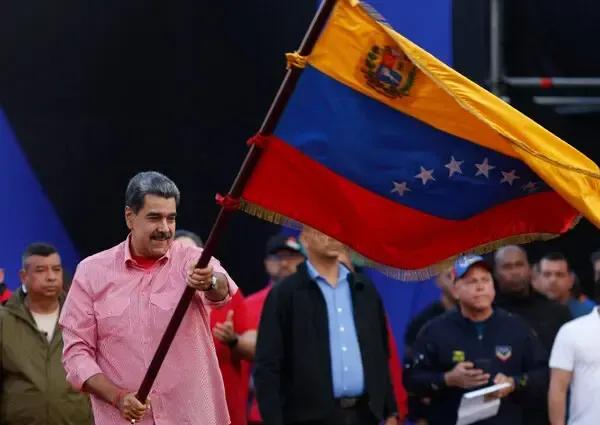
The next phase of the Trump administration's pressure campaign on President Nicolás Maduro's government could involve sabotage or some sort of cyber, psychological, or informational operation. Credit...Agence France-Presse — Getty Images
An unexpected twist in U.S. strategy
The relationship between the United States and Venezuela is once again in the spotlight, this time with a mix of military pressure, secret plans, and discreet conversations that create a context as unstable as it is decisive. Donald Trump has authorized covert CIA operations, while simultaneously opening negotiation channels with Nicolás Maduro. A double game that seeks to reposition Washington in a region that no longer easily accommodates old alignments.
Where does the U.S. really want to go?
Trump's green light
The White House approved a series of plans devised by the CIA to operate within Venezuela. There are no public details —as is logical— but the range includes sabotage, as well as cyber, psychological or informational operations. These are tools that, in other scenarios, have served to "prepare the ground" before major escalations.
What stands out is that these movements occur without Trump having authorized ground troops. That limit remains in place, but the magnitude of this new chapter is clear: Washington is willing to tighten the noose, even as it keeps one foot in diplomatic terrain.
Parallel negotiations
While secret operations are being assessed, informal conversations exist between Trump's representatives and regime officials. A surprisingly flexible Maduro appears, offering preferential access to Venezuelan oil for U.S. companies.
He even hinted at an unthinkable possibility a few years ago: his resignation, but with a transition period of two to three years. The White House slammed the door on that option. For Trump, any prolonged delay in the exit of the Venezuelan leader is —at least— "unacceptable."
The combination of oil offerings and political flexibility reflects a cornered but still calculating regime. At the same time, it showcases a U.S. administration more focused on strategic interests than on ideological rhetoric.
The “Operation Southern Lance”
One of the most visible elements of this phase is the U.S. military presence. With the aircraft carrier USS Gerald R. Ford in the Caribbean and about 15,000 personnel deployed among ships and regional bases, Washington is executing the largest naval concentration in the area since the missile crisis.
This does not necessarily imply imminent military intervention. But it does send a powerful message: Maduro's room for maneuver is shrinking.
The Pentagon is not missing a thing: it has lists of facilities linked to drug trafficking for potential strikes and military units close to the Venezuelan political power as potential targets.

The legal and political front: the Cartel of the Suns in the crosshairs
The United States announced that the Cartel of the Suns will be designated as a terrorist organization. Beyond the debate over whether this group fits or not into that category, the decision has a clear purpose:
to underscore a pathway towards the legal justification for military action or, if not, to directly pressure the sectors of Venezuelan power involved.
This move reconfigures the international narrative about Venezuela and lays the groundwork for future steps, whether military or diplomatic.
Attacks on vessels and internal controversies in Washington
Since October, the United States has launched 21 attacks against vessels suspected of drug trafficking, with at least 83 dead. Trump claims they are based on solid intelligence. However, officials admitted before Congress that the vessels were transporting cocaine, not fentanyl, as the president stated publicly.
This point opened internal criticisms:
Does the president have the authority to order attacks without Congressional approval?
Are we targeting civilians suspected but not confirmed as combatants?
It is a legal gray area that could discomfort even Trump's political allies, depending on how the operation escalates.
What does the U.S. really want?
Strangely enough, the greater mystery is not Maduro but Trump. All options are on the table:
A oil agreement that relaunches U.S. economic influence.
A negotiated transition with an "orderly" exit of the Venezuelan leader.
A military intervention, direct or covert, to force the end of the regime.
The lack of explicit definition from the president fuels uncertainty. And perhaps that ambiguity is part of the strategy: keeping everyone —Maduro, the region, and even his own team— uncertain.
A shifting board that no one entirely controls
The U.S. strategy has military pressure, covert operations, and diplomatic negotiation. It is a hybrid approach that can swing towards a negotiated exit or a military escalation.
Today, the scenario is volatile and open. Venezuela is moving in its eternal crisis, but now with an external actor willing to recalibrate the regional balance.
Will this time be the play that changes something?
Because the moves are on the table, but the outcome —still— is unknown territory.

Comments