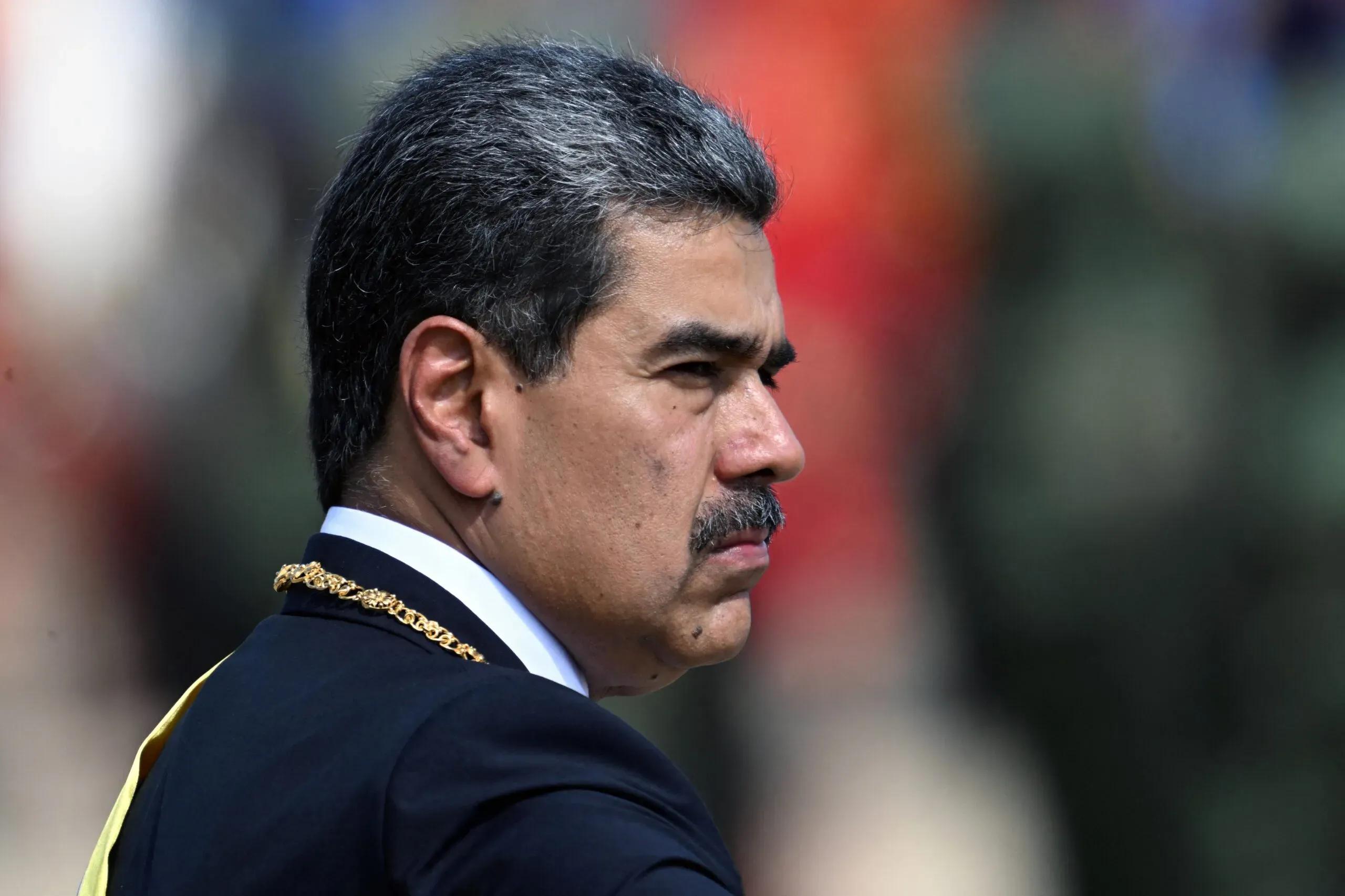
What happened in Venezuela once again brings to the table a discussion that much of the political leadership and regional progressivism avoids facing honestly: how is the sovereignty of a people defended who have been subjected for decades to a dictatorship that does not accept free elections, represses its society, and expels millions of citizens?
The regime of Nicolás Maduro is presented by some governments and international organizations as a “legitimate actor” with whom dialogue is necessary. However, in reality, Venezuela meets all the characteristics of a consolidated narco-dictatorship: total control of the state apparatus, systematic persecution of the opposition, annulment of the electoral process, and use of violence as a tool for social discipline.
Electoral processes without people: a hollow democracy
Speaking of “elections” in Venezuela is, at a minimum, a fiction. According to data from international organizations and the UN, more than 7.7 million Venezuelans are exiled or forcibly displaced, the largest diaspora in recent Latin American history. This is not voluntary migration: it is political and economic exile resulting from a regime that has made everyday life unviable.
Additionally, a central fact is added: dozens of opposition leaders have been disqualified from competing electorally, including candidates with broad popular support. Others have been directly imprisoned or forced into exile. The result is obvious: when the regime wins, it does so without real rivals; when it loses support, it simply prevents competition.
The existence of political prisoners, detention centers reported for torture and temporary disappearances, and the criminalization of protest complete the picture. Popular marches in Venezuela are not democratic expressions: they are repressed with armed forces, paramilitary collectives, and mass detentions.
A case that illustrates the character of the regime is that of Argentine citizen Nahuel Gallo, kidnapped more than a year ago without clear judicial guarantees, in a context where the justice system responds directly to political power. There is no rule of law: there is an administration of fear.
International law and its moral limit
In the face of this scenario, much of the international community argues that any external intervention “violates Venezuelan sovereignty.” This is an argument that sounds good in diplomatic forums but becomes fragile when contrasted with reality.
International law was conceived to protect peoples, not regimes that oppress them. When a government annuls the popular will, persecutes opponents, manipulates elections, and condemns its society to misery, the question ceases to be legal and becomes political and moral: how long does non-intervention become complicity?
How do you remove a dictatorship that rejects elections?
This is the question that many avoid. If there are no free elections, if protests are repressed, and if the opposition is imprisoned or exiled, what options remain?
History shows that no dictatorship fell only because of the goodwill of power. At various moments in the 20th and 21st centuries, the United States actively participated in political transition processes: from Europe after World War II to diplomatic, economic, and strategic interventions in various countries where authoritarian regimes had closed off the democratic path.
Today, what has happened in Venezuela opens a historical window: for the first time in years, the regime shows real cracks. And US intervention, far from being a classic colonial act, can be read as decisive external pressure to break a closed system that could no longer be reformed from within.
Oil, poverty, and the great scam of the “sovereign resource”
The argument that the United States intervened in Venezuela “only for the oil” is often presented as a revealed truth. But when one looks at the Venezuelan reality, that reasoning starts to fall apart. Venezuela has the largest proven oil reserves in the world and, at the same time, is one of the poorest countries on the continent. Something doesn't add up.
According to the latest National Survey of Living Conditions (ENCOVI), more than 80% of Venezuelans live in poverty and nearly 50% in extreme poverty. In other words: having oil did not prevent social collapse, nor did it guarantee decent salaries, food, or basic services. On the contrary, oil became the booty of a political and military elite that governs against the interests of society.
For years, the regime of Nicolás Maduro used the state oil company PDVSA as a political cash cow. Oil sales were conducted through opaque intermediaries, shell companies, and no-bid contracts, often with discounts of up to 40% to evade international sanctions. In many cases, the oil did not even enter the country as foreign currency: it was exchanged for cash payments, political favors, or debt cancellations with foreign powers.
Additionally, there are oil agreements with China and Russia under the “oil for debt” modality, where Venezuela delivered millions of barrels for years without parliamentary control or public accountability. The result was devastating: the country lost strategic resources without improving the lives of its population, while oil infrastructure deteriorated and production fell to historical lows.
Even licenses granted to foreign companies — such as Chevron — highlighted the underlying problem: oil does generate income when there are rules, institutions, and controls, something non-existent under Chavismo. Where there was minimal transparency, there were results; where regime discretion prevailed, there was looting.
This point is key to dismantling the simplistic narrative: oil is not synonymous with well-being, and much less with sovereignty. Without institutions, without economic freedom, and without democratic controls, natural resources become a curse. Venezuela is the most brutal example of that.
Therefore, stating that the United States “only did it for the oil” ignores an uncomfortable reality: the oil was already being exploited, but not for the Venezuelans. It was taken by a ruling caste that used this resource to maintain its power, finance corruption networks, and ensure internal loyalties while the people stood in line for food or fled the country.
The fundamental discussion is not who gets the oil, but who benefits from it. And today it is clear that under a dictatorship, strategic resources are not sovereign: they are hostages. Only in a scenario of real political transition, with free elections and citizen oversight, can oil stop being an instrument of domination and start being a tool for national reconstruction.
In this context, external intervention ceases to be seen as a classic looting and becomes part of a deeper dispute: ending a regime that turned natural wealth into structural misery.
Sovereignty is not about supporting dictators
The great mistake of the debate is to confuse sovereignty with the regime's permanence. Sovereignty belongs to the people, not to the dictator. Defending Venezuelan sovereignty cannot mean defending a power that has expelled millions of citizens, destroyed the currency, annihilated production, and turned the State into a control structure.
Today, Venezuela has an opportunity it has not had in years: to rebuild its State, recover real elections, and allow the return of its people. It will not be a clean or immediate process. No transition is. But continuing to look the other way in the name of legal purism would once again condemn an entire people to political confinement.
The dilemma is uncomfortable but inevitable:
when democracy is impossible from within, external pressure ceases to be an intrusion and becomes a tool. History will tell, but what is already clear is that inaction only guaranteed the continuation of the dictatorship. And that, definitely, is not sovereignty.

Comments