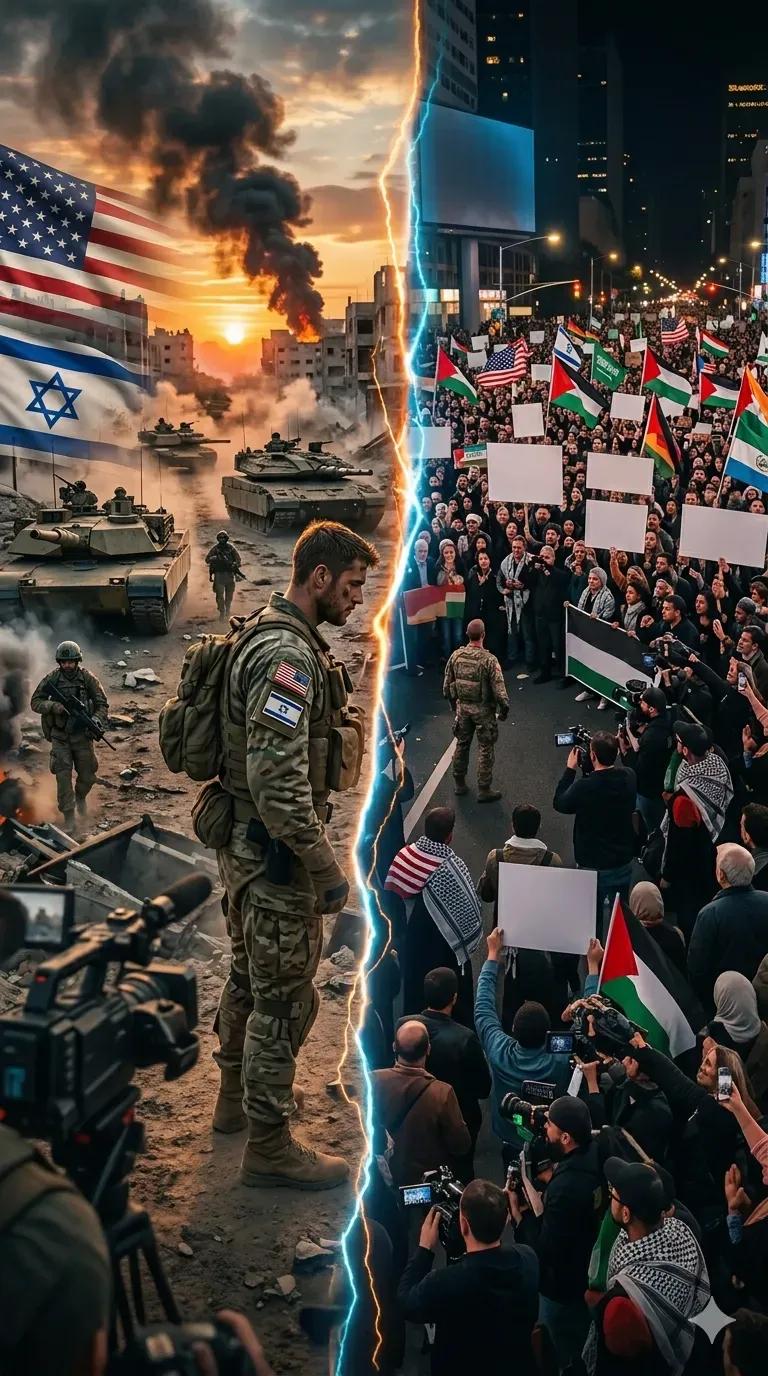
The overwhelming military superiority of Washington and Tel Aviv against Iran and Hezbollah does not translate into lasting strategic advantages. As the conflict drags on —now entering its sixth week— the human, economic, environmental, and geopolitical costs accumulate, creating a troubling landscape: a tactical victory that threatens to become a historical defeat for the U.S.-led international order.
Military history is rife with triumphs that, over time, reveal their true ambiguous nature. The current war in the Persian Gulf is heading towards being inscribed in that tradition, where military effectiveness coexists with political failure. The United States and Israel have once again showcased their technological dominance, their control of airspace, and their ability to destroy critical Iranian infrastructures. However, far from moving closer to their strategic goals, the conflict progressively erodes the pillars of their own hegemony.
The concept of "Pyrrhic victory" —a triumph obtained at such a high cost that it is practically equivalent to defeat— is not merely a metaphor here, but a precise analytical tool for understanding the drift of the confrontation. According to the available analyses, the war has not only failed to break the Iranian will to resist but has produced the opposite effect: it has strengthened the internal cohesion of a country that, faced with external aggression, has rallied around its political and military institutions.
Far from provoking the collapse of the regime, the attacks —including the elimination of Supreme Leader Ali Khamenei— have contributed to consolidating it. The initial expectation that the decapitation of key figures would unleash a popular insurrection has proven incorrect. Instead, the conflict has activated deeply rooted nationalist springs, turning the struggle into an existential fight for the Iranian nation. This phenomenon, recurrent in contemporary history, highlights a structural misunderstanding of Iran's social and political dynamics by Western planners.
On the ground, the apparent military superiority is beginning to show less visible but decisive cracks from a strategic standpoint. The asymmetric warfare driven by Iran has exposed a critical vulnerability of the U.S. military model: its economic unsustainability in long-duration conflicts. The cost disproportion between Western defensive systems —multimillion-dollar missiles— and Iranian offensive means —low-cost drones and missiles— is devastating. Intercepting cheap projectiles with high-tech weaponry is not an anomaly, but a structural pattern that undermines long-term operational capability.
This logic transforms every exchange into a relative loss for the technologically superior power. Iran does not need to win conventional battles; it only needs to prolong the conflict, raise its costs, and wear down the adversary. In that arena, time stands as a more powerful strategic ally than any arsenal.
Additionally, there is a concerning factor: the progressive internal disarticulation of the U.S. military apparatus. Tensions in the chain of command, the dismissals of senior officials, and signs of resistance to a possible ground escalation point to deep fractures within the armed forces. In any prolonged war, internal cohesion is as decisive as offensive capability. When it fractures, the outcome ceases to depend solely on the enemy.
On the international plane, the isolation of the military operation constitutes another clear indicator of strategic failure. Europe, far from unreservedly aligning itself with Washington, has adopted an ambiguous stance: rhetorical condemnation of Iran combined with a refusal to directly engage in the conflict. The lack of operational support from key allies reveals a weakening of the Western consensus that sustained the global projection of the United States for decades.
Meanwhile, powers like Russia and China are carefully observing each phase of the confrontation. This is not a direct intervention, but a strategic watch that allows them to draw lessons about the actual functioning of U.S. and Israeli military systems. This transfer of knowledge, along with the potential indirect supply of intelligence and weaponry to Iran, turns the war into a geopolitical laboratory whose repercussions extend far beyond the regional scenario.
But it is in the economic sphere where the effects are most devastating. The effective closure of the Strait of Hormuz —through which approximately one-fifth of the world's oil and a similar proportion of liquefied natural gas transit— has triggered an energy crisis of historic dimensions. The flow of crude oil has reduced to a drip, causing a dizzying surge in prices: the barrel has surpassed levels not seen since the major crises of the 20th century, with peaks that have touched or exceeded $100 at times.
This shock is not limited to the energy sector. The interconnection of the global economy amplifies its cascading effects: transportation, agriculture, industry, and consumption are simultaneously hit. Inflation soars as growth slows, creating a stagflation scenario that evokes the worst episodes of the 1970s, although with potentially greater intensity. Even a complete military victory over Iran would be insufficient to reverse the damage already done: the war has irreversibly altered market expectations, accelerated the fragmentation of the global energy system, and eroded trust in the stability of trade routes. U.S. hegemony, which relies heavily on its ability to guarantee international economic order, is seriously compromised.
To this dimension is added a factor often underestimated, but with lasting consequences: the environmental impact. Attacks on energy infrastructures have released millions of tons of pollutants, caused large-scale industrial fires, and led to hydrocarbon spills in the Persian Gulf. Images of skies darkened by toxic smoke, black rains, and polluted marine ecosystems do not merely represent collateral damage: they serve as a reminder that contemporary conflicts generate global effects. Pollutants can travel thousands of kilometers and affect countries far removed from the conflict. In this sense, the war becomes a planetary problem.
Simultaneously, Washington's escalation strategy raises questions of enormous gravity. The possibility of systematically destroying essential civil infrastructures —electric supply, drinking water, sanitation systems— not only generates a moral dilemma but a top-tier geopolitical risk. The functional annihilation of a state with nearly ninety million inhabitants could trigger an unprecedented humanitarian crisis, with unpredictable repercussions for regional and global stability.
In this scenario, the central question is no longer whether the United States and Israel can win the war in military terms. The real issue is what "winning" means in a conflict of this nature. If victory implies the destruction of a country, the partial collapse of the global economy, global environmental degradation, and the weakening of their own hegemony, then the very concept of victory loses its meaning.
The erosion of internal support in the United States adds an additional layer of complexity. The fall in presidential approval and the growing skepticism of public opinion reflect a disconnect between declared objectives and the social perception of the conflict. In contemporary democracies, internal legitimacy constitutes a strategic resource as valuable as any weapons system.
Thus, the war in the Persian Gulf looms as a historic turning point. Not so much due to the outcome of battles, but because of its systemic consequences. In an interdependent world, military force no longer guarantees political control or economic stability. Tactical superiority can coexist with strategic defeat.
Perhaps, when the smoke clears and the final figures are known, this war will be remembered not as a demonstration of power, but as the moment when that power began to fade: an ostensibly uncontestable victory that ultimately revealed itself for what it always was: a deferred defeat.
Adalberto Agozino is a Doctor in Political Science, International Analyst, and Lecturer at the University of Buenos Aires

Comments