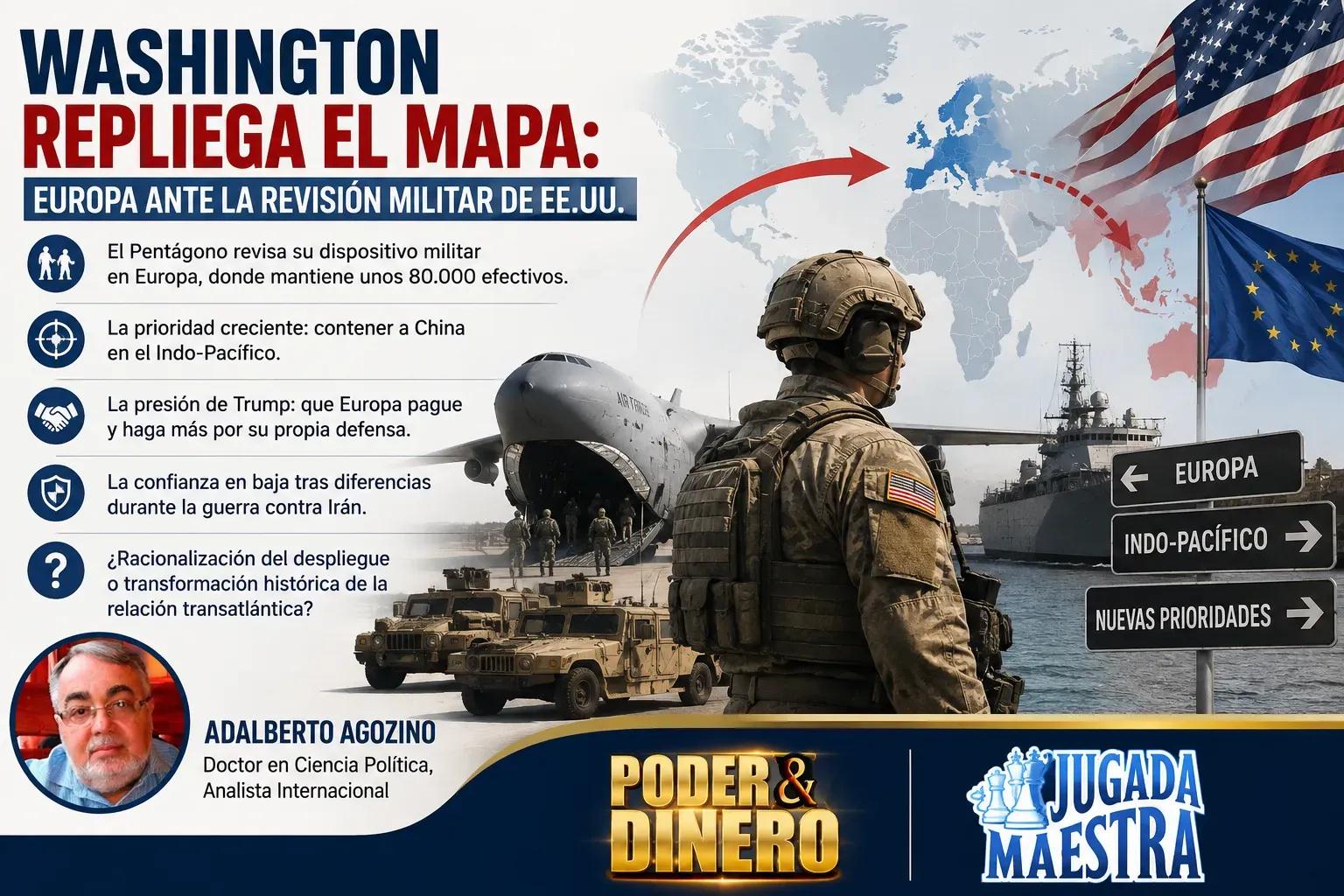
The image of the approximately 80,000 U.S. military personnel deployed in Europe has acquired a value that transcends the numerical dimension. From Germany to Italy, Poland, the United Kingdom, and Spain, these forces represent much more than soldiers, aircraft, ships, or facilities. They are the physical expression of the U.S. guarantee regarding European security. That is why the review being conducted by the Pentagon has provoked concern in European capitals, even before a definitive decision exists.
The process, which started in June and has accelerated in recent weeks, involves delivering to Defense Secretary Pete Hegseth at least four alternatives before November 6, although the complete review should conclude in December. The internal document that establishes the so-called Terms of Reference demonstrates that Washington is not simply conducting an accounting exercise regarding the number of soldiers that should remain in Europe. It is reconsidering the very architecture of its military presence.
The file examines the number and location of troops, costs, the speed with which they could be deployed, available bases, and, especially, the access, parking, and airspace conditions that allies provide to U.S. forces. It also incorporates space, cyber, and intelligence infrastructures that allow projecting U.S. military power. The questionnaire sent to allies additionally asks about defense spending, military acquisitions, transatlantic industrial cooperation, and the degree of alignment with Washington's foreign policy priorities.
It is not just about deciding where there will be fewer soldiers. The question is much deeper: what kind of commitment does the United States want to maintain with Europe and what capabilities is it willing to retain to ensure it.
The shadow of China over the Atlantic
The most important explanation for the review is probably found outside of Europe.
Over the past two decades, Washington has gradually shifted the center of gravity of its military planning towards the Indo-Pacific. The change does not stem from a perception that Europe has ceased to be important, but because China represents, from the U.S. perspective, a challenge of a different nature and potentially much more decisive for the global balance.
The U.S. National Defense Strategy of 2026 explicitly establishes the deterrence of China in the Indo-Pacific as one of the main lines of action. The document states that Washington intends to build a denial defense across the first island chain, from Japan and the Philippines to Taiwan, and calls for greater participation from regional allies. At the same time, it notes that in Europe, it will be the allies who must take the lead against threats considered less serious for U.S. interests, while Washington provides more limited but critical support.
The formulation is particularly revealing. It does not say that Europe has ceased to be strategic. It says that its relative importance has changed.
Secretary Hegseth has already publicly expressed that logic by stating that if European allies take on a greater share of the burden, the United States can concentrate more resources in the Indo-Pacific, which he referred to as its "priority theater."
The reason is simple. China has increasing capacity to challenge U.S. military freedom of action in the western Pacific. Its naval modernization, long-range missiles, space and cyber capabilities, and the development of systems designed to impede or hinder the approach of U.S. forces to the first island chain compel Washington to distribute its resources differently.
Taiwan constitutes the point of maximum tension. During 2026, Taiwanese authorities have warned that the alert time for a potential Chinese attack is decreasing, while Beijing maintains virtually constant military activity around the island.
This does not mean that the United States has decided to prepare for war with China. It means that the Pentagon must have sufficient forces to deter it. And deterrence requires presence, ammunition, aircraft, ships, intelligence, air defense, logistics, space systems, and the capability to rapidly deploy forces from the United States and allied bases.
In that equation, every resource permanently committed in Europe is a resource that cannot be simultaneously utilized in Asia.
The Pentagon's own documentation is explicit: Europe must take the lead against threats that are more serious for Europeans, while the United States focuses its attention on threats considered more important to its national interests.
Russia remains a threat, but Washington assesses it differently
However, it would be a mistake to interpret the review as a consequence of a supposed disappearance of the Russian threat.
The war in Ukraine has proved precisely the opposite. NATO continues to consider Russia a long-term threat to Euro-Atlantic security. At the 2025 Hague Summit, allies explicitly described Russia as a long-term threat and agreed to drastically increase their military investments.
The question is another: how much of that threat should be faced directly by the United States?
Washington seems to consider that the European response must be much greater than in the past. The paradox is evident. Russia remains dangerous enough to justify a strengthening of European defense, but not necessarily to the extent of justifying that the United States retains the same volume of resources on the continent that it did during the decades in which Europe depended almost exclusively on American protection.
The difference is fundamental.
NATO has more than three million non-U.S. military personnel, but the European problem has never simply been the number of soldiers. The United States provides capabilities that Europe cannot quickly substitute: intelligence, reconnaissance and target acquisition, command and control, strategic transport, replenishment, electronic warfare, air defense, logistics, and certain space capabilities. The relevance of U.S. participation resides as much in the quality of those capabilities as in the number of personnel.
A too-rapid withdrawal could thus create a much larger vacuum than what the simple troop reduction would suggest.
Trump and the cost policy
The second explanation is political and economic. Donald Trump has considered for years that the United States has borne an excessive proportion of the cost of European security.
His argument has changed little: Europeans enjoy U.S. protection that for decades they have not sufficiently paid for. The Trump Administration wants to turn that criticism into a new distribution of responsibilities.
The Pentagon's review fits perfectly into that purpose. Washington is asking allies if they have credible plans to increase their budgets, cover the capabilities that the United States may abandon, and facilitate access to their military facilities.
The pressure has already produced results. At the Hague summit, NATO members agreed to reach 5% of GDP annually in defense and security-related spending by 2035: at least 3.5% aimed at essential military capabilities and up to 1.5% for infrastructures, resilience, networks, and defense industry.
This is no small change. It represents more than doubling the former 2% benchmark.
European allies and Canada increased their combined defense spending by nearly 20% in real terms in 2025, and in 2026 the trend continued.
Trump can present that increase as a political victory. But U.S. strategic logic goes further. Washington wants Europeans to develop the necessary capabilities to progressively replace those that the United States currently provides.
The review constitutes, in that sense, a mechanism of pressure. Europe knows that the greater its military dependence on Washington, the greater its vulnerability to a potential U.S. reduction. And Washington knows that the more it threatens to reduce its presence, the greater European incentives will be to invest.
The Iran factor and the retaliation policy
There is also a third dimension, much more situational and personal: the relationship between Donald Trump and certain European governments.
The war between the United States and Israel against Iran opened an unexpected rift within the alliance. Washington reproached some European countries for limiting or delaying the use of their bases and airspace for U.S. operations. Spain and Italy were particularly exposed in those discussions. The Pentagon's questionnaire now explicitly incorporates access, parking, and airspace restrictions, known as ABO.
It is difficult to determine to what extent any troop decisions will be used as a mechanism of punishment. The Pentagon itself maintains that the review aims to present different alternatives and not to execute a previously adopted decision. However, European officials suspect that Washington has already decided at least to explore significant reductions.
Here appears the most transactional component of Trump's foreign policy. For the current Administration, an alliance is not measured solely by signed treaties, but by the concrete willingness of each ally to back U.S. interests when Washington considers they are at stake.
The message is unequivocal: whoever wants U.S. protection must be ready to provide bases, airspace, military spending, industrial cooperation, and political backing.
Europe facing its own responsibility
The great paradox is that the U.S. review could end up strengthening European defense, precisely because it forces Europe to confront a reality it could postpone for decades.
Europeans have significantly increased their spending. Germany has begun a transformation of its defense policy; Poland has become one of the main military investors on the continent; France and the United Kingdom maintain their own nuclear capabilities, and several countries are rebuilding their ground forces and arsenals.
However, spending more does not automatically equate to being able to replace the United States.
The decisive question will be whether Europe can transform the new budgets into integrated, interoperable, and sustainable military capabilities. It needs more air defense, ammunition, strategic transport, intelligence, command and control systems, electronic warfare, replenishment, and long-range capabilities. NATO has already identified precisely these shortfalls in its new capability goals.
That is why a moderate U.S. withdrawal could even be beneficial for Europe. A sudden withdrawal, on the other hand, could create a strategic problem before Europeans are ready to fully assume responsibility.
The beginning of another transatlantic relationship
The Pentagon’s review should ultimately be interpreted as part of a broader transformation of U.S. foreign policy.
It does not seem likely that Washington will abandon Europe. Elbridge Colby himself reaffirmed this week that Europe remains a "core interest" for the United States. But he added a decisive nuance: Washington is prioritizing the Western Hemisphere and the first island chain of the Indo-Pacific.
That phrase summarizes the new distribution of priorities.
The United States is not necessarily abandoning Europe; it is attempting to cease being its main military guarantor. It also does not believe that Russia has ceased to be dangerous. It rather considers that Europeans are better positioned to face it and that China demands an increasing concentration of U.S. resources.
The result could be a different NATO. An alliance in which Europe has to provide the conventional mass, while the United States retains critical strategic capabilities, intelligence, technology, mobility, and nuclear deterrence. A NATO in which Washington remains present, but no longer necessarily as the actor that singularly supports the building.
The real question will not be how many of those 80,000 soldiers will disappear from Europe. It will be what capabilities will remain, which will be transferred, and, above all, if Europeans will be able to fill the spaces that the United States leaves vacant.
The Pentagon's military review is, therefore, much more than a reorganization of troops. It is a stress test for the Atlantic alliance. And also the first rehearsal of a new geopolitical division of labor: Europe against Russia, the United States against China, and both, still, under the same NATO umbrella. The open question remains whether this redistribution of responsibilities will strengthen the alliance or, conversely, end up turning European autonomy into an unintended consequence of the America First strategy.
Adalberto Agozino is a Doctor of Political Science, International Analyst, and Professor at the University of Buenos Aires.

Comments