The numbers first
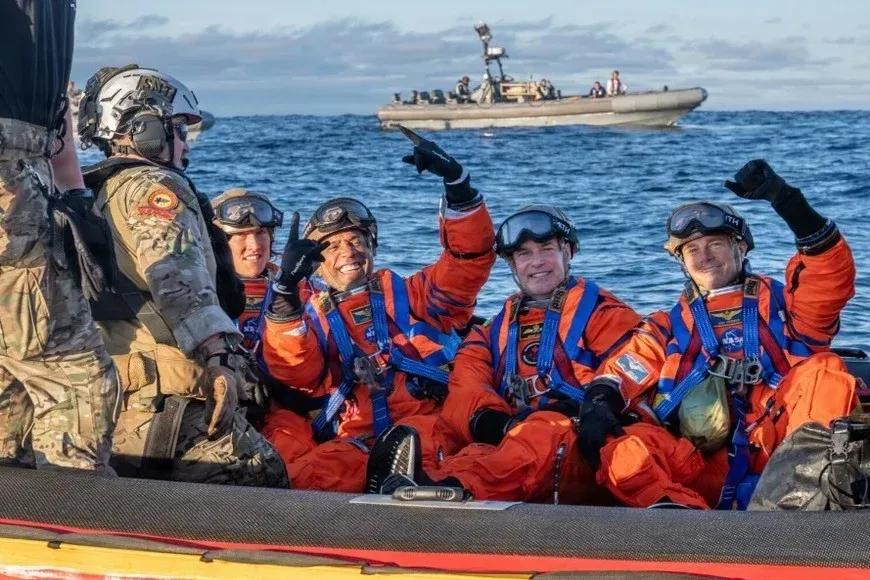
On April 1, 2026, NASA launched Artemis II from the Kennedy Space Center. On board: Reid Wiseman, Victor Glover, Christina Koch, and Canadian Jeremy Hansen. Ten days later they splashed down in the Pacific. The mission did not land on the Moon — it was a flyby. But they traveled 1,117,659 kilometers, farther than any human since Apollo 13 in 1970.
It was the first time in 54 years that anyone reached the vicinity of the Moon with people inside. The last was in 1972. And when NASA won the space race, it simply stopped going.
Total distance: 1,117,659 km — record since Apollo 13
Duration: 10 days
Last crewed lunar mission prior: Apollo 17, December 1972
Estimated cost of the Artemis program: +USD 93 billion
Why now, after half a century?
The short answer: China.
Beijing has been quietly building the most ambitious space program outside of the United States for years. They landed on the far side of the Moon with Chang'e 4 — something no other country had achieved. They brought lunar samples back to Earth with Chang'e 5. And this very year, 2026, they plan to explore the lunar south pole with Chang'e 7.
The head of NASA, Jared Isaacman, no longer speaks of China as a possible partner. He calls it "a real geopolitical rival that challenges U.S. leadership in space." President Trump, on the day of the launch, wrote on Truth Social that the United States "does not just compete, it DOMINATES."
Beijing, for its part, claims it is not participating in any space race. And at the same time, it continues to advance.
The last time we competed, this happened
Between 1957 and 1972, the space race between the United States and the Soviet Union was not just a flag dispute. It was the largest forced R&D program in modern history. The pressure to get there first forced the development of technology that did not exist.
The direct results of that competition include GPS, microprocessors, portable water purification systems, memory foam, household smoke detectors, digital cameras, and much of the satellite telecommunications infrastructure we use today without thinking. It was not philanthropy — it was the result of two powers racing non-stop for fifteen years.
The question that nobody can answer yet is what will come out of this new race. But history suggests that something will emerge.
What’s at the lunar south pole
Both the United States and China want the same place: the lunar south pole. It’s no coincidence.
This region has permanently shadowed craters where the temperature never rises. There’s water ice trapped for billions of years. Water that can be turned into oxygen to breathe, into hydrogen for fuel, into a resource to sustain a lunar base without relying on Earth for every resupply.
There’s also helium-3, an isotope that is nearly nonexistent on Earth and which some physicists consider the ideal fuel for future nuclear fusion. The Moon has enough helium-3 on its surface to power Earth for centuries, according to estimates from the European Space Agency.
Helium-3 on the Moon: ~1,100,000 tons estimated on the surface
Theoretical value of lunar helium-3: +USD 3 million per kg in current markets
Estimated frozen water at the south pole: Hundreds of millions of tons
This time there are private actors involved
The most important difference between the space race of the 60s and the current one is not technological. It’s structural.
In the Cold War, two States competed with public money and ideological motivation. Today, the United States competes with a hybrid model: NASA sets the legal framework and part of the funding, but SpaceX builds the landing rocket for Artemis III, Blue Origin builds the alternative module, and dozens of private companies compete for the contracts that will define who operates on the Moon in the coming decades.
SpaceX has already earned more than USD 4 billion just in lunar landing module contracts. Blue Origin is around USD 3.4 billion. This is not space philanthropy — it’s a business bet on who will control logistics and resources when this scales.
China, on the other hand, maintains the state model. Its program is progressing more slowly but with less dependence on private markets. Analysts disagree on who has the advantage — it depends on what you value more: speed or control.

The problem: there are no rules
The Outer Space Treaty was signed in 1967. It prohibits countries from claiming the Moon or other celestial bodies. That’s fine. The problem is that it says absolutely nothing about extracting resources from those celestial bodies.
The United States solved that on its own: in 2015 it passed a law that allows U.S. citizens and companies to own the resources they extract from space. Not the territory — the resources. China did not sign that interpretation. Russia did not either.
Russia, in fact, has just announced 7.5 billion euros for its lunar program and has talked about establishing "Russian sovereign territories" on the surface. That directly violates the 1967 treaty. No one knows yet how this will be resolved.
At the UN, the discussion is slow. On the Moon, everyone is advancing quickly. There’s a principle in space geopolitics that more and more experts repeat: like in Antarctica, the rules are defined by whoever gets there first and stays.
What’s next
Artemis II was a test flight. The next step is Artemis III, scheduled for 2027: that one lands on the lunar surface. It’s the first time humans would step on the Moon since 1972.
Then, Artemis IV in 2028 and the gradual construction of orbital infrastructure. NASA's declared goal is to have a permanent presence on the Moon before 2030 and use that as a base for crewed missions to Mars.
China aims for its own crewed landing before 2030. Its Long March 10 heavy rocket, necessary for that, has yet to fly with a crew.
Argentina, local note: CONAE has a satellite, ATENEA, selected to fly on Artemis II. It studies radiological shielding and long-distance communications. It’s Argentina's first participation in a lunar mission.
To close
We went to the Moon because China is going. What happens at the lunar south pole in the next ten years will define who controls resources, who sets the rules, and who leads the space economy of the century. It’s not science fiction — it’s geopolitics with rockets.
The last time two powers competed this way, the world ended up with GPS, satellite internet, and microprocessors. This time there are more actors, more private money, and fewer agreements. What comes out of this will be bigger. And nobody knows exactly what that is yet.

Comments