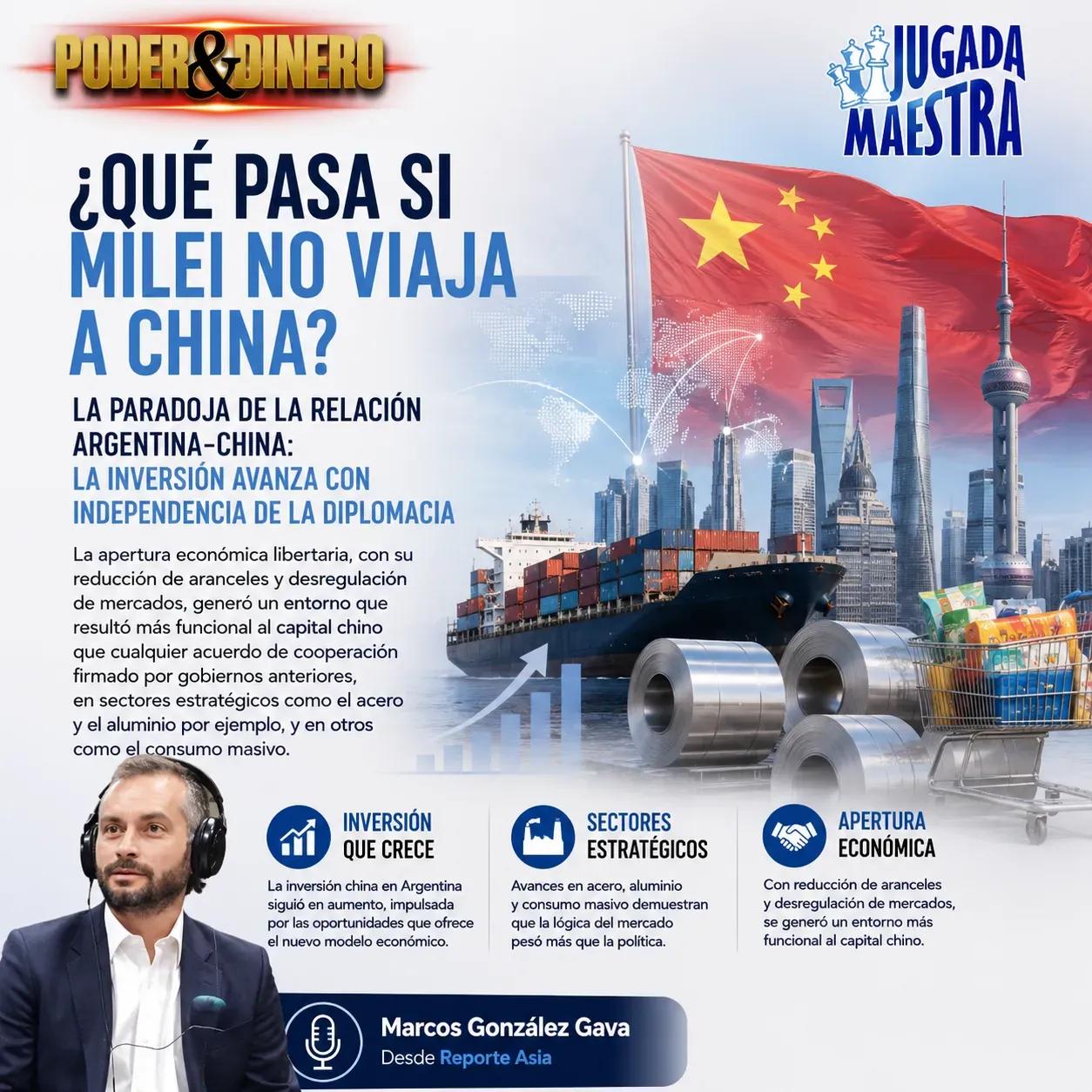
The presidential trip to Beijing still has no confirmed date, while Chinese investment grows autonomously, the swap expires in August, and the bilateral agenda accumulates open files that no foreign ministry meeting can resolve.
Javier Milei's trip to China has been announced, postponed, and reframed for over a year. In January 2026, Milei confirmed in an interview with journalist Andrés Oppenheimer that an official trip to China was being organized, presenting it as a pragmatic turn after months of confrontational rhetoric during the electoral campaign and the early stages of his management. History records that this same announcement had been made before.
The libertarian government postponed that visit and then tried to exchange it for a trip led by Karina Milei and a good part of the cabinet, which also did not materialize. Today, in mid-2026, the trip remains in diplomatic limbo.
A relationship that grew on its own
The paradox of the Argentina-China relationship under Milei is that investment has progressed independently of diplomacy. The libertarian economic opening, with its reduction of tariffs and deregulation of markets, created an environment that proved more functional to Chinese capital than any cooperation agreement signed by previous governments, in strategic sectors such as steel and aluminum, for example, and in others like mass consumption.
The most visible case is retail. Miniso, the Chinese chain of everyday consumer products, opened its first store in Buenos Aires in April 2026 with a line of seven blocks. The company plans to invest 50 million dollars and open 100 stores in the country over the next five years, with at least 10 operational stores before the end of 2026.
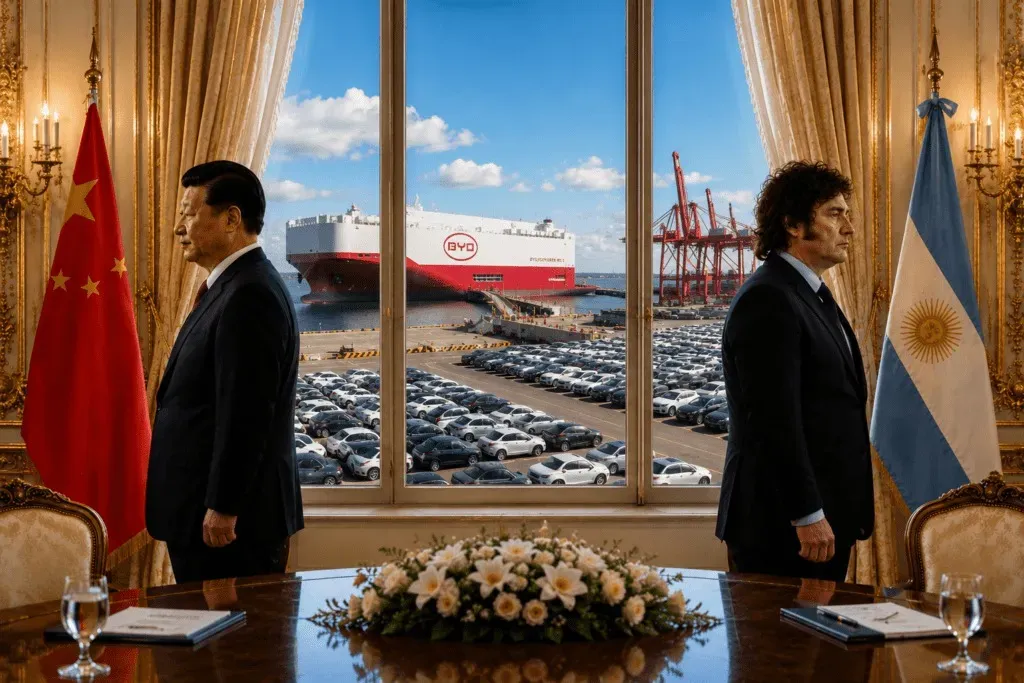
Another star sector is that of Chinese cars. The share of Made In China vehicles in the Argentine automotive market has strongly consolidated, reaching nearly 20% of monthly registrations in key segments such as SUVs and electrified vehicles. Driven by a diversified offer of about 14 brands (notably BAIC, BYD, Haval, and Chery), the Asian industry has stopped competing solely on low prices to contend for leadership in technology, connectivity, and hybrid or electric design.
On the other hand, in mining, the deployment is structural. China is making investments estimated at 3.383 billion dollars in seven lithium projects in Northwest Argentina, with operations in Jujuy, Salta, and Catamarca. The most advanced company is Ganfeng Lithium, which operates the Cauchari-Olaroz project in Jujuy. Since its production entry in 2023, EXAR —the company operated by Ganfeng together with Lithium Argentina and the provincial public company JEMSE— grew from 6,000 tons in its first year to 25,000 tons in 2024, consolidating itself as the main lithium carbonate producer in the country.
Within the framework of the RIGI (Incentive Regime for Large Investments), Ganfeng obtained approval for the expansion of Cauchari-Olaroz with a committed investment of 1.241 billion dollars, becoming the only Chinese capital project approved under that regime. Until April 2026, there was only one formal rejection in the RIGI: the project presented by Ganfeng itself for the Mariana deposit in Salta. The duality illustrates the state of the relationship: China invests where the rules allow it and pressures where the State still blocks.

Likewise, a historic record of nearly 81,000 travelers from the region (including Argentina) entered China recently. This boom in visitors was fueled by policies allowing entry without a visa for up to 30 days, which caused a 50.5% jump in the number of tourists. This was reinforced by the arrival of giants like China Southern Airlines, which just announced that it will be making 4 flights between Buenos Aires and Shanghai per week, with a stop in Auckland, bringing air connectivity to unprecedented levels.
Moreover, the highest attendance of Argentine businessmen at the Canton Fair was recorded in 2025, when 3,890 buyers from the country traveled to China, marking a 90% year-on-year leap. This number far exceeded the 2,040 attendees from the previous edition. Beyond the distance Milei-Xi, more and more Argentinians see China as a trading partner, a technical supplier, a technology partner.
The swap: negotiations that do not stop
The financial core of the relationship has its own calendar. The currency agreement that Argentina has with the Asian giant for 17 years will expire on August 6, with a current understanding of about 130 billion yuan, equivalent to approximately 19.2 billion dollars.
It was this expiration that led the president of the Central Bank, Santiago Bausili, to travel to Shanghai. The official attended a meeting of the Bank for International Settlements (BIS), although the real focus was on negotiations to finalize the extension of the swap. On June 10, Bausili met in Shanghai with his counterpart from the People's Bank of China, Pan Gongsheng, taking a new step in that direction.
However, the BCRA itself cooled expectations. Official sources from the entity ruled out immediate announcements: "Don't expect any news about the swap upon Bausili's return. There are still two months left and they are never finalized in advance." From the economic team, they believe that the renewal shouldn't face obstacles, given the strengthening of dialogue between both institutions.
The pattern of postponed gestures
The sequence between Buenos Aires and Beijing has a recognizable pattern. Milei's pragmatic turn towards China occurred after Beijing agreed to renew the swap. In exchange, the government pushed for the departure of the two officials who had defended the right to self-determination for Taiwan —Omar De Marchi and Diana Mondino— considered a red line for Beijing.
However, with Trump's return to the White House, Milei attempted a new turn and distanced himself from China again, ordering the suspension of Karina Milei's visit to Beijing. This pattern was joined in January 2026 by a decree that tightened the conditions for Chinese state-owned companies to participate in tenders in Argentina, which was unequivocally interpreted as a gesture towards Washington.
But as they say, forewarned is forearmed. Milei had already begun a policy contrary to China when he formalized Argentina's withdrawal from the BRICS group (Brazil, Russia, India, China, and South Africa) on December 29, 2023, making it clear that his alignment with Beijing would not be exemplary during his term.
Similarly, if the trip does not happen this year, it is difficult to assess whether the Argentine government is even considering doing it in 2027, when Milei will have to face presidential elections. In that context, a rapprochement with China would likely be undesirable if the "lion" tries to demonstrate that his unyielding spirit remains intact.
The open agenda that the trip should close
If the trip were to materialize, it would have to address at least three files that no technical meeting can resolve.
The first is the Santa Cruz dams. The works have an investment of about 1.85 billion dollars since 2015, out of a budgeted 4.714 billion, with construction halted since November 2023. The Jorge Cepernic dam has progressed by 42% and the Néstor Kirchner dam only 20%. The signing of Addendum XII, which updates amounts and recognizes pandemic costs, is still pending.
The second is the CART. The Chinese Argentine Radiotelescope, a 32 million dollar project in San Juan that was set to be the largest of its kind in Latin America, remains stalled: the Government did not renew the agreement that expired in June 2024 and blocked the entry of equipment sent from China at Customs.
The official argument was that the shipments presented irregularities and that no relevant Chinese authority took responsibility for them. At the same time, the pressure from Washington on Chinese space infrastructure in the region (which for the United States has dual scientific-military use) weighs on any decision that unlocks the project.
The third is what the trip will likely not include. Xi Jinping will hardly put on the table the "stumbling blocks" that have been complicating the relationship: the CNNC nuclear project for the construction of Atucha III, definitely canceled by the libertarian government with already signed contracts with the State, nor the terms of the recent tender for the waterway that prevented the participation of Chinese companies. Those files have no immediate diplomatic solution: they are domestic policy decisions that Argentina made based on its alignment with the United States. But they are also gestures that China takes as signals, leading it to question: are we really welcome in the Argentine market?
Decidedly, in some sectors, China made bets that it has not been able to collect. And today, many of its state-owned construction and engineering companies are leaving Argentina to move to other more active markets in the region, while in Argentina, public works are almost nonexistent due to lack of state contributions for the development of major water, electrical, etc. projects; Hence, today, private Chinese companies lead the presence of the Asian giant, when ten years ago, it was mostly firms like CMEC, GEZHOUBA, CRCC, CRECC, all state-owned.
A meeting that will wait to happen
Logic suggests that a presidential meeting between Milei and Xi Jinping, if it occurs without proper preparation, would be more of a symbolic act than a moment of agreement. But more than anything, it would be a missed opportunity. Without clear objectives, it is preferable that it does not happen.
Milei's foreign policy is showing an evolution from rigid ideological positions towards a calculated pragmatism that recognizes the limitations and opportunities of Argentina's international position. But that pragmatism has a limit: subordination to the Trump axis conditions how much he can yield on sensitive issues such as infrastructure, space research, or nuclear energy.
Beijing, for its part, observes the relationship from a different perspective. Chinese private investment grows autonomously, the swap is negotiated technically, Miniso fills shopping malls, BYD and BAIC lead the electric car market, and Ganfeng extracts lithium. The presidential visit is not, for China, a condition of survival of the bond: it is a symbolic recognition of parity that Xi Jinping can await with patience.
It is true that previous Argentine governments led us to think that if there is no political rapprochement with the Chinese Communist Party, then there cannot be significant economic exchanges. But now, it has been demonstrated that this is not the case.
Therefore, if Milei does not travel to China, nothing happens. The relationship with the Asian giant is built through other actors daily, among politics, the private sector, and institutions of business, education, and culture. Although, by not confirming the trip, the Argentine president leaves pending the only instance that could convert a functional but asymmetric relationship - Argentina's bilateral trade with China has a strong deficit, registering historical negative balances that exceed USD 100 billion accumulated since 2008 - into a partnership with its own agenda and identity beyond alignment with the United States.
And with the swap expiring in August, it could be understood that this postponement has less and less margin to be painless. In any case, China sees Argentina as a long-term partner, and it is expected to continue supporting its South American partner financially beyond the political fluctuations presented by the current libertarian administration. Therefore, it is not surprising that commercial ties continue to grow, and that Milei ends his term without shaking hands with Xi Jinping in Beijing.
Marcos González Gava is Co-Founder of Reporte Asia, specialist in financial and economic business, and cultural affairs of the People's Republic of China.

Comments