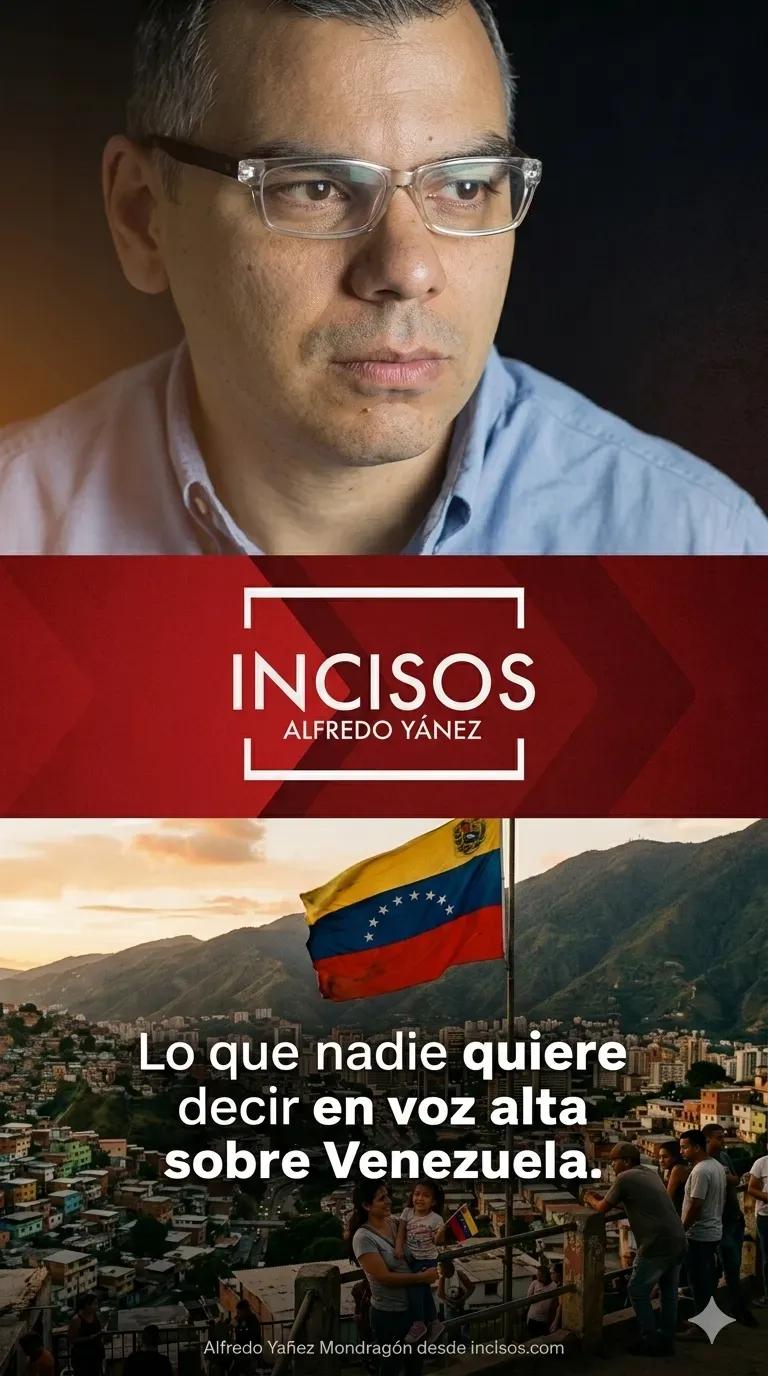
There is a question that Venezuelans ask ourselves quietly, almost with guilt, as if formulating it out loud were a betrayal of all that we have suffered. The question is this: what if the transition they are selling us is not for us?
I don't ask it from cynicism. I ask it from the same place where many of you feel it but do not say it: from the genuine relief that January 3 brought, mixed with an unease that does not quite go away, that settles in the chest like a small but heavy stone.
Maduro is gone. Or more precisely: he was removed. And that matters. Of course, it matters. After years of documented repression, more than seven million displaced people, tortured political prisoners, stolen elections, institutionalized hunger — any break from that regime deserves to be recognized. I will not be the journalist who cannot celebrate anything.
But celebrating is not the same as stopping to look.
The new power has a name and a surname
Three months after Maduro's capture, Venezuela has a president who was not elected by anyone. Delcy Rodríguez reached the position thanks to three pages of an expedited ruling from the Supreme Court, drafted in hours, that invented the legal figure of "temporary absence" for a situation that the Venezuelan Constitution never contemplated: that the president was taken out of the country by foreign military forces.
There was no election. There was no referendum. There wasn't even the constitutional mechanism that would have triggered elections in 30 days. There were three pages, a ruling made early in the morning, and the continuity of chavismo with another face.
What is most striking is not that. It's that Washington endorsed it.
Trump gave the green light for chavismo to remain in power with a new figure at the helm with the tacit approval of an administration that presented itself to the world as the liberator of Venezuela. The same administration that today negotiates with Rodríguez on oil flow, foreign companies' access to the Venezuelan market, and the electoral calendar that, according to a constitutional lawyer consulted by El País, will arrive "when the U.S. government orders it."
That is not a democratic transition. It is a managed transition. And the difference is not semantic.
The numbers that no one celebrates
The Foro Penal, the most rigorous human rights organization in the monitoring of Venezuelan political prisoners, reported on April 11 that 485 people are still detained, and denounced that the Amnesty Law operates as a "funnel" that delays releases instead of speeding them up. Rodríguez, for her part, has publicly declared that more than 8,000 people benefited from the amnesty. But as Foro Penal also points out, most of that number corresponds to individuals who already enjoyed conditional freedom measures. The Venezuelan state, three months later, still has not published an official list with the names of the beneficiaries — something that even the UN High Commissioner for Human Rights has formally requested.
These are not technical details. They are the real thermometer of a transition. When a regime that claims to be changing cannot publish the list of the prisoners it released, something does not add up.
The diaspora as spectators
From Columbus, Ohio, the story looks different. Here live Venezuelans who have been waiting for years. They have open asylum cases. They have relatives who cannot return. They celebrated January 3 with arepas and tears in restaurants on High Street — and three months later still do not know if they can return to their country, if their immigration cases will change, if the new order in Caracas will give them something concrete or just a more hopeful narrative than the previous one.
The Venezuelan diaspora is the largest in Latin America: more than seven million people scattered around the world. It is also the most ignored in negotiations. No one asked the Venezuelans in Columbus what they want from this transition. No one asked those who have spent ten years in the limbo of asylum if the agreement between Washington and Rodríguez changes anything in their legal situation. No one, except perhaps Incisos, will continue to do so.
The question worth asking
There are analysts who describe Delcy Rodríguez fulfilling a "triple role": savior of the original chavismo, representative of Washington's geopolitical interests, and initiator of an opening that could eventually lead to a political transition. It is an elegant description. It is also a description that fails to answer the most important question: transition to what, and for whom?
Because if the answer is "to an economy open to international oil, with chavismo managing political stability until there is enough legal certainty for companies to invest" — that is not what 90% of Venezuelans said they wanted when they went out to vote in July 2024. That is something else. It is an agreement between powers that uses the word democracy as marketing.
And Venezuelans, after all they have lived through, deserve something more than marketing.
Alfredo Yánez Mondragón is a journalist, editor of Incisos.com and author of "El Sistema no te lo explicó," "El Banco no te lo explicó," and "Before the Border." He writes from Columbus, Ohio.
Comments