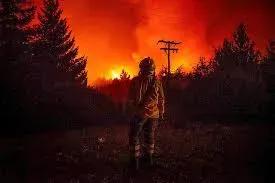
Patagonia is burning again and, once more, the fire reveals much more than an environmental tragedy. The wildfires affecting Río Negro, Chubut, and Neuquén have consumed tens of thousands of hectares, devastating native forests, productive areas, and homes, putting entire communities at risk. But beyond the material destruction, the emergency exposes an underlying political discussion: how the relationship between central power and territories operates when the crisis demands immediate responses.
Since the onset of the fires, the most effective response did not come from the national government but from the Patagonian provinces themselves. Governors from different political backgrounds coordinated resources, firefighters, firefighting planes, and logistical assistance, understanding that in the face of a catastrophe of this magnitude, regional cooperation is not an ideological option, but an urgent necessity. Río Negro, Chubut, and Neuquén articulated efforts in real-time, demonstrating that territorial management becomes central when national leadership appears distant.
The magnitude of environmental damage highlights an uncomfortable reality: southern provinces provide strategic resources to the country but often face their emergencies alone. Wildfires are not a new phenomenon, but their increasing intensity, exacerbated by climate change and the lack of sustained investment in prevention, demands an active presence from the national state. However, that presence has been weak and fragmented. There was no clear strategy or a strong political signal indicating that the emergency was a priority on the Executive's agenda.
In this context, Vice President Victoria Villarruel's visit to the areas affected by the fires gained significant symbolic value. Her presence was interpreted as an explicit recognition of the seriousness of the situation and as institutional support for the provinces facing the advance of the flames. In disaster scenarios, politics is expressed not only through budget allocations but also through gestures of proximity and the willingness to take public responsibility.
The comparison with President Javier Milei's attitude was inevitable. While the fires raged and provincial governments coordinated efforts to contain the disaster, the head of state maintained a public agenda unrelated to the emergency. His presence at a show alongside Fátima Flores and his participation in an event in Córdoba, where he even shared the stage singing with Chaqueño Palavecino, created a politically difficult-to-justify image. It was not just a physical absence in the affected areas but a symbolic absence in the face of an environmental tragedy that demanded leadership, empathy, and absolute priority from the Executive Power.
This contrast reinforces an increasingly visible tension within the national political system. When the central government retreats or delays its intervention, it is the provinces that end up assuming responsibilities that exceed their fiscal and operational capacities. In this case, the Patagonian articulation did not respond to homogeneous party affinities but to a pragmatic management logic: to protect territories, communities, and resources in the face of an emergency that does not allow delays.
What happened during the fires exposes a structural problem. The relationship between the nation and provinces often still depends on the political will of the current Executive. When that will is lacking, territorial balance suffers, and the burden falls unevenly on local governments. Cooperation among provinces then appears as a defensive tool in the absence of an active national leadership.
The fires will leave environmental scars that will take decades to heal. But they also impart an immediate political lesson: a country that organizes in a decentralized way cannot afford an indifferent central power in the face of regional tragedies. Today, Patagonia resists thanks to the coordination among its provinces. The open question is whether this cooperation will continue to be a complement to the national state or if it will ultimately consolidate as the clearest evidence of its retreat.

Comments