On the morning of February 22, 2026, in the mountains of southern Jalisco, the man who built the most violent, expansive, and corrosive cartel in recent Mexican history for a decade fell. Nemesio Oseguera Cervantes, alias “El Mencho,” leader of the Jalisco New Generation Cartel (CJNG), died during a joint operation of the Mexican Armed Forces with support from U.S. intelligence, as confirmed by Mexican authorities on February 22 (BBC Mundo, 2026; Associated Press, 2026). It was not a clean capture. It was a battle that left more than 70 dead in a single day, triggered 252 blockades in 20 states, and sent a brutal message: the leader's death did not mean the surrender of the group, but the beginning of a new phase of violence (AP News, 2026; CNN en Español, 2026).
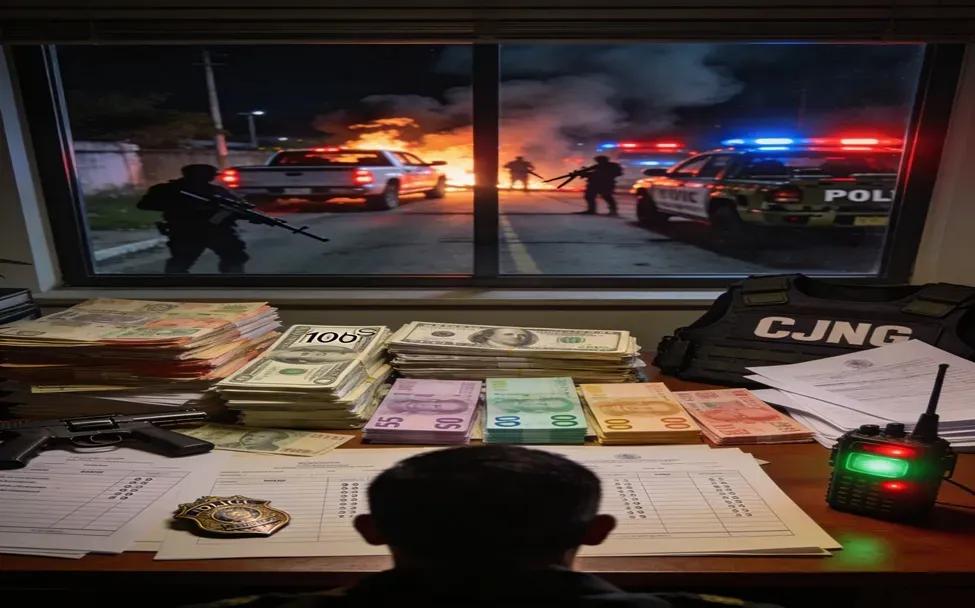
But what followed the headlines is as relevant as the operation itself. In the safe house where “El Mencho” spent his last days, authorities found something more valuable than weapons or cash: the cartel's internal accounting, a set of handwritten sheets and digital files revealing how it finances itself, how it is structured, and, above all, how it purchases impunity (El País, 2026; Infobae, 2026). Among the accounted concepts, alongside salaries for scouts and hitmen, appear systematic payments to elements of the National Guard, municipal police, prosecutors, and other officials at all three levels of government (El País, 2026). These are not rumors or accusations without evidence: they are lines with amounts, dates, and labels, written with the same naturalness with which any company pays its suppliers.
This report reconstructs, from a perspective of security, intelligence, and strategic analysis, five layers of a story that goes beyond the biography of a drug lord: how the operation that ended “El Mencho” unfolded, what criminal career led him to the top, how the CJNG spread across Mexico and the world, what type of succession is at play within the organization today, and, above all, how institutional corruption has become the fuel that keeps a criminal machinery running that cannot exist without the complicity—active or by omission—of individuals within the government. Beyond the immediate celebration, the uncomfortable question is another: does the drug lord's death reduce the problem or open the door to an even more violent fragmentation in a country where entire sectors of the state remain on the narco's payroll?
The operation: a couple, a siege, and a crossfire that did not stop
The Mexican armed forces had been pursuing the CJNG leader for years. What changed in February 2026 was concrete data: the surveillance of one of his romantic partners allowed them to locate him in a cabin in the Sierra de Tapalpa, Jalisco, where he moved with a very small security circle to go unnoticed, according to reports by Associated Press on February 23, 2026 (AP News, 2026). That trail, crossed with U.S. intelligence provided by the DEA, allowed for the assembly of a device that combined ground units, armed helicopters, and discreet deployments in neighboring states to avoid raising suspicions (AP News, 2026; BBC Mundo, 2026).
On the morning of February 22, special units of the Army, Air Force, and National Guard closed in. The objective was to capture “El Mencho” alive, but the operation faced the usual response: massive fire and high-powered weapons, including rocket launchers similar to those the CJNG had used in 2015 to bring down a military helicopter, BBC Mundo reported on February 22, 2026 (BBC Mundo, 2026). Oseguera Cervantes initially managed to exit the refuge with two of his bodyguards, leaving behind a heavily armed group that held the military back long enough to attempt an escape (AP News, 2026).
The exchange lasted long enough to turn the forest into a combat zone. At least six cartel members died on site, and three others, including “El Mencho,” were seriously injured (BBC Mundo, 2026). According to official reports, the drug lord was placed on a helicopter bound for Mexico City, but died during the transfer due to the severity of his injuries, as confirmed by the National Defense Secretariat on February 22 (BBC Mundo, 2026). The operation also left wounded soldiers, burned vehicles, and a scene that, viewed from the air, looked more like a battlefield than a high-profile arrest (AP News, 2026).
The CJNG's response: a besieged country in a matter of hours
While the government fine-tuned the statement to confirm the death of the CJNG leader, the organization was already in revenge mode. In a matter of hours, and following orders from regional commanders, cells of the cartel activated a strategy of mass punishment: roadblocks, vehicle fires, attacks on banks, and direct assaults on security installations, AP News documented on February 23, 2026 (AP News, 2026).
The events concentrated in Jalisco but spread to other states where the CJNG has a presence, affecting both tourist cities and industrial corridors and rural areas (CNN en Español, 2026; The New York Times, 2026). In several localities, the scene was repeated: families locked in their homes, businesses pulling down their shutters, and roads taken over by armed men who set trucks on fire to erect barricades (The New York Times, 2026).
Official sources and media reports agree that it was one of the most violent days in recent years: more than 70 dead among military personnel, police, alleged cartel members, and civilians, along with dozens of bank branches vandalized and businesses destroyed, reported AP News on February 23, 2026 (AP News, 2026). The government responded by sending reinforcements: about 2,000 additional soldiers to try to stabilize Jalisco and contain the wave of attacks in other key states (France 24, 2026).
What for many was a tactical victory—the death of the drug lord—turned, within hours, into a demonstration of the firepower and capacity to paralyze territories that the CJNG still retains even without its top leader (AP News, 2026; The New York Times, 2026). This is the first warning for any serious security analysis: decapitating a group of this size does not mean shutting it down.
From deported avocado farmer to chief of the most feared cartel
To understand why “El Mencho's” death matters so much, we have to go back to the beginning. Nemesio Oseguera Cervantes was born in 1966 in Aguililla, Michoacán, an area that decades later would become synonymous with cartel wars (Proceso, 2026). In the 1990s he crossed into the United States and ended up incarcerated in California for a heroin trafficking case; his migratory story was not that of a worker who stays in the fields, but of a young man who finds in the drug business a swift but lethal ladder (Proceso, 2026; BBC Mundo, 2026).
Deported to Mexico after serving his sentence, he joined the municipal police in Cabo Corrientes and Tomatlán, Jalisco, before leaving the force to fully engage as a hitman for the Millennium Cartel, an organization with a strong presence in Jalisco and Michoacán linked to the Valencia family (Proceso, 2026; BBC Mundo, 2026). There he rose through the ranks in logistics and security to become a trusted operator. When that structure fractured towards the end of the 2000s, Oseguera and his circle seized the void to create their own brand: the Jalisco New Generation Cartel (BBC Mundo, 2026).
The formula of the new group combined three elements: internal discipline, unmitigated violence, and an aggressive bet on synthetic drugs and control of strategic Pacific ports, according to an analysis by BBC Mundo published on February 23, 2026. In a few years, the CJNG went from being an emerging player to disputing—and in several regions surpassing—the territorial presence of the historic Sinaloa Cartel (BBC Mundo, 2026; Yahoo Noticias, 2026). On the priority target lists of Mexico and the United States, “El Mencho” earned the place once held by names like “El Chapo” Guzmán: the “public enemy number one” on the Mexican drug trafficking map (BBC Mundo, 2026).
The business model: methamphetamine, fentanyl, cocaine, and a parallel state
Under “El Mencho's” command, the CJNG ceased to be merely a drug-moving organization and became a criminal network with traits of a multinational company and a parallel state (BBC Mundo, 2026; Yahoo Noticias, 2026). The economic base has been, above all, the production and trafficking of methamphetamines and fentanyl to the United States, combined with the purchase of cocaine in South America and its redistribution by land, air, and sea (BBC Mundo, 2026; Yahoo Noticias, 2026).
Clandestine laboratories in Jalisco, Michoacán, and Colima produce tons of methamphetamine annually, fed by chemical precursors that arrive from Asia through ports like Manzanillo and Lázaro Cárdenas (BBC Mundo, 2026; Yahoo Noticias, 2026). From the late 2010s onwards, the cartel fully entered into the production of fentanyl, the synthetic opioid that has spiked overdose deaths in the United States (Yahoo Noticias, 2026). These synthetic opioid and crystal routes connect with distribution networks in at least 21 states of the Union, according to assessments by the DEA cited by specialized media (Yahoo Noticias, 2026).
But the CJNG does not live solely on drug exports. Around it operates an ecosystem of crimes: extortion of local businesses, protection rackets, kidnapping, fuel theft, arms and human trafficking, and money laundering through shell companies and schemes such as fraud in tourist timeshares in the Mexican Pacific (El País, 2026; Infobae, 2026). This diversification has allowed it not only to withstand partial blows but also to weave networks of complicity with municipal authorities, police, and financial intermediaries that enable dirty money to end up disguised as legal investments (El País, 2026; Infobae, 2026).
Close circle and structure: family, operators, and regional franchises
The classic image of a drug lord surrounded only by hitmen falls short for the CJNG. “El Mencho's” immediate circle combines family, historical operators, and regional bosses with operational autonomy (The New York Times, 2026; BBC Mundo, 2026). His wife, Rosalinda González Valencia, and several members of the González Valencia family—known as “Los Cuinis”—have been identified as responsible for managing part of the financial structure and money laundering; several of them have been arrested in Mexico or extradited to the United States in the last decade (Proceso, 2026; El País, 2026).
In parallel, figures like Erick Valencia Salazar “El 85,” Ricardo Ruiz Velazco “El Doble R,” Juan Carlos González “El 03,” or José Bernabé Brizuela “El Vaca” have built their own weight within the cartel as plaza bosses and military command in Jalisco, Michoacán, Nayarit, and other key states (IMER Noticias, 2026; The New York Times, 2026). Under them operate armed cells and local structures dedicated both to narcotics and to extortion and social control in communities where the state's presence is weak or nonexistent (BBC Mundo, 2026; IMER Noticias, 2026).
Instead of a rigid pyramid, the CJNG operates as a network of regional franchises: each plaza contributes resources, controls local illicit businesses, and maintains its own networks of political protection, but all, in theory, recognize a central command and pay a part of the profits (BBC Mundo, 2026; IMER Noticias, 2026; The New York Times, 2026). This architecture has allowed the group's rapid expansion and explains why the death of the leader does not automatically mean the collapse of the organization.
Where they operate: All of Mexico, the United States, and various continents
The power of the CJNG is not measured only in bullets but on the map. Various intelligence reports and journalistic analyses agree that the cartel has a presence in most of Mexican territory and an unprecedented international projection for a criminal organization that emerged in Jalisco (Yahoo Noticias, 2026; BBC Mundo, 2026; CNN en Español, 2026).
In Mexico, the CJNG operates, with varying levels of control, in at least 27 of the 32 states, with clear strongholds in Jalisco, Michoacán, Colima, Nayarit, Guanajuato, and Veracruz, among others, according to reports from CNN en Español on February 24, 2026 (CNN en Español, 2026). In those territories, it disputes routes, ports, and local markets with other organizations such as the Sinaloa Cartel, the Santa Rosa de Lima Cartel, the Gulf Cartel, and remnants of regional groups (CNN en Español, 2026; IMER Noticias, 2026).
In the United States, the DEA has documented CJNG operations in at least 21 states, with key nodes in California, Texas, Arizona, Illinois, New York, and Florida, which function as wholesale distribution centers for methamphetamine, fentanyl, and cocaine (Yahoo Noticias, 2026). The organization does not always appear with its explicit brand, but its supply chains are a central part of the opioid crisis facing the country (Yahoo Noticias, 2026).
Outside the continent, investigations have linked the CJNG to trafficking and money laundering networks in more than 40 countries, including alliances with cocaine suppliers in Colombia, Peru, and Bolivia, transit corridors in Central America, and presence in consumer markets in Europe, Asia, and Oceania (Yahoo Noticias, 2026; BBC Mundo, 2026). These are not formal branches, but nodes of a global criminal network that buys, moves, sells, and launders capital on a scale that was once reserved for much older organizations.
Emblematic violence: messages written with fire
If there is one thing that sets the CJNG apart from the rest of the Mexican cartels, it is its way of using violence as a political and reputational message. “El Mencho” quickly understood that striking the state spectacularly could serve both to intimidate and to demonstrate strength to rivals (BBC Mundo, 2026; El País, 2026)."In 2015, the downing of a military helicopter with a rocket launcher in Jalisco marked a before and after: for the first time a Mexican criminal group used that type of weaponry against a state aircraft and managed to shoot it down (El País, 2026; BBC Mundo, 2026). That same year, ambushes against police convoys left dozens of agents dead on roads in Jalisco, sending the message that approaching certain areas came at a very high cost for law enforcement (El País, 2026).
In 2020, the organization brought the confrontation to the political heart of the country: a heavily armed command attacked the armored vehicle of Omar García Harfuch in Mexico City, then Secretary of Security (BBC Mundo, 2026). The official survived, but the attack confirmed that the CJNG was willing to target high-profile figures far from its historical strongholds.
Additionally, there have been years of narco-blockades, vehicle fires, and simultaneous attacks in states like Jalisco, Guanajuato, and Michoacán when a regional boss was arrested or when an important blow against the structure was attempted (Infobae, 2026; IMER Noticias, 2026). The wave of violence unleashed after the death of "El Mencho" is a logical continuation of that manual: responding to state pressure by paralyzing the everyday life of entire regions.
**The accounting of corruption: when the state enters the payroll of the CJNG**
The accounting records found after the fall of "El Mencho" leave little room for naivety: the CJNG not only pays hitmen and scouts, but also allocates a fixed part of its budget to buy institutional protection (El País, 2026; Yahoo Noticias, 2026; Infobae, 2026). The documentation includes lines with acronyms for corporations and municipalities — National Guard, prosecutors, local police of Tapalpa, Atemajac de Brizuela, Chiquilistlán — accompanied by monthly amounts, as if they were any other cartel supplier (El País, 2026; Infobae, 2026).
In some cases, payments to municipal police represent between 20% and 30% of the official payroll, a figure that illustrates the extent to which crime money can compete with the state's salary and bend wills, as revealed by El País on February 27, 2026 (El País, 2026). This "narco-payroll" is not simply an accounting record: it is the map of an institutional capture where patrols stop passing through certain roads, operations are leaked in advance, and warrants become useless paper (El País, 2026; Univision, 2026).
Thus, corruption ceases to be an isolated phenomenon to become the backbone of impunity. The CJNG incorporates bribery as a fixed cost of business, just as indispensable as purchasing weapons or vehicles: without bought police, the risk skyrockets; with them on the payroll, the state becomes a silent partner (El País, 2026; Infobae, 2026). When the cartel's accountants record each month what is spent on military, agents, and local leaders, they are in fact registering the price of the state’s neutralization in wide areas of the country (El País, 2026; Infobae, 2026).
In this context, President López Obrador's policy of “hugs, not bullets” finished closing the circle. While the federal government avoided direct and sustained clashes with major cartels, organizations like the CJNG took advantage of the reduced pressure and the fabric of local complicities to expand their territorial and economic presence (Infobae, 2024; The New York Times, 2022). Various analyses from international media agree that this strategy reduced some indicators of direct confrontation, but did not contain, and in several cases accompanied, the strengthening of criminal structures (Infobae, 2024; Entérate México, 2024).
The uncomfortable but realistic phrase is this: drug trafficking on the scale of the CJNG cannot exist without the blessing — explicit or by omission — of people within the government. There are no shipments crossing ports, roads, and airports systematically for years without officials looking the other way or getting paid to do so (El País, 2026; Infobae, 2024). And while that blessing continues to be written on accounting sheets as another cartel expense, any strategy limited to decapitating bosses, without thoroughly cleaning institutions, will be doomed to repeat the same story with new names (El País, 2026; The New York Times, 2026).
**The succession: names, fractures, and risks**
With the leader dead and a good part of the family core in prison, the immediate question is who will take over the keys to the cartel. Both authorities and analysts agree that there is no unique and natural heir, which opens the door to an internal struggle (The New York Times, 2026; BBC Mundo, 2026).
Among the names that come up most often are Erick Valencia “El 85”, a historical operator with strong influence in Jalisco; Ricardo Ruiz Velazco “El Doble R”, with weight in Michoacán and the port area; Juan Carlos González “El 03”, linked to shock units of the CJNG; and José Bernabé Brizuela “El Vaca”, with regional power in Nayarit (IMER Noticias, 2026; The New York Times, 2026). Each controls networks, territories, and loyalties, but none has, on their own, the level of authority that “El Mencho” concentrated (The New York Times, 2026; BBC Mundo, 2026).
The scenarios under consideration are three. In the most "ordered" one, regional franchises accept negotiated leadership — probably a consensus figure backed by the strongest leaders — and the CJNG maintains its structure, adjusting the form but not the substance (The New York Times, 2026; IMER Noticias, 2026). In the middle ground, there are tensions and localized clashes for control of key plazas, but the cartel avoids a total break (The New York Times, 2026; IMER Noticias, 2026).
In the worst case for public safety, the succession turns into an open war between factions: groups that seek to claim ports, fentanyl corridors, and extortion zones in states like Jalisco, Michoacán, Guanajuato, and Zacatecas (IMER Noticias, 2026; The New York Times, 2026). This would not only increase violence in Mexico but could fragment the CJNG into several medium-sized organizations, more unpredictable and willing to do anything to demonstrate power (The New York Times, 2026). The specter is known: something similar happened when the Sinaloa Cartel entered internal disputes and factions with their own logic emerged.
**Conclusion**: **A symbolic blow in a war that does not end while the state remains on the payroll**
The death of Nemesio Oseguera Cervantes is undoubtedly one of the most important blows that the Mexican state has dealt to a leader of organized crime in recent decades (BBC Mundo, 2026; AP News, 2026). It sends a message both internally and externally: no capo is untouchable, even if their organization has a presence on half the planet and the capacity to paralyze entire cities (BBC Mundo, 2026; Yahoo Noticias, 2026). For communities that have lived for years between the gunfire of the CJNG and the silence of the state, the news means at least that someone, at some level, dared to go for the head of the group (The New York Times, 2026).
But reducing the problem to the biography of one man would be a mistake. The CJNG is not just "El Mencho": it is a network of franchises, illicit businesses, financial structures, and political complicities that do not disappear with the founder's death (BBC Mundo, 2026; Yahoo Noticias, 2026; Infobae, 2026). The coming months will tell if the organization can reorganize under new leadership or if it fractures into pieces that multiply the hotspots of violence throughout the country (The New York Times, 2026; IMER Noticias, 2026).
Beyond tactical operations, what the CJNG’s accounting documents reveal is the more uncomfortable dimension of the problem: drug trafficking at this scale cannot exist without the blessing of people within the government. As long as there are police, military, and officials receiving monthly bribes as part of the crime payroll, and as long as the state's strategy consists of hitting bosses without tackling the root of the institutional corruption supporting them, any victory will be partial and provisional (El País, 2026; Infobae, 2024; The New York Times, 2022).
In terms of security and intelligence, the challenge for Mexico and the United States is no longer just to pursue the next name on the list, but to prevent the power vacuum from turning into a new wave of massacres, displacements, and lawless territories (The New York Times, 2026; AP News, 2026). The end of “El Mencho” closes a chapter, but the CJNG book — and the cartels surrounding it — remains open. The question is whether the states confronting it are willing to read it to the end, cleaning their own institutions, or whether they will continue reacting, time and again, only when the fire is already at the door."
Infobae. (2024, May 21). AMLO's "hugs, not bullets" policy helped drug cartels thrive, according to U.S. senators.https://www.infobae.com/mexico/2024/05/22/politica-de-abrazos-no-balazos-de-amlo-ayudo-a-prosperar-a-los-carteles-de-la-droga-segun-senadores-de-eeuu
Infobae. (2026, February 27). CJNG's narconómina: the five keys that reveal the true reach of the cartel.https://www.infobae.com/mexico/2026/02/27/narconomina-del-cjng-las-cinco-claves-que-muestran-el-verdadero-alcance-del-cartel
Proceso. (2026, February 23). “El Mencho”: from drug dealing to leading the most powerful cartel in Mexico.https://www.proceso.com.mx/nacional/2026/2/24/el-mencho-de-narcomenudeo-dirigir-el-cartel-mas-poderoso-de-mexico-369047.html
The New York Times. (2022, August 31). AMLO promised “hugs, not bullets", but violence continues.https://www.nytimes.com/es/2022/08/31/espanol/mexico-violencia-amlo.html
The New York Times. (2026, February 22). What you need to know about the death of “El Mencho”.https://www.nytimes.com/es/2026/02/22/espanol/america-latina/muerte-mencho-cartel-jalisco-nueva-generacion.html
The New York Times. (2026, February 23). The day after “Mencho's” death in Mexico.https://www.nytimes.com/live/2026/02/23/espanol/mexico-mencho-violencia
The New York Times. (2026, February 23). “El Mencho” is dead. What will happen with the Jalisco New Generation Cartel?https://www.nytimes.com/es/2026/02/23/espanol/america-latina/cartel-jalisco-nueva-generacion-que-pasara.html
Univision. (2026, February 26). “Narconómina” reveals salaries of up to $9000 for police officers.https://www.univision.com/noticias/el-mencho-narconomina-revela-sueldos-de-hasta-9-000-para-policias-video
Yahoo Noticias. (2026, February 23). CJNG, present in all of Mexico and 40 countries.https://es-us.noticias.yahoo.com/cjng-presente-m%C3%A9xico-40-pa%C3%ADses-060000663.html
Yahoo Noticias. (2026, February 26). GN, police, and "halcones" in CJNG's narconómina.https://es-us.noticias.yahoo.com/gn-polic%C3%ADas-halcones-narcon%C3%B3mina-cjng-060000469.html
About the Author:
William L. Acosta is a graduate of PWU and Alliance University. He is a retired New York City police officer, a former U.S. Army veteran, and the founder and CEO of Equalizer Private Investigations & Security Services Inc., a licensed agency in New York and Florida, with international reach. Since 1999, he has led investigations in narcotics, homicide, and missing persons cases, in addition to participating in criminal defense at both state and federal levels. A specialist in international and multijurisdictional cases, he has coordinated operations in North America, Europe, and Latin America.

Comments