Many international analysts wonder whether the decisions of U.S. President Donald Trump are driven by improvisational impulses —and therefore, unthoughtful— or if, on the contrary, they are part of a carefully designed strategy to redefine the global balance before his term ends. The accumulation of measures taken since his return to the White House seems to suggest the latter: a coherent, albeit disruptive, plan aimed at preserving the primacy of the United States in an increasingly hostile international system perceived by Washington.
Upon reassuming the presidency, Trump appeared to arrive at a central conclusion: the global leadership of the United States was being eroded by the rise of a rival power. Unlike the times of Ronald Reagan, when the "Evil Empire" was the Soviet Union, the strategic challenge of the 21st century comes from China.
The Asian giant not only has an economy capable of disputing U.S. technological and industrial primacy, but it also has a network of political and commercial allies that expand its influence. Among them standout the countries grouped in the BRICS bloc, a platform formed by emerging economies that seeks to reduce Western financial hegemony through initiatives such as the de-dollarization of international trade, the creation of alternative credit mechanisms, and greater use of national currencies in global transactions.
A new geopolitical "axis"
In Washington's strategic vision, the system of alliances orbiting around Beijing includes Russia, Iran, and North Korea as main pillars. Around them align smaller —though geopolitically relevant— partners like Venezuela, Cuba, and Nicaragua.
These countries play a particularly sensitive role for the United States because they are situated in the Caribbean and Latin America, regions traditionally considered part of its strategic sphere of influence. From the U.S. perspective, their presence there constitutes a direct threat in the so-called "soft underbelly" of the country.
The cooperation between these states is not limited to the political realm. It also includes military agreements, intelligence sharing, and joint exercises. In some cases, it even includes the physical presence of foreign forces. Russian troops have been deployed in Venezuela and Cuba, while China maintains space monitoring and electronic warfare facilities on Cuban territory.
In February 2026, the head of U.S. Southern Command, Admiral Alvin Holsey, warned Congress that Beijing uses Cuba as an "advanced platform for intelligence gathering." According to the U.S. administration, these activities date back at least to 2019 and have expanded in recent years.
This network is complemented by other signs of strategic cooperation. Iranian vessels have made frequent stops at Venezuelan and Cuban ports, while military exchanges between Moscow, Tehran, and Caracas have become increasingly visible.
China's strategic enclaves in Latin America
China has also consolidated key positions in Latin America through investments in critical infrastructure. These include the control that companies linked to the Hong Kong conglomerate CK Hutchison exert over facilities in the Panama Canal, the megaport of Chancay in Peru —designed as a direct gateway to Asian trade— and the Chinese space station installed in Bajada del Agrio, in the Argentine province of Neuquén.
This complex, which occupies about 200 hectares in Patagonia, is operated by the China Satellite Launch and Control Agency, which is part of the People's Liberation Army. For many Western analysts, its dual nature —civil and military— raises questions about its potential use for strategic purposes.
The energy dimension is also part of this equation. In 2025, Venezuela supplied between 3.3% and 3.5% of China's total oil imports, while Iran provided about 13%. These flows consolidate interdependence between Beijing and some of Washington's main adversaries.
The rise of China's military
Although China's international expansion has primarily relied on trade and investment, Beijing has not neglected the development of its military power. In recent years, it has rapidly modernized its navy and naval aviation, enhancing its capacity to project power in the South China Sea and along the maritime routes that supply its economy.
The inauguration of its naval base in Djibouti, located in the strategic Horn of Africa, was a symbol of this shift in scale. Since then, China's naval presence in the Indian Ocean and the western Pacific has steadily increased, raising concerns in countries such as Japan, South Korea, and Taiwan.
Trump's response
In the face of what he considers an existential threat to American hegemony, Donald Trump has opted for a direct strategy: strengthening his allies, weakening the rival coalition, and reconfiguring the international system in more favorable terms for Washington.
His inaugural speech already contained signals of this direction. Among them was his interest in acquiring Greenland and reinforcing U.S. control over the Panama Canal, two strategic enclaves for North Atlantic trade and military routes.
At the same time, he demanded NATO countries significantly increase their defense spending, warning that the United States could reconsider its commitment to European security if allies did not assume a greater share of the burden. The suggestion that Washington might withdraw its "nuclear umbrella" over Europe caused unease in several capitals on the continent.
Trump also marginalized European governments from major international negotiations, especially in the conflicts in Ukraine and the Middle East, reinforcing a diplomatic style based on unilateral decisions.
From multilateralism to bilateralism
U.S. foreign policy thus underwent a significant shift: the abandonment of traditional multilateralism in favor of bilateral agreements or ad hoc coalitions.
In January 2026, Washington promoted the creation of the Board of Peace, an international forum aimed at coordinating security initiatives, conflict mediation, and reconstruction in war zones. Among its initial members were several leaders ideologically close to Trump, such as Argentine President Javier Milei, Salvadoran Nayib Bukele, Ecuadorian Daniel Noboa, and Italian Prime Minister Giorgia Meloni.
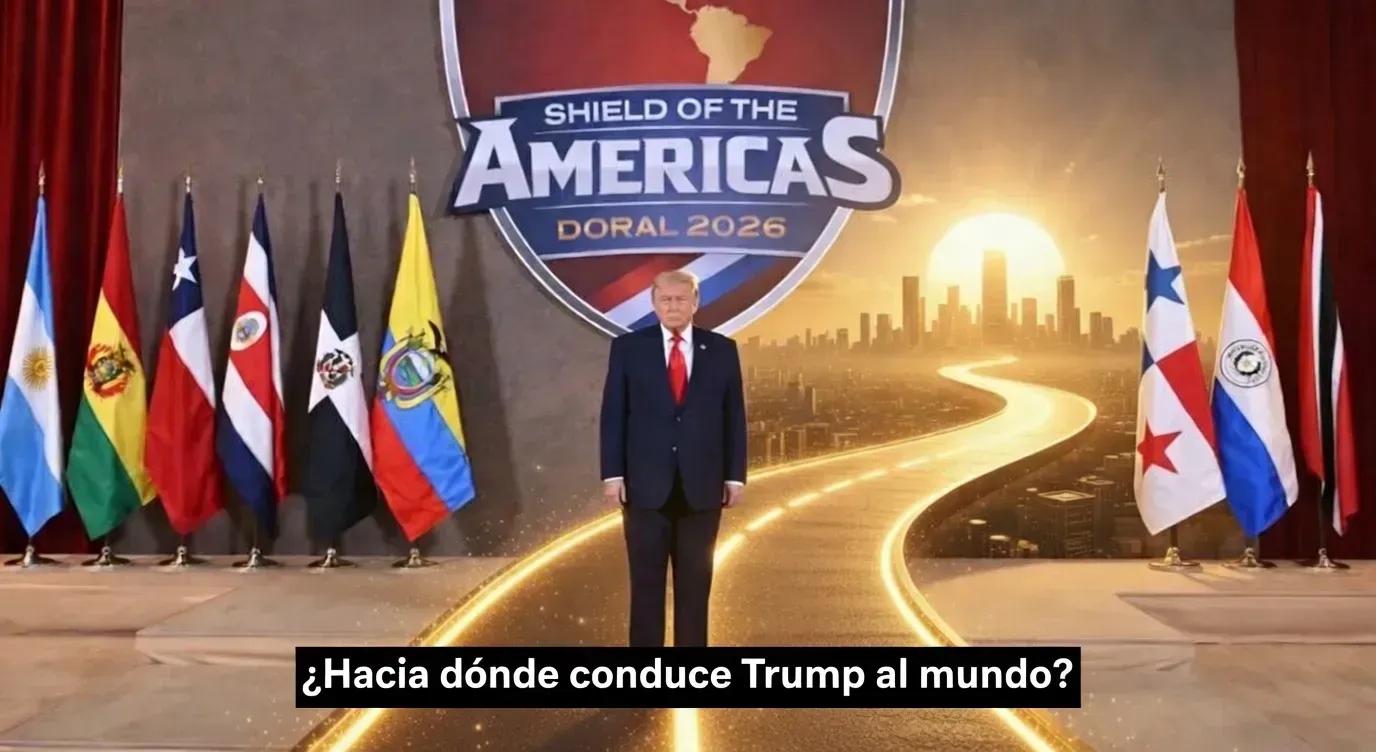
At the same time, the United States pushed for a regional alliance called the Shield of the Americas, consisting of 17 countries and oriented toward military cooperation against drug trafficking and the growing Chinese influence in the Western Hemisphere.
A distancing from the United Nations
This new approach also implied a growing distance from traditional multilateral institutions. The Trump administration suspended U.S. funding to various agencies linked to the United Nations, including the World Health Organization, UNESCO, the Human Rights Council, and the agency for Palestinian refugee assistance.
In January 2026, the president also signed a memorandum ordering a review of U.S. participation in 66 international organizations.
For the White House, many of these institutions had become bureaucratic platforms that used U.S. funds to promote policies contrary to Washington's interests.
Europe, between dependence and autonomy
In this context, Europe faces an uncomfortable reality. Without full assurances of American security, the European Union faces the challenge of strengthening its strategic autonomy.
The President of the European Commission, Ursula von der Leyen, expressed this clearly in March 2026 during a conference of ambassadors in Brussels. "The idea that we can simply retreat from this chaotic world is a fallacy," she stated. Europe, she added, must develop "greater assertiveness" and build new forms of cooperation to defend its interests in an increasingly unstable international system.
Interventions and conflicts
Meanwhile, the White House has continued to rapidly deploy its global strategy.
After the so-called "tariff battle", the United States bombed Iranian nuclear facilities to end the so-called Twelve Days War between Israel and Tehran. Subsequently, it promoted an agreement to stop the war between Israel and the militias of Hamas and Hezbollah in Gaza and Lebanon.
But the most immediate front for Washington was in the Caribbean. There, the Trump administration intensified its pressure on the Chavista regime in Venezuela. Initially, it justified its intervention with the threat of drug trafficking, although soon the discourse shifted toward control of the world's largest oil reserves.
According to various reports, in early 2026, U.S. forces managed to capture Venezuelan leader Nicolás Maduro, forcing the weakened government led by Delcy Rodríguez to accept an agreement that included opening the oil sector to U.S. companies and the release of political prisoners.
The pressure on Cuba and Latin America
The White House also hardened its stance toward Cuba, imposing a total embargo and predicting the regime's collapse before October. Trump has even suggested that the island could become an "associated state" or eventually the "51st state" of the Union.
The tensions were not limited to these countries. Mexico, Colombia, and Brazil have also received warnings from Washington.
In Mexico, U.S. pressure contributed to a change in strategy against drug trafficking, culminating in the death of the leader of the Jalisco New Generation Cartel, Nemesio Oseguera Cervantes, "El Mencho," during a military operation in February 2026.
In Brazil, relations with President Luiz Inácio Lula da Silva have deteriorated due to Brasília's closeness to the BRICS and the visit of Iranian warships to Brazilian ports in 2025.
The confrontation with Iran
The most explosive front of this strategy is in the Middle East.
With the deployment of a powerful naval force led by the aircraft carrier USS Abraham Lincoln, the United States launched on February 28 the Operation Epic Fury, a joint offensive with Israel against Iranian military and nuclear facilities.
Washington's declared objectives were clear: to destroy the Iranian nuclear program, cut Tehran's support for allied militias like Hamas, Hezbollah, and the Houthis, and ultimately weaken the regime of the ayatollahs.
But the war also has an energy dimension. Iran possesses the third-largest oil reserves in the world. If Washington were able to indirectly control these resources —added to those of Venezuela— its influence over the global energy market would be considerable.
A world in transition
The conflict with Iran has caused severe damage to civilian infrastructure, regional tensions, and a new jolt to the global economy, still weakened by the consequences of the COVID-19 pandemic.
At this moment, it is impossible to foresee the outcome of the conflict. Iran may not be able to win the war, but the question is whether the regime will survive long enough to rebuild its military capacity and continue its ambition to become a nuclear power.
The more unsettling question, however, is another: whether this series of maneuvers constitutes the prelude to a much larger confrontation with China.
Because behind each of these crises, the true strategic objective of Washington seems to be taking shape: preventing Beijing from becoming the dominant power of the 21st century.
Adalberto Agozino is a Doctor in Political Science, International Analyst, and Professor at the University of Buenos Aires

Comments