A few days ago, in this very site, we published two notes regarding the proposals that are being studied for the reconversion of the energy matrix of Venezuela. Both were signed by the same author: Wilmer Ruperti (see https://www.fin.guru/es/politica-y-sociedad/oil-sovereignty-and-commitment-to-the-future-wilmer-ruperti-t82tvbnenw and https://www.fin.guru/es/politica-y-sociedad/plan-ruperti-recovery-of-the-energy-logistics-and-strategic-oil-capacity-of-venezuela-wilmer-ruperti-t3lbe7vfg6)
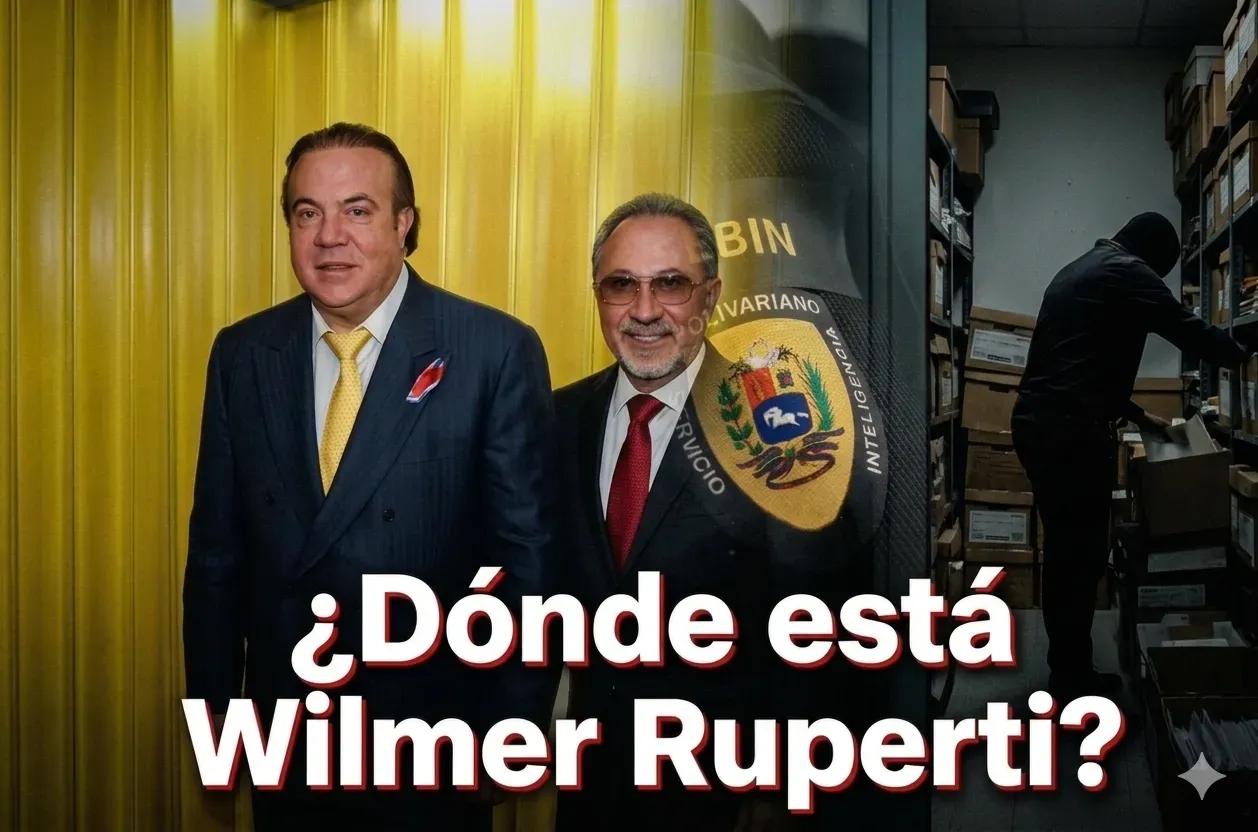
Ruperti, a Venezuelan national, is a magnate, businessman, investor, founder of Global Ship Management, and owner of the Tiburones de La Guaira, as well as of Canal I. One of the many businessmen who had to coexist with the castrochavista dictatorship of Venezuela, although with a fundamental difference from the majority of his peers: despite being investigated by the U.S. Department of the Treasury, he was never subject to any commercial sanctions and, moreover, still holds a valid visa allowing him to enter and exit the United States freely. Not only that, he married in this country, and the godparents of his wedding were two icons of the Cuban diaspora: Emilio (in the photo) and Gloria Estefan.
But why are we returning to this topic? Very simple. As simple as it is grave. Yesterday we learned that Ruperti had been summoned to present himself at noon at a headquarters of the Bolivarian Intelligence Service (SEBIN), without any indication of the reason. Complying with this ¨invitation¨, he arrived on time with his personal escort, who were separated from the businessman, had their phones and weapons confiscated, and a couple of hours later were able to leave without being informed of the situation of the detained. At the time of writing this note, Ruperti's whereabouts remain a mystery. Our hypothesis is that the proposal contained in Ruperti's articles (we are not referring to his Energy Recovery Plan for Venezuela, or Plan Ruperti) worried, if not scared, members of the government and businessmen whose relationship with the governments of Hugo Chávez and Nicolás Maduro borders on complicity. Something that cannot be attributed to the businessman now ¿detained? ¿imprisoned? ¿disappeared? since he is involved in a million-dollar litigation with the government of Venezuela to recover properties that were arbitrarily confiscated from him (¡Expropriate!), which we will refer to next.
Beyond his technical, economic, and commercial considerations, Ruperti argues that it is the ideal time to raise the debate about ¨who is who¨ in the oil business and its logistics in Venezuela. I believe, dear readers, that you will understand that the outcome of this debate, at a moment when the castrochavista dictatorship is wobbling, may not be very convenient for many. We cannot state who they are, but the coincidence between the articles signed by Ruperti, published here, and his detention raises many suspicions for us. And we believe they are well-founded.
According to legal documentation and highly reliable sources, the Venezuelan oil businessman Wilmer Ruperti, through Maroil Trading S.A., maintains a formal claim against PDVSA for an accumulated debt that exceeds USD $610.6 million, arising from unpaid obligations, costs incurred on behalf of PDVSA, contractual damages, and other commitments breached over the years. This claim was officially notified in a letter dated March 11, 2026, sent by Winston & Strawn LLP, from Washington, D.C., to the president of PDVSA, Héctor Andrés Obregón Pérez. The document expressly identifies Maroil Trading S.A. as the creditor and states that PDVSA owes USD $610,604,514.57, excluding interest, fees, or additional costs.
The letter also notes that the debt arises from various categories of obligations since 2017 and highlights as a central piece Contract No. 4U-059-022-A-16-N-0004, dated March 7, 2017, whereby Maroil obtained the irrevocable right to receive and market petroleum coke as a mechanism for compensation for investments made for PDVSA. According to the letter, Maroil fulfilled its obligations, but PDVSA did not correctly activate the compensation mechanism in its SAP system and additionally marketed portions of the coke in violation of the contract.
In light of this document, it is not far-fetched to think that within the regime’s environment there may be annoyance at the existence of this claim, especially since it is no longer a matter of rumors or an informal dispute, but a legally structured notification from a top-tier law firm in Washington. That does not, by itself, prove retaliation but does put the controversy in a much more delicate terrain, especially when combined with the political and oil moment that Venezuela is living. The letter itself underscores that recent changes in the global landscape, updates to Venezuelan legislation, and the stance of U.S. authorities open new sources of income and investment for PDVSA, and that Maroil intends to vigorously defend its interests in any necessary forum.
What is most concerning is that, according to widespread allegations, Ruperti was reportedly detained by SEBIN without a judicial order or due process. I could not verify with sufficient strength in reliable public sources, at the time of this review, an independent and fully documented confirmation of this detention, so that part should be handled as alleged or reported, not as a closed fact. It is true that the context described draws powerful attention: this situation occurs after Ruperti publicly expressed, through articles and proposals, his intention to participate in the recovery of the Venezuelan oil industry through what he has presented as a Ruperti Oil Recovery Plan. Moreover, all of this coincides with speculation about the difficulties faced by the so-called narco-couple’s environment to obtain legitimate and clean funds with which to sustain a legal defense in the United States, just as the start of a federal case in New York approaches. On that last point, it is also advisable to present it as speculation or analysis, not as a proven fact, unless later tied with additional documentary evidence.
The coming hours will be critical to understand what may happen to Wilmer Ruperti, and who or what is behind his detention, which has all the characteristics of intimidation. Will they be able to silence Ruperti? If we take the name of his baseball team, it seems very unlikely. We will be attentive. Not only for Ruperti, but because we are facing a clear test to determine whether something is indeed changing in Venezuela or if it is simply political cosmetic.

Comments