Changing is very difficult both personally and collectively.
There are official figures and there is reality.
The official figures say that there are around one million Israelis living abroad. If we count their children and those who are in the limbo of "I went to try," we are between 1.1 and 1.2 million Israelis living abroad.
In another time, they were called traitors, yordim. Today, every Israeli family and every family in the diaspora has one.
And here comes the second fact that we can no longer ignore.
In the world, we are 15.8 million Jews. Today, about 7.2 million Jews live in Israel - out of a total population of almost 10 million - and 8.5 million Jews live in the diaspora. Of those, about 7 million are Jews who are not Israeli citizens. We live in the U.S., France, Argentina, Canada, England.
And not infrequently, the interests of the Israeli government do not coincide with the interests of Jews in the countries where we reside. Antisemitism rises here, not there.
That is the brutal asymmetry that October 7 exposed. We are an integral part of the Jewish destiny in speeches but have no real means of participation. Only to applaud or donate.
I say this from the outside, as a Jewish member of the diaspora who is not an Israeli citizen and who loves Israel: the Israeli political system, inherited from the British parliamentary model, has stopped functioning. And it affects us all.
This will be the sixth election since 2019. The 2022 election was the fifth in less than four years. This one, on October 27, 2026, is the first since 2019 that reaches the term because this government, the 37th, managed to complete its full term. That we have to celebrate that a government completes its legal period shows the depth of the crisis.
Why is this happening? Because of the low number of signatures to register a party and the threshold of just 3.25% to enter the Knesset, in a country divided into multiple minority sectors, it has perverted the system. It is trapped in the impossibility of governing for the majorities. Those small parties are key to forming governments, holding the coalition captive and hostage, and becoming more powerful than the elected first bloc.
What was once good has stopped working. And almost no party talks about this in its platform for October 27. The principle of "let's continue as we are" is followed.
Let’s look at history to understand the dimension:
For the first Knesset election, on January 25, 1949, in the midst of the War of Independence, 506,567 citizens were eligible, and 440,095 voted, 86.88%. Mapai won 46 seats, Mapam 19, United Religious Front 16, and Herut 14. It was a country being born that struggled to survive. Politics was not the issue. Surviving was the issue.
For this election on October 27, 2026, there are 7,336,553 eligible voters in 12,018 polling stations. 38 lists have been presented. With the current fragmentation, 30,000 votes can paralyze the country for another two years.
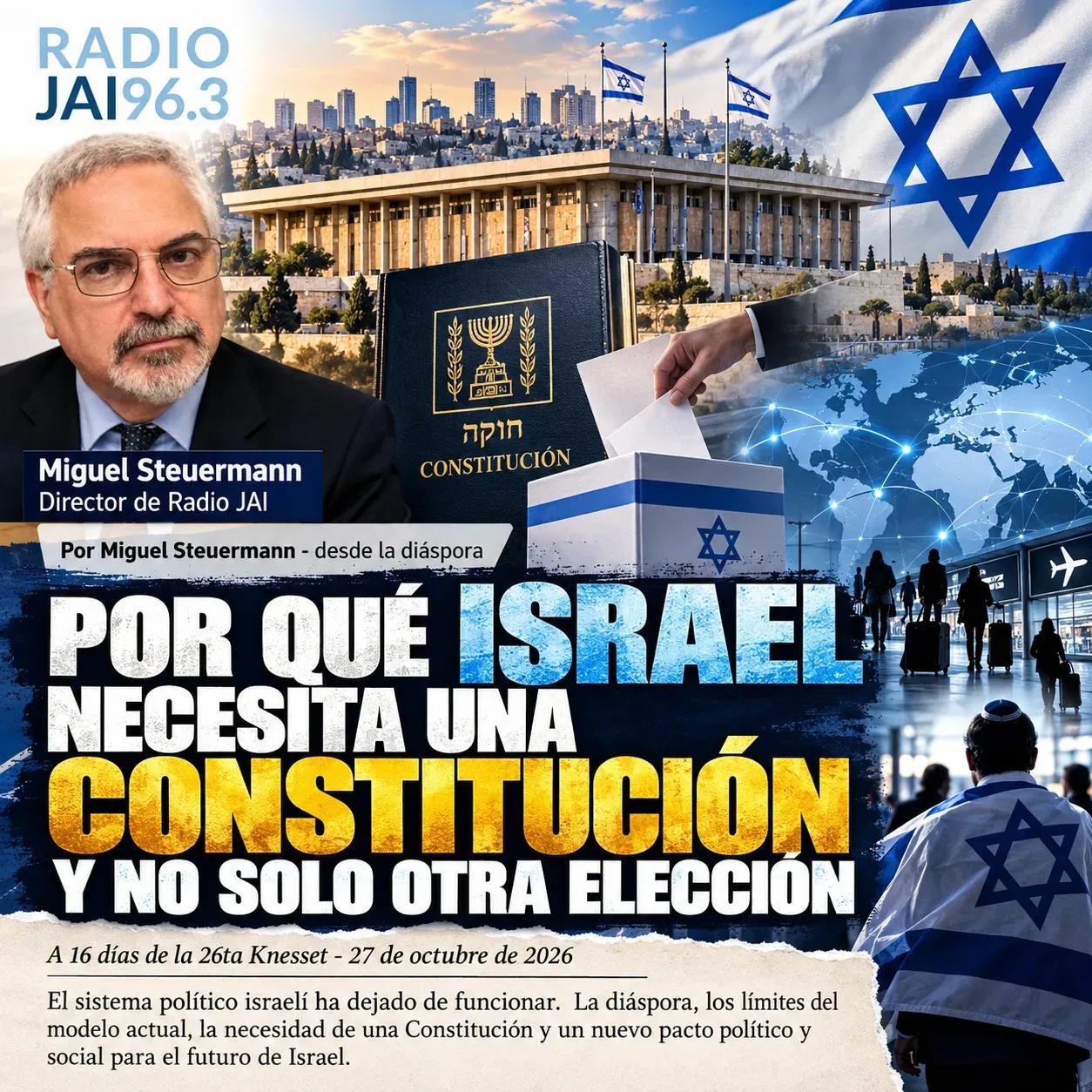
Approaching 80 years, Israel requires what it has never had: a Constitution and a different political system.
A Constitution is not a luxury for jurists. It is what protects the majority from the minority and the minority from the majority. It sets rules of the game that are not changed every Tuesday night to save a minister. Today, Israel is governed by Basic Laws that any occasional majority of 61 can overturn. That is not stability. It is legalized anarchy.
And it requires a system that does not reward extreme fragmentation. A threshold of 5 or 7% if it continues with the parliamentary model.
On the diaspora, the world has already invented models: France elects 11 deputies and 12 senators from its citizens abroad. Italy 8 and 4 in four worldwide constituencies. Portugal, Croatia, Colombia, Ecuador with 6, Dominican Republic with 7. It is not eccentricity. It is the norm in countries with a diaspora.
25 years ago I was called to Kol Dor, designed by brilliant young Israelis who invited young Jews from around the world. Even then we proposed that the President of Israel, a symbolic figure above politics, be elected by all the Jewish people. A way for the 8.5 million in the diaspora to feel that we participate in something and that forced candidates to campaign for the Jewish world and, above all, to know and listen to it.
There are more drastic proposals: that 20% of the Knesset be elected among Jews from the diaspora and Israelis abroad.
Everything requires debate. But above all, it requires an awareness that the model that worked yesterday may not be the right one today, and that there are 7 million Jews abroad whose interests do not always coincide with those of the current government in Jerusalem and who deserve an institutional channel, not just an emotional one.
And here I want to close with this:
The art of politics is to exclaim that one wants to change in order to change nothing, or to change only if it benefits me. It is the art of day-to-day survival.
The art of statesmen is different. It is to recognize the underlying problems and propose solutions thinking of the next decades and the next generations, even at the cost of votes today.
Israel had statesmen in 1949 who founded a State without a Constitution because survival was the imperative. Today, at 80, it needs statesmen who have the courage to propose a Constitution and a new political and social pact.
Maybe it is time for Israel not only to vote for parties but to offer its population options for the future to be voted on in a referendum. Constitution yes or no. Electoral system. Diaspora vote. As serious democracies do when what is at stake is not a government, but the country.
Miguel Steuermann, Director of Radio JAI, the radio of the Jewish community in Latin America

Comments