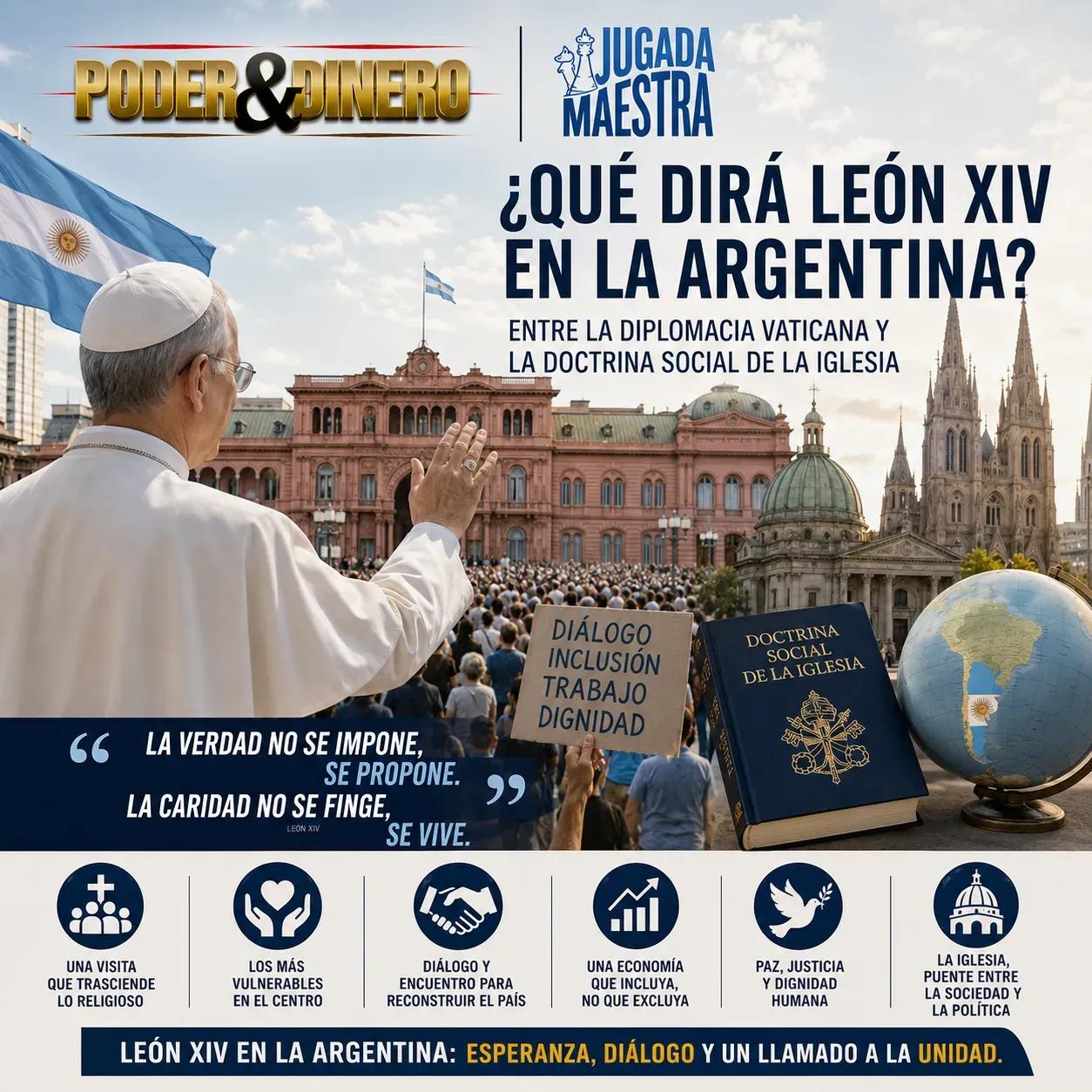
What will Leo XIV say in Argentina? Between Vatican diplomacy and the social doctrine of the Church
The potential visit of Pope Leo XIV to Argentina awakens an expectation that transcends the religious sphere. In a country marked by deep political polarization, a severe economic transformation, and intense debate about the role of the State, every word from the Pontiff will be closely observed by the Government, the opposition, the Church, and the international community.
The big question is not just whether he will come, but what he will say.
The Argentine Church has already taken a position
During the national celebrations of May 25 and July 9, the Archbishop of Buenos Aires, Jorge García Cuerva, delivered homilies that many interpreted as a warning about the moment the country is going through.
Without directly mentioning President Javier Milei, his messages focused on some recurring themes:
the rise of poverty;
social exclusion;
the loss of the culture of encounter;
the need for political dialogue;
the responsibility of leadership towards those left out of economic development.
These were not partisan speeches. They were, rather, a reaffirmation of the Social Doctrine of the Church, which historically places human dignity, work, and solidarity at the center of reflection.
At the same time, numerous Argentine bishops have expressed similar concerns at different times regarding the social consequences of economic adjustments and the increasing vulnerability of broad sectors of the population.
Will Leo XIV follow this path?
So far, the new Pontiff has avoided getting involved in national political debates.
However, his early public interventions allow us to identify some constants:
defense of peace;
concern for wars and human displacements;
priority for the most vulnerable;
rejection of polarization;
the need to rebuild trust between institutions and society.
This is not new language.
It is part of the Church's tradition since Leo XIII, the author of the encyclical Rerum Novarum (1891), considered the starting point of modern Social Doctrine.
Precisely for this reason, it seems unlikely that Leo XIV will travel to Argentina to make a partisan intervention or issue a direct judgment on the government of Javier Milei.
Vatican diplomacy rarely operates that way.
A criticism without proper names
The Holy See usually formulates universal principles that each society then interprets according to its own political reality.
Therefore, a possible papal message could address issues such as:
the dignity of work;
the fight against poverty;
social inclusion;
access to education;
the responsibility of leadership;
dialogue as a condition for democratic coexistence.
None of these concepts would necessarily imply a condemnation of the government's economic program.
But it would not be strange for many to interpret them as a critical observation if they coincided with the concerns currently raised by various sectors of the Argentine Church.
The dilemma of Milei
The government has considerably moderated its relationship with the Church compared to the beginning of the term.
The harsh criticisms that Javier Milei directed at Pope Francis years ago are now behind us.
Today, the Casa Rosada understands that a papal visit would have enormous institutional and international value.
Consequently, the government will seek to present any message from the Pontiff as a support for institutional stability and national dialogue.
The opposition will likely emphasize any references to poverty, inequality, or exclusion.
That is to say, the same speech could be read in completely different ways.
A new chapter in the relationship between Church and State?
There is, moreover, a historical aspect.
During Pope Francis' pontificate, the relationship between broad Argentine political sectors and the Vatican was marked by partisan interpretations that often overshadowed the pastoral content of his messages.
Leo XIV seems determined to avoid that scenario.
His style, more sober and less confrontational, suggests a greater distance from national political disputes.
This does not mean abandoning the Social Doctrine of the Church.
It means expressing it through language less associated with the context and more oriented to permanent principles.
More than a pastoral visit
The potential visit of Leo XIV will inevitably have a political dimension, even if he does not intend it.
Every gesture will be observed.
Every photograph will be analyzed.
Every word will be interpreted.
However, reducing the visit to a mere support or questioning of the government would ignore how the Holy See has historically developed its international action.
Popes do not usually travel to intervene in electoral campaigns or to support specific economic programs.
They travel to remind principles they consider permanent.
And precisely there lies the true question.
If Leo XIV speaks of poverty, inclusion, work, dialogue, and human dignity, is he questioning the Argentine government?
Or is he simply reiterating a teaching that the Church has maintained for over a century?
Perhaps the answer depends less on the content of the message than on the willingness of each political actor to listen to it.
In a deeply divided Argentina, even the most universal words can become the center of political debate.
Power & Money
Comments