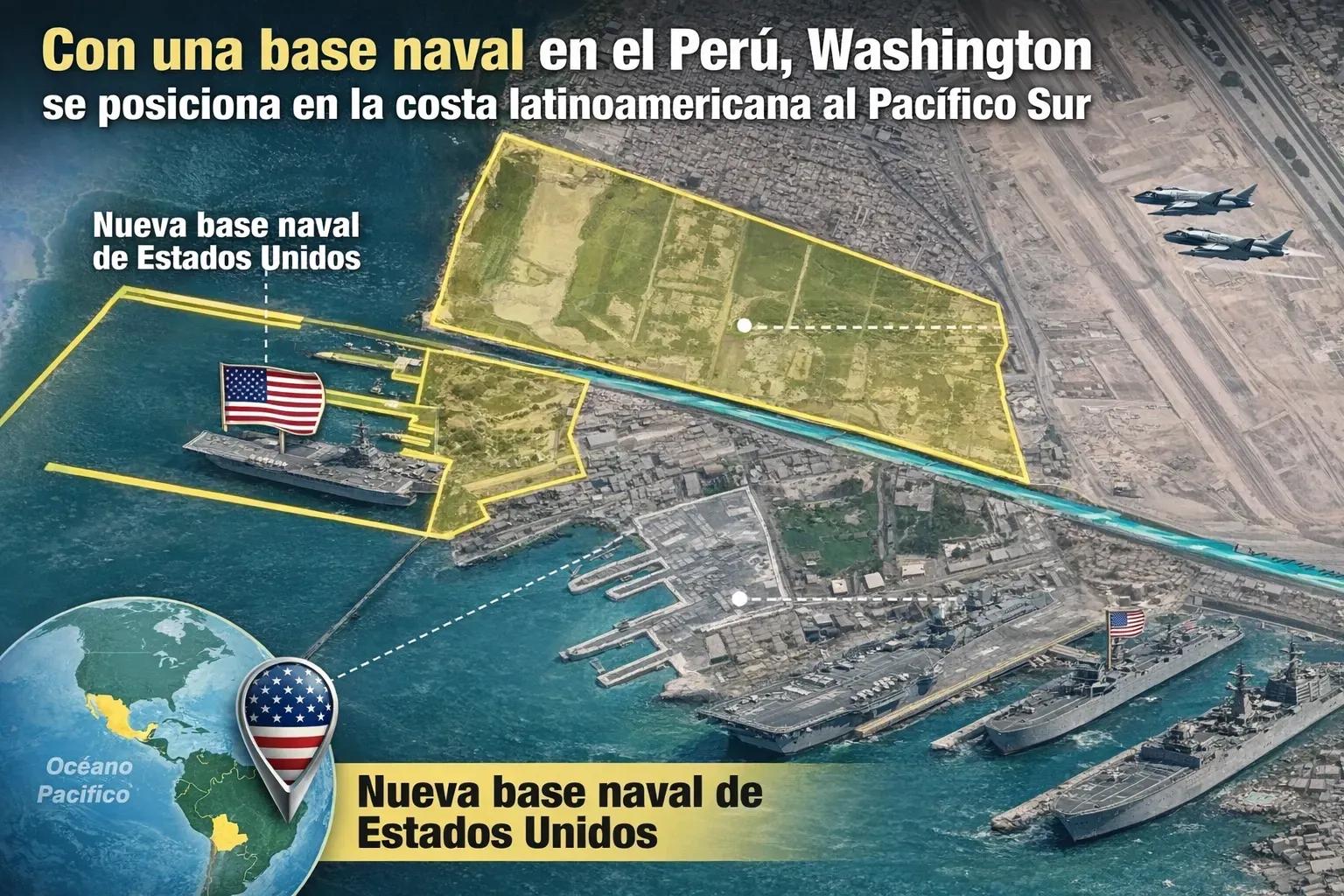
The central coast of Peru has become a privileged stage for global geopolitical competition. The decision by the United States Government to authorize a cooperation agreement for the comprehensive modernization of the Callao Naval Base, the main installation of the Peruvian Navy, not only redefines the bilateral relationship in defense matters but also projects its effects far beyond the strictly military scope. In a context of growing rivalry with China, Washington is again focusing on the Western Hemisphere, particularly on the strategic axis of the Pacific Ocean.
The project, approved by the State Department and notified to the U.S. Congress in January 2026, includes a possible Foreign Military Sale (FMS) amounting to a maximum of $1.5 billion. Unlike other defense agreements, this does not involve the acquisition of heavy weaponry or the formal establishment of a foreign base with permanent troops, but rather a broad package of services and equipment aimed at the design, construction, and modernization of maritime and land infrastructures in Callao. The declared objective is to strengthen the logistical and operational capabilities of the Peruvian Navy, adapting them to contemporary standards and the demands of a region increasingly exposed to global dynamics.
The initiative envisions a profound transformation of the current naval base, much of whose facilities date back to the mid-20th century. The modernization aims to reorganize spaces, optimize access, and improve the functionality of docks, maintenance areas, and operational buildings. A central element of the plan is the reduction of overlap between civil and military activities, a historical problem in Callao, where the naval base coexists with the country's main commercial port. By freeing and redistributing strategic areas, the project would also facilitate the expansion of the civil port, key for Peru's foreign trade.
From a technical standpoint, the agreement includes engineering studies, life-cycle planning for the facilities, comprehensive project management, and supervision of the works over a period that could extend up to ten years. For this, the presence in Peru of up to twenty U.S. representatives is planned, including government officials and specialists from contractors authorized by the Pentagon. Their role will be strictly technical and advisory, as emphasized by Washington authorities, who insist that the operation will not alter the regional military balance.
The location of the base gives the project a singular strategic relevance. Callao faces Lima, concentrates most of the country's maritime traffic, and is located less than 80 kilometers from the megaport of Chancay, a continental-scale infrastructure driven and financed by Chinese capital. Recently inaugurated as one of the most ambitious nodes of Beijing's logistics projection in South America, Chancay symbolizes China's growing economic influence in the region and its bid to control crucial points of Pacific trade routes.
It is precisely in this context that the U.S. investment acquires a broader geopolitical dimension. The U.S. National Security Strategy for 2025 identifies the Western Hemisphere as a priority space, underscoring the need to counter the influence of extra-hemispheric powers and to ensure that strategic assets do not fall under the control of global competitors. While not explicitly mentioning China in every section, the document reflects a growing concern about Beijing's presence in critical infrastructures, from ports to telecommunications and energy, in Latin America and the Caribbean.
The modernization of the Callao Naval Base can thus be read as an indirect but forceful response to that expansion. By strengthening its cooperation with Peru in naval and logistical matters, Washington seeks to consolidate a strategic partner on the South American Pacific coast and maintain its capacity for influence in a region where trade with Asia is steadily increasing. The initiative fits into a broader logic of U.S. repositioning, which some analysts interpret as a pragmatic update of the old Monroe Doctrine, adapted to a multipolar world and an increasingly overt rivalry with China.
For Peru, the agreement presents opportunities and dilemmas. From an internal perspective, the investment promises to modernize a key infrastructure, energize sectors linked to construction and engineering, and strengthen the capabilities of its Navy without resorting to direct arms purchases. It also reinforces a historical relationship with the United States in defense matters, a cooperation that has been maintained for decades, especially in areas such as maritime security and the fight against transnational threats.
However, the project also requires Lima to manage its foreign policy cautiously. China is currently Peru's main trading partner and a central actor in its strategy for global economic insertion. The coexistence of a strong Chinese presence in civil port infrastructures and reinforced military cooperation with the United States makes the Peruvian coastline a space of delicate balance, where any movement can be interpreted as a strategic alignment. The traditional Peruvian aspiration to maintain a strictly non-aligned policy thus faces the tensions inherent in a global rivalry that is increasingly expressed in the field.
Criticism has not taken long to appear. Some sectors warn that the prolonged presence of U.S. advisors and contractors, though limited in number and functions, could set a precedent for greater external interference in defense matters. Others point to the risk of Latin America becoming a stage for disputes between major powers, with cooperation projects turned into pieces of a geopolitical board that exceeds national priorities.
Nonetheless, the modernization of the Callao Naval Base marks a turning point. More than an infrastructure project, it is a symbol of the return of Latin America —and the South Pacific in particular— to the center of Washington's strategic concerns. In a world beset by competition between the United States and China, the Peruvian port is emerging as one of the scenarios where this rivalry is materializing most clearly, anticipating a decade in which geopolitics will once again look attentively towards the shores of South America.
Adalberto Agozino holds a PhD in Political Science, is a lecturer at the University of Buenos Aires, and is an International Analyst.

Comments