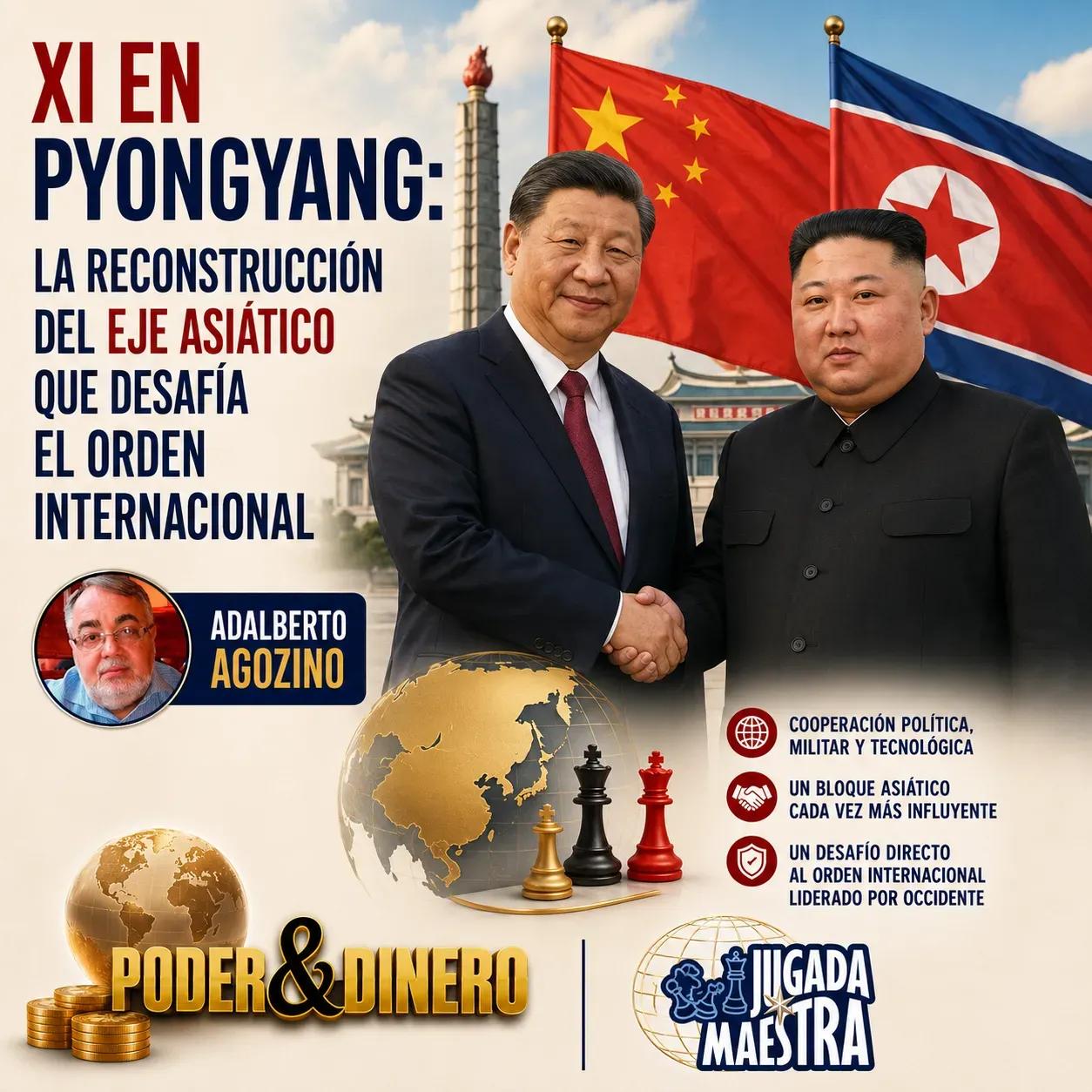
The arrival of Xi Jinping in North Korea to meet with Kim Jong-un constitutes one of the most significant diplomatic events of 2026. Although the trip was officially cloaked in references to the historical friendship between both countries, the real implications of the visit vastly transcend the bilateral scope. Behind the speeches about economic cooperation, socialist camaraderie, and regional stability lies a complex dispute over the configuration of power in Asia and, ultimately, the very nature of the emerging international order.
During two carefully choreographed days in Pyongyang, Xi and Kim agreed to deepen political, economic, and strategic cooperation, reaffirming a relationship that both regimes describe as a friendship "forged in blood". The symbolism was evident in every detail: the visit to the Friendship Tower dedicated to Chinese soldiers who fell during the Korean War, the tour of ideological training centers of the Workers' Party, and the gestures aimed at showing a harmony that had been increasingly questioned in recent years due to North Korea's growing proximity to Russia.
The historical importance of Sino-North Korean relations is difficult to exaggerate. Since China's intervention in the Korean War between 1950 and 1953, the survival of the North Korean regime has been closely linked to support from Beijing. The entry of hundreds of thousands of Chinese soldiers into the peninsula prevented the collapse of communist forces and sealed a strategic alliance that has lasted for over seven decades. That war turned North Korea into a key piece of the Chinese security system, a kind of buffer state between the mainland of China and the U.S. forces deployed in South Korea.
However, that relationship has never been without tensions. Under Kim Jong-un's leadership, Pyongyang developed a more autonomous foreign policy than that of its predecessors. Nuclear tests, ballistic missile launches, and the execution in 2013 of Jang Song-thaek — considered by Beijing one of its main interlocutors within the North Korean regime — significantly deteriorated mutual trust. For several years, Xi avoided meeting with Kim and even visited South Korea first, a gesture interpreted in Pyongyang as a diplomatic humiliation.
Reconciliation began in 2018 when international sanctions and economic difficulties forced Kim to seek Chinese support again. Since then, contacts have intensified, although a new factor altered the equation: the rapprochement between Pyongyang and Moscow following the Ukraine war. The signing of a mutual defense treaty between North Korea and Russia in 2024 and the sending of North Korean troops to support Russian forces profoundly transformed the regional strategic dynamic.
Precisely for this reason, many experts believe that Xi's main objective during this visit was to regain influence over an ally that was beginning to partially escape the Chinese orbit. Scholar Ankit Panda has pointed out that Beijing seeks to ensure that its strategic interests remain protected in North Korea as Moscow increases its political and military presence in the country. An excessively reliant North Korea on Russia would reduce China's ability to shape the evolution of the Korean peninsula.
The economic dimension of the relationship explains much of this concern. China continues to be, by far, North Korea's main trading partner. Most of the food, fuel, machinery, and consumer goods imports arriving in North Korea come from the Chinese market. Chinese exports to Pyongyang recently reached levels not seen since before the pandemic, while railway connections and economic cooperation projects suspended for years were reactivated.
For Kim Jong-un, maintaining a close relationship with Beijing remains a strategic necessity. Russia may provide armaments, military technology, and political support, but it lacks the economic capacity to replace the role that China plays as the structural support of the North Korean economy. The regime's survival continues to depend largely on access to the Chinese market and Beijing's tolerance regarding the enforcement of international sanctions.
Nonetheless, the most significant aspect of the visit likely lies in the realm of security. One of the elements that caught the attention of international observers was Xi's emphasis on expanding strategic coordination, military exchanges, and security cooperation. Even more revealing was the absence of explicit references to the denuclearization of the Korean peninsula, a goal that China had formally defended for decades.
For analysts like Leif-Eric Easley or Lim Eul-chul, this omission can be interpreted as a signal that Beijing is adapting its policy to a new reality: the tacit acceptance of North Korea as a de facto nuclear power. It does not necessarily mean an open endorsement of the North Korean atomic program, but it does reflect that for China, the current priority is strategic stability against the United States and its allies, even if it means coexisting with a nuclearized North Korea.
The consolidation of closer military cooperation between China and North Korea would have profound consequences for regional security. Washington, Seoul, and Tokyo observe any signs of strategic convergence between the two countries with concern. Increased coordination could strengthen Pyongyang's deterrent capability and complicate U.S. defensive plans in Northeast Asia. Additionally, it could accelerate the integration of South Korea and Japan's security systems with U.S. forces, fueling a new spiral of military competition.
The visit becomes even more relevant when viewed from the broader perspective of the Asia-Pacific. In recent years, China has faced an increasingly hostile strategic environment. U.S.-led alliances, trilateral cooperation between South Korea, Japan, and Washington, the strengthening of mechanisms like the Quad, and tensions surrounding Taiwan have increased the sense of strategic encirclement in Beijing.
In that context, North Korea acquires extraordinary geopolitical value. As researcher Victor Cha has pointed out, for China it is preferable to maintain a stable and strongly armed allied state on its northeastern border than to face the possibility of a unified Korean peninsula under U.S. influence.
The relationship with Russia constitutes another central element of this equation. Although China and Russia maintain an increasingly close strategic partnership, there is also a silent competition for influence in certain areas of Eurasia. Moscow's rapprochement with Pyongyang has provided Kim Jong-un with new diplomatic and economic alternatives. However, Xi's visit can be interpreted as a reminder that China still considers North Korea an essential part of its strategic sphere of influence.
The interaction with India and Pakistan adds an additional dimension to the analysis. China maintains a close strategic partnership with Pakistan, regarded for decades as one of its primary allies in Asia. The China-Pakistan Economic Corridor, military cooperation, and diplomatic convergence make Islamabad a fundamental piece of China's strategy to balance the power of India.
New Delhi, in turn, observes with growing unease the consolidation of a strategic space integrated by China, Russia, North Korea, and Pakistan. Although India maintains relatively cordial relations with Moscow and participates along with China in multilateral forums like BRICS, Sino-Indian rivalry continues to be one of the main factors of geopolitical instability in Asia. The strengthening of ties between Beijing and Pyongyang can be perceived in New Delhi as a new manifestation of China's growing capacity to project influence simultaneously on several strategic fronts.
From a global perspective, Xi Jinping's visit to North Korea reflects the emergence of an increasingly multipolar world. The meeting does not represent the formation of a homogeneous ideological alliance comparable to Cold War blocs. Rather, it symbolizes the convergence of interests among actors who share the goal of limiting Western influence and promoting a redistribution of international power.
Xi himself has repeatedly insisted on the need to build a multipolar world order and oppose what he calls hegemonism. The visit to Pyongyang fully fits into that narrative. By showing himself capable of dialoguing simultaneously with Washington, Moscow, and Pyongyang, the Chinese leader seeks to project the image of an indispensable power for international stability and the resolution of major global conflicts.
However, this gamble carries significant risks. Excessive support for North Korea could further deteriorate China's relations with the United States, Japan, and South Korea. It could also fuel the regional arms race and reinforce the perception that Beijing is leading a revisionist bloc willing to question the prevailing international rules.
Xi Jinping's visit to Pyongyang, therefore, is not simply another episode of Asian diplomacy. It is a signal that China is redefining its strategic priorities in an international environment marked by great power competition. The recovery of influence over North Korea, the management of the relationship with Russia, the balance against India, and the strengthening of its position against the United States are part of the same equation. What is at stake is not only the future of the Korean peninsula but also the configuration of the balance of power that will define the 21st century.
Adalberto Agozino holds a PhD in Political Science, is an International Analyst, and a Professor at the University of Buenos Aires, Argentina.

Comments