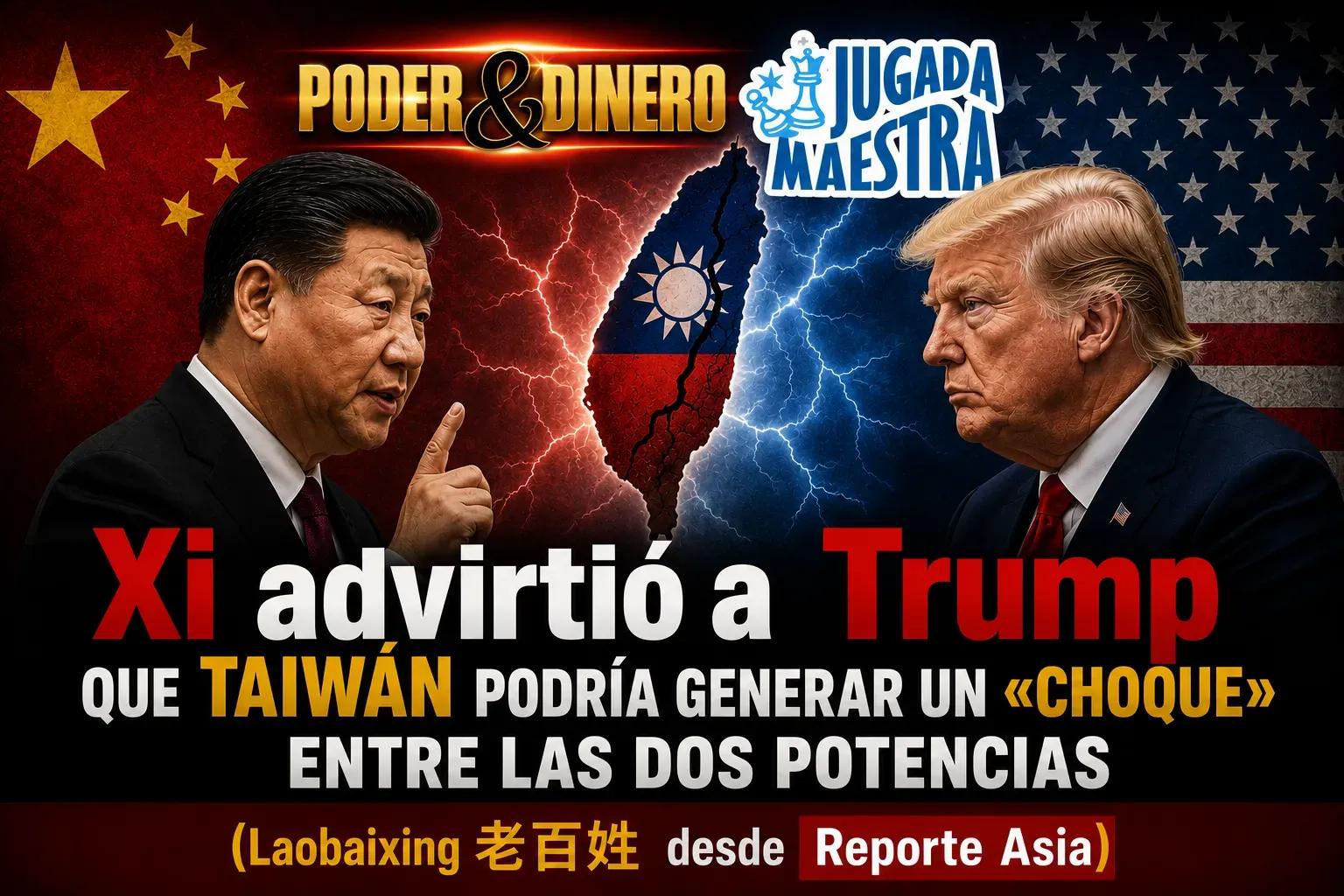
The most serious warning from the Beijing summit did not come in a statement or a technical document. It was delivered by Xi Jinping in the meeting room of the Great Hall of the People, at the beginning of the bilateral meeting on Thursday, May 14, looking at Trump: Taiwan is "the most important issue" in the ties between the two countries, and if handled "badly," the two powers risk a "collision" that could push "the entire China-U.S. relationship to a very dangerous situation." The state agency Xinhua spread the words. The White House's summary of the meeting—briefly described as "good"—did not mention Taiwan in any line.
The omission was eloquent. When Trump and Xi walked together on a tour of the Temple of Heaven and a journalist shouted a question about whether they had talked about Taiwan, the U.S. president did not respond.
The warning that nobody can ignore
Xi was explicit in two ways. First, about the consequence of mismanagement: the risk of a "collision" between the two largest military powers on the planet. Second, about the incompatibility of principles: "Taiwan's independence and peace in the Taiwan Strait are incompatible," he said, according to Xinhua. The formulation left no room for interpretive ambiguity.
The Taiwan Affairs Office of the mainland government had been even more direct in the run-up to the summit: "Our resolution to oppose Taiwan independence is as firm as a rock, and our ability to crush Taiwan independence is unbreakable." And the Chinese embassy in Washington had publicly listed four "red lines that should not be challenged," topped by Taiwan, before Trump's arrival in China.
The break with six decades of U.S. policy
What made Taiwan the most sensitive topic at this summit was a move by Trump prior to the trip. On May 11, the president posted on Truth Social that he would discuss U.S. arms sales to Taiwan with Xi, thereby breaking the so-called Six Guarantees that Washington has maintained since 1982, among which is the commitment not to consult with China about those transactions.
The statement generated immediate alarm in Taipei and expectation in Beijing. Analysts pointed out that raising that topic with Xi—even without offering concrete concessions—constituted in itself a gesture of enormous symbolic weight, as it enshrined the principle that the United States is willing to discuss arms sales to the island with China. Just months earlier, in December 2025, the Trump administration had approved an arms package for Taiwan worth $11.1 billion, which had deeply irritated Beijing.
What Trump did not say
The contrast between the Chinese position—explicit, documented, communicated through multiple channels before and during the summit—and the U.S. position—absent from the official summary, unanswered when directly questioned—generated opposing readings among analysts.
For George Chen, partner at The Asia Group for Greater China, Xi established at this summit "clear limits for Americans on what they can and cannot do with China." In the political dimension, Chen said, "there is zero tolerance for any ambiguity regarding Xi's opposition to Taiwan independence, and he makes the red line absolutely clear" directly in front of Trump.
The Mainland Affairs Council of Taiwan, which oversees Taipei's policy toward China, said on Thursday that up to that point "there had been no surprises" at the Beijing summit, and that Taipei was maintaining close contact with Washington regarding the discussions. The phrasing—no surprises—could be read as relief or as resignation to an agenda that Taiwan does not control.
The language that matters
Experts who followed the summit pointed out that one of the most significant possible outcomes would have been a change in Washington's declaratory language regarding Taiwan. The distinction is technical but enormously relevant: the United States has historically said that it "does not support" Taiwan independence, but it does not say that it "opposes" it. A shift toward "opposing" would be seen throughout the region as a significant victory for Beijing.
Nothing in the statements released on Thursday indicates that such a change has occurred. But the fact that Trump brought the issue of arms sales to the negotiating table with Xi—and that the U.S. summary of the meeting made no mention of Taiwan—left an open zone of uncertainty that Taipei, Tokyo, and Seoul will be closely monitoring in the coming hours.
Susan Thornton, a former diplomat and academic at Yale Law School, had anticipated this at a forum in Beijing in March: "President Trump is, of course, a master of visual narrative." The images of Trump and Xi strolling together through the Temple of Heaven, smiling, are part of that narrative. What was said—and what was not said—about Taiwan in the meeting room is the other part, the one that matters most.

Comments