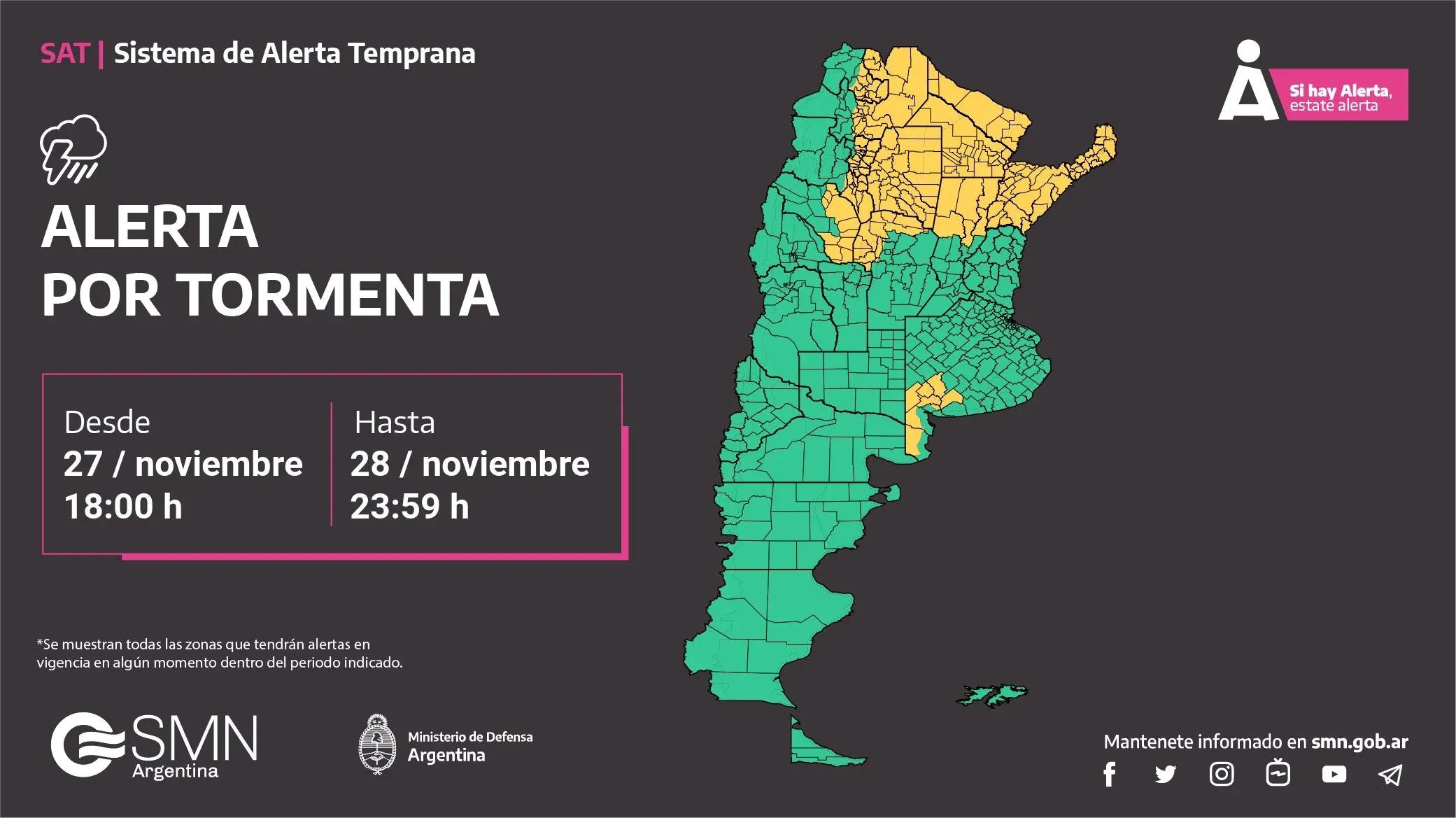
The recent yellow alert for severe storms affecting 18 Argentine provinces invites us to reflect on the climate vulnerability faced by the country. How do these extreme weather conditions impact our daily lives, our economy, and our public policies? This phenomenon is not just an isolated event but a manifestation of broader climate changes that require our immediate attention. The importance of this analysis lies in the need to understand the causes, consequences, and possible strategies to mitigate their effects in the future.
Current situation and context
According to the National Meteorological Service (SMN), a yellow alert for severe storms has been issued for much of the country, indicating that intense rainfall and strong winds are expected in various regions. This phenomenon has led to the activation of emergency plans in several provinces, where accumulations of up to 100 mm of rain have already been reported in some areas, which may cause local flooding. The SMN indicates that these conditions are conducive to the formation of hail and thunderstorms, which increases the risk for the population and infrastructure. In this context, it is crucial to examine how similar situations have been managed in the past and what lessons we can learn.
Analysis of causes and factors
The increase in the frequency and intensity of severe storms can be attributed to several climatic factors. Firstly, global climate change has altered traditional weather patterns, increasing the average temperature of the planet. According to a study published by the Intergovernmental Panel on Climate Change (IPCC), global temperatures have risen by approximately 1.1 °C since the late 19th century, contributing to extreme weather phenomena. Additionally, local factors such as deforestation and uncontrolled urbanization exacerbate this situation by reducing the soil's capacity to absorb water and increasing the risk of flooding.
Historically, Argentina has faced similar extreme climate events; however, the current combination of climatic and human factors seems to be more intense. For example, during the weather event known as "El Niño" in 2016, torrential rains were recorded in various provinces with devastating consequences for thousands of households.
International comparison and global impact
The Argentine situation is not unique; other countries also face similar challenges due to climate change. For instance, Brazil has experienced a significant increase in extreme weather events: according to data from the National Institute of Meteorology (INMET), rainfall has increased by 30% in certain regions since 2000. In Europe, events such as the devastating floods in Germany in 2021 highlight how these phenomena can have severe economic and social repercussions.
Lessons learned internationally indicate that an effective response requires not only immediate measures during emergencies but also long-term planning that considers sustainable urban development and stricter environmental policies. In Argentina, it is essential to adopt a similar approach to mitigate the future effects of extreme weather.
Implications and consequences
The implications of severe storms are profound. Economically, losses can be significant; according to recent estimates from the World Bank, natural disasters could cost Argentina up to $10 billion annually if adequate mitigation strategies are not implemented. This includes damage to critical infrastructure such as roads and bridges, as well as significant agricultural losses that directly affect local producers.
Additionally, socially these events can exacerbate existing inequalities; vulnerable communities are often the hardest hit due to their geographical location and lack of resources to recover. The government’s response also plays a crucial role: ineffective management can lead to social discontent and erode public trust in institutions.
Strategic perspective and future outlook
Looking forward, it is essential to establish a comprehensive strategy that addresses both the symptoms and underlying causes of climate change. This includes investments in climate-resilient infrastructure, education on environmental sustainability, and proactive policies to reduce greenhouse gas emissions.
The challenge is considerable but not insurmountable; there are opportunities to foster a green economy that not only mitigates environmental impact but also generates sustainable jobs. International cooperation will be key; Argentina could greatly benefit from sharing knowledge and resources with other countries affected by similar phenomena.
In conclusion, as we face this yellow alert for severe storms, let us remember that every challenge brings with it an opportunity to reinvent ourselves. Technology does not replace humanity; it amplifies it if we know how to use it. It is about finding that balance between adaptation and innovation to build a more resilient future against the onslaught of climate.
---

Comments