The recent history and its main cultivator
Born in Buenos Aires on December 16, 1946, Yofre embodies a unique training: journalist, essayist, diplomat, historian, and politician, with the rare privilege among intellectuals of having directed the State Intelligence Secretariat (SIDE) during Carlos Menem's government, from 1989 to 1990. Subsequently, he served as ambassador in Panama and Portugal, and in June 2024, he was appointed by President Javier Milei as director of the National School of Intelligence. His extensive network of contacts, forged over decades in politics, diplomacy, and journalism, has allowed him access to top-level testimonies and documents.
His lineage places him at the heart of the Argentine patriciate. Great-nephew of Felipe Yofre Pizarro[i], minister of General Julio A. Roca during his second presidency; grandson of the prestigious physician Dr. Carlos Bonorino Udaondo[ii]; and son of Felipe Yofre Hueyo[iii], first ambassador of the Liberating Revolution in Paraguay and later in Peru. His mother, María Cristina Bonorino, was a prominent figure in the Ceremonial Directorate of the Ministry of Foreign Affairs for decades. The family tradition continued with his brothers: Felipe, a close collaborator of Vice President Vicente Solano Lima during the presidency of Héctor J. Cámpora, and Ricardo, a radical leader, son-in-law of José Luis Cantilo[iv] and General Secretary of the Presidency during Jorge Rafael Videla's government.
This early immersion in politics was complemented by his time at the General San Martín Military Lyceum and the National Military College —where he shared his promotion with figures such as Roberto Bendini— which allowed him to understand the unwritten rules of the military world and earn the respect of many uniformed personnel, who consider him “one of their own.”
Methodology: between oral history and archives
In his works, Yofre combines two contemporary historiographical approaches: oral history, which recovers unpublished anecdotes, off-the-record and intimate accounts that humanize the protagonists, and extensive documentary work that he colloquially describes as “making history with papers.” He has intensively exploited declassified archives —including those of American historian Robert Potash and those of Lieutenant General Alejandro A. Lanusse, provided by his children— and has gathered private documents from key figures of national politics, enriched with oral testimonies from direct witnesses.
Since the publication in 2006 of Nobody Was —a compilation of articles from Ámbito Financiero that became an immediate bestseller—, Yofre positioned himself as the most read historian in the country. With nearly twenty books in the last two decades, eight of them bestsellers, his production covers the most controversial themes of recent Argentine history: political violence of the seventies, the National Reorganization Process, the Falklands War, the role of Cuba and the communist international, and the figure of Ernesto “Che” Guevara. Works like We Were All, 1982, The Madrid Plot, Cuba Was, or The Trap have marked milestones in public debate.
The Generals: an immersion in the military corporation
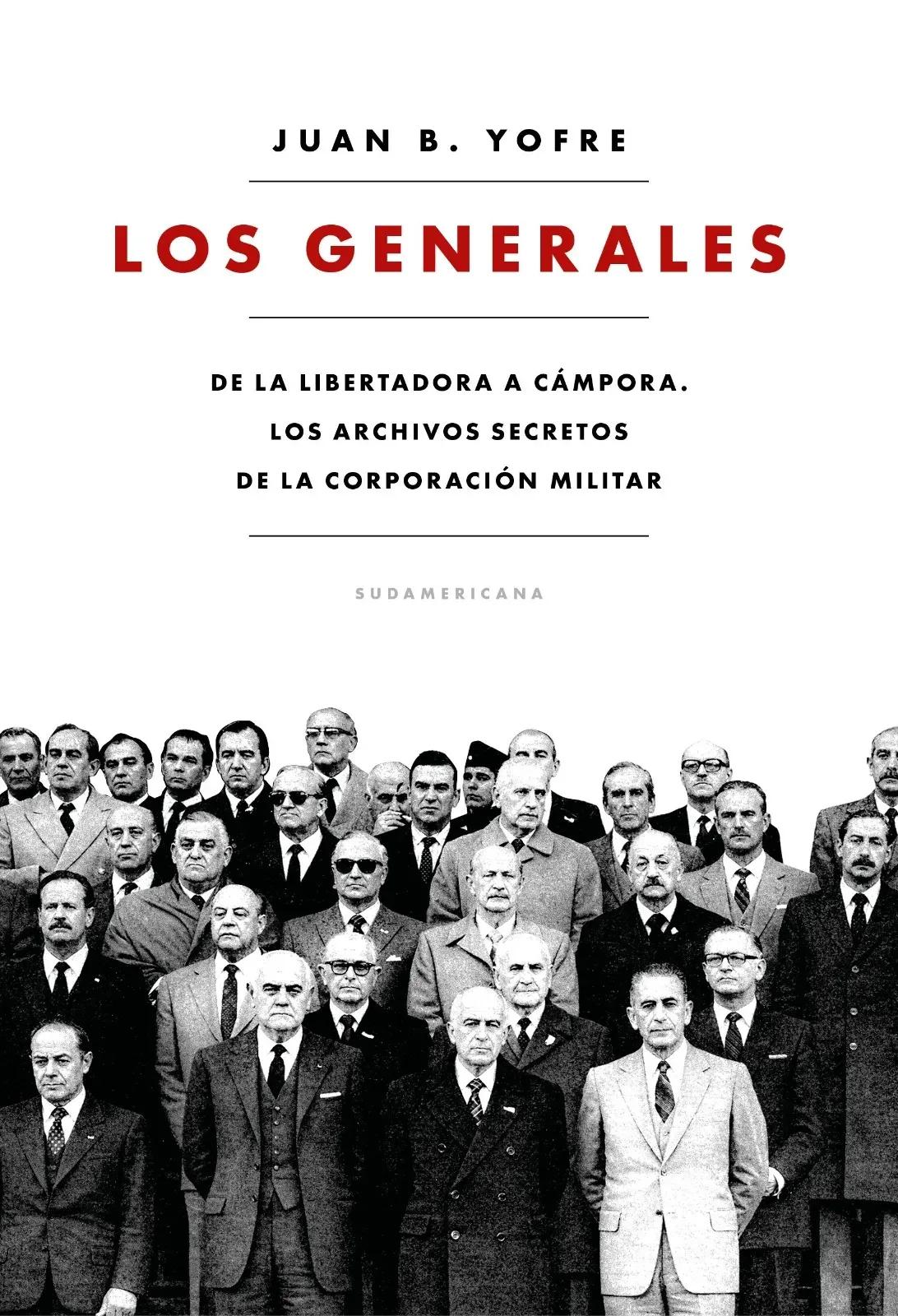
The Generals. From the Liberating Movement to Cámpora. The secret files of the military corporation is his longest book to date: 720 pages distributed in a preface and fifteen chapters. It covers the period from the overthrow of Juan D. Perón in September 1955 to the return of Peronism to power in 1973, under the leadership of Héctor J. Cámpora as the exiled leader's delegate.
The text meticulously reconstructs the military interventions in what could be termed “the anti-Peronist Argentina”: an era of chronic instability in which no civil or military government lasted more than three years. It was a time marked by the proscription of Peronism, the exile of its leader, and the emergence of a true “party of generals” that acted as a de facto power, capable of conditioning, overseeing, or overthrowing constitutional governments. Yofre exposes the internal intrigues of the military corporation, its tensions with the Peronist leadership in exile, and the hidden mechanics that contributed to Argentina's decline in the second half of the 20th century.
Armed with previously unpublished local and foreign documents, personal archives never before revealed, exclusive interviews, and a wealth of bibliographical sources —along with his own experience as a privileged witness— the author describes without euphemisms or pre-judgments the power plots, conspiracies, and decisions that defined one of the most turbulent cycles in our history. The book portrays a bipartite Argentina in its real centers of power: Buenos Aires, dominated by the generals, and the place in the world where Perón was found.
His engaging and fluid prose, peppered with revealing anecdotes and striking images, transforms the 720 pages into a captivating and accessible read. For those who lived through that era, the volume allows one to relive events with an unprecedented depth and a “secret plot.” For younger generations, it represents an exceptional opportunity to learn about a history that is often not taught in secondary or university classrooms.
An essential contribution
Yofre does not shy away from uncomfortable topics. His research on revolutionary and counter-revolutionary violence, the Cuban role in the region, and other controversial episodes led to political and judicial persecution during the Kirchnerist governments. However, his work is anchored in rigorous documentation and a commitment to historical truth that transcends slogans.
The Generals undoubtedly ranks among the best of his production. Some will consider it his magnum opus; others will prefer Nobody Was, The Madrid Plot, or Cuba Was. Each reader is entitled to their preferences, but no one aspiring to understand recent Argentine history can afford to overlook this book.
Final recommendation: an unmissable, rigorous, documented, and passionate work that enriches the national historiographical heritage and invites deep reflection on the causes of our tumultuous institutional trajectory.
[i] FELIPE YOFRE: (Córdoba, September 2, 1848 – Buenos Aires, 1939) was an Argentine lawyer and politician who held various political and judicial positions, including Minister of the Interior and briefly Minister of Foreign Affairs during Julio Argentino Roca's second presidency.
[ii] Dr. Carlos Bonorino Udaondo (1884-1951) was a pioneering Argentine physician and national reference in the study and treatment of digestive diseases. He promoted the creation of the Argentine Society of Gastroenterology and founded in 1938 the “Dr. Carlos Bonorino Udaondo Gastroenterology Hospital,” the first specialized center in Latin America, located in Barracas, Buenos...
[iii] FELIPE YOFRE HUEYO (Buenos Aires 1909 – Lima 1961) was president of the Democratic Party and secretary of the national committee. In 1951, he participated in the military uprising of General Benjamin Menéndez during Juan D. Perón's first government. He was the unifying factor of strong personalities, thanks to his impeccable tact and diplomacy. In times of trial, Felipe Yofre experienced imprisonment, having been thrown into jail several times without cause, which he endured with remarkable fortitude, supported morally by his partner, the incomparable Cristina Bonorino de Yofre. On another occasion, he had no choice but to hide for several months in Corrientes, sheltered by his friend Elías Abad. After the revolution of 1955, Yofre served as ambassador in Paraguay first, and later in Peru, where he brought his historical knowledge, the unique style of a first-rate politician, and the affability that tempered his robust character to serve the country. He died prematurely, after a surgical operation, at the age of 50. He left many friends distraught, the conservatives without a leader of his stature and the Argentine nation without a man of democracy who would have been particularly useful to strengthen it. His seven children continued to honor a lineage of service to the Fatherland.
[iv] José Luis Cantilo was a political leader and Argentine official linked to the universe of the Civic Radical Union (UCR). He was born on May 21, 1909, in Buenos Aires, in a family tied to the radical tradition. He was the son of José Luis Cantilo, a prominent figure of yrigoyenismo, which early on marked his entry into political life. In 1962, during José María Guido's provisional presidency, he was appointed Minister of Defense amid the crisis between military factions known as “blues” and “reds.” Subsequently, during the constitutional government of Arturo Umberto Illia (1963–1966), Cantilo was appointed to head the Industrial Bank of the Argentine Republic. Even after the coup d'état of 1966 that overthrew Illia, Cantilo continued to be called by various de facto governments due to his technical profile. In 1972, during Alejandro Agustín Lanusse's presidency, he participated in tasks related to the renegotiation of Argentina's external debt, a central issue on the economic agenda at the time. He passed away on June 13, 2003, having experienced almost the entire 20th century and being a witness —and partly an actor— of its main political transformations in Argentina.
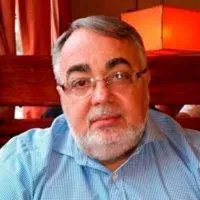
Adalberto Agozino holds a PhD in Political Science, is an International Analyst, and a Lecturer at the University of Buenos Aires
Comments