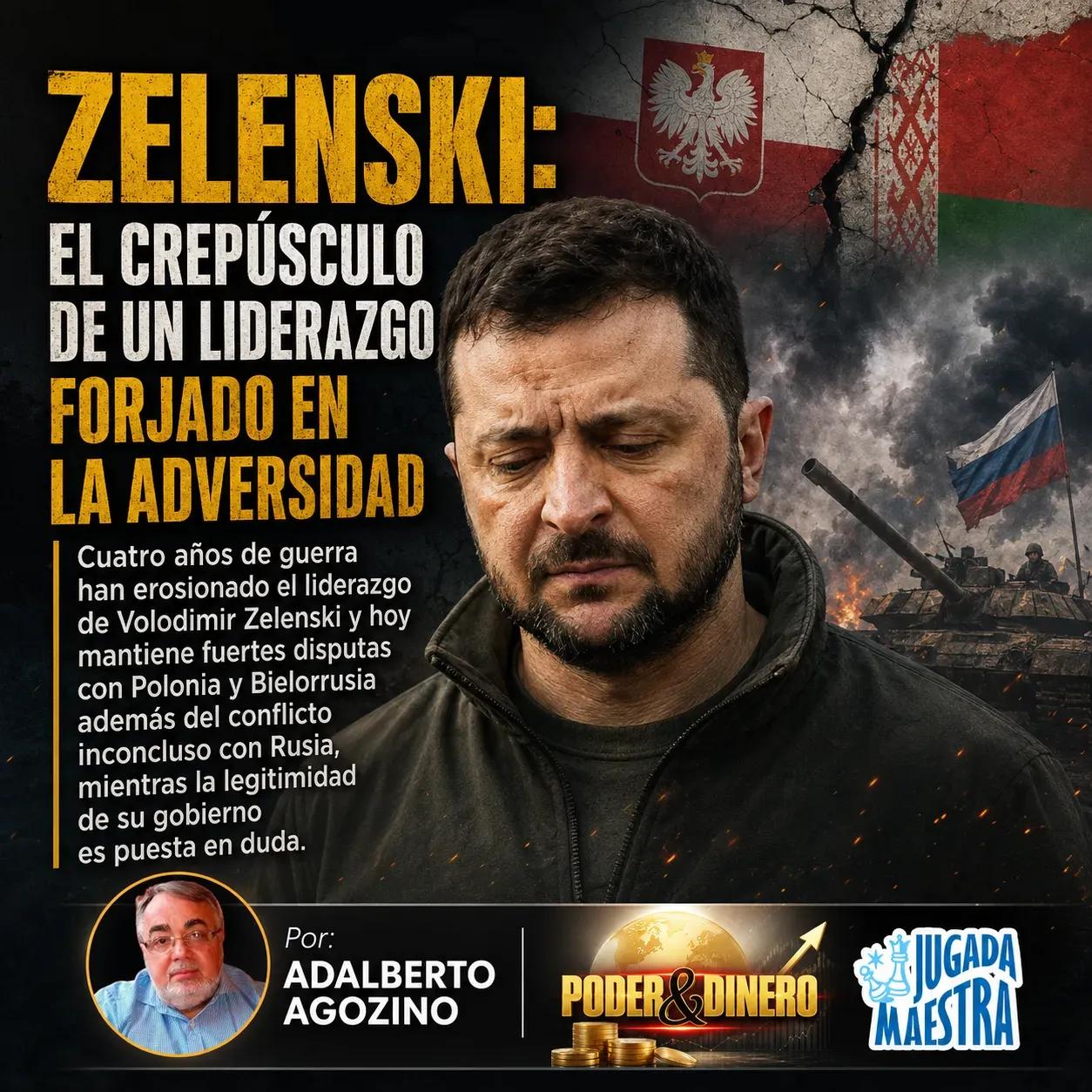
On the verge of a conflict that has already lasted over four years, Volodymyr Zelensky's trajectory starkly illustrates the inherent paradoxes of any prolonged war: how the unifying symbol of national resistance can be eroded by the inexorable weight of weariness, internal fractures, and the complexities of relentless geopolitics. The former comedian who, in 2019, embodied the hope for anti-corruption renewal and peace in the Donbas has become, for many, the emblem of a besieged Ukraine; however, in 2026, his leadership faces questions that transcend the battlefield and put the very resilience of the Ukrainian state to the test.
The national unity that characterized the early days of the Russian invasion in February 2022 was undoubtedly Zelensky's main bulwark. That unprecedented cohesion allowed a historically fragmented country to present itself to the world as a monolithic block in defense of its sovereignty. Nevertheless, as analysts of prolonged conflicts warn, attrition wars tend to reveal fissures that the initial urgency kept latent. The continuous mobilization of human resources, the economic stagnation, human losses, and the fatigue stemming from strategic uncertainty have begun to undermine that primordial unity.
In this context, the debate surrounding the constitutional legitimacy of the presidential mandate becomes particularly relevant. Critics, including voices sympathetic to Moscow and certain internal opposition sectors, argue that Zelensky's formal term expired in May 2024, constituting a democratic anomaly. The official position from Kyiv, backed by most Western governments and prominent constitutionalists, invokes the Ukrainian Constitution and martial law legislation, which expressly prohibit the holding of national elections in times of war. As Zelensky himself has reiterated, “allow a ceasefire of at least 60 days and we will hold elections”; a condition that underlines the practical impossibility of an electoral process under constant bombardment and with millions displaced and soldiers at the front.
Experts such as Anton Hrushetskyi, director of the Kyiv International Sociology Institute (KIIS), have highlighted that, while Zelensky maintains significant trust levels—around 60% in recent polls—this backing is more functional, linked to his role as a war leader, than personal or unconditional. Only a minority of his supporters would wish to see him continue in office after the war, reflecting a widespread desire for political renewal once peace is restored.
Politics
The military situation reinforces this dynamic of wear and tear. Although Ukraine has displayed remarkable innovative capacity—with long-range drone attacks against Russian infrastructures and the development of a domestic defense industry—the strategic reality is far from the initial optimism. Russia maintains substantial demographic, industrial, and territorial advantages in a war of attrition where the replenishment of troops and military production are decisive. Discussions about expanding mobilization and lowering the recruitment age reveal the structural tensions faced by Kyiv.
The dependence on Western aid is another vulnerable pillar. While in Europe the official solidarity remains intact—with the European Council reaffirming its political and economic support and commitment to Ukrainian EU accession—ever more noticeable fissures emerge in practice. None as emblematic as the crisis with Poland, a key strategic ally.
Polish-Ukrainian relations have historically been marked by contrasting memories, particularly the tragic events of Volhynia and Eastern Galicia between 1943 and 1944, where units of the Ukrainian Insurgent Army (UPA) perpetrated massacres against the Polish civilian population—classified by Warsaw as genocide—while, for sectors of Ukrainian nationalism, they represent a struggle for independence against the Soviet yoke. During the early years of the invasion, both sides opted to set aside these differences for the sake of common survival. Poland emerged as a crucial logistical center, hosting millions of refugees and providing essential weaponry.
The rupture occurred in May 2026, when Zelensky awarded an honorary title to a military unit symbolically associated with the UPA tradition. The Polish response was swift: President Karol Nawrocki revoked the White Eagle Order awarded to Zelensky, the highest state distinction, creating the most serious diplomatic crisis since the conflict began. Zelensky returned the decoration, and senior Ukrainian officials, including former presidents, followed his lead. Prime Minister Donald Tusk warned that this dispute only benefits Russia and called for restraint, while polls reveal a noticeable deterioration in the perception of Ukraine among the Polish public, also influenced by fatigue with refugees and agricultural disputes.
As the Polish president noted, “glorifying the UPA provides oxygen to Russian propaganda”. Analysts agree that, while it does not imply a cessation of military support, this controversy exposes the limits of solidarity when it collides with deeply entrenched historical identities.
On the northern flank, tensions with Belarus have reached concerning levels. Zelensky has publicly accused Aleksandr Lukashenko's regime of facilitating Russian operations through relay stations and logistical support for drones. Kyiv has demanded the dismantling of these facilities, threatening direct action if compliance is not met. Minsk, Russia's main ally, has so far avoided massive involvement, but Russian pressures for greater military integration increase the risk of escalation and a new front, which would impose an intolerable burden on Ukrainian forces.
On the transatlantic front, the relationship with the United States has taken on a more transactional tone under the Trump administration. Although Washington maintains some support, negotiations are constant and conditional, with pauses in deliveries and a priority focus on a negotiated settlement. Trump has pushed for a swift cessation of hostilities, sometimes questioning Zelensky's legitimacy due to the absence of elections, adding uncertainty to the flow of aid.
With the European Union, the outlook is more constructive, though not without challenges: questions remain about the costs of accession, endemic corruption, and the reconstruction of a devastated country. Experts warn that war fatigue in the West and corruption scandals surrounding Zelensky—though he is not directly involved—are eroding the perception of Kyiv as a reliable partner.
Zelensky retains undeniable international recognition as the face of resistance. But he governs a state subjected to extraordinary pressures: he must sustain internal cohesion in the face of questions about his mandate, a war of attrition against a superior power, the unity of increasingly demanding allies, historical tensions with Poland that threaten the Ukrainian identity narrative, and the risk of escalation with Belarus. As analyst Mick Ryan observes, Ukraine has evolved into a more autonomous actor, but the sustainability of its effort depends on balancing these simultaneous fronts.
Ukrainian governability will be decided by the interaction of these vectors. If the conflict drags on without decisive advances, internal and external tensions will sharpen. Conversely, if a negotiated path opens that stabilizes the front and offers horizons for reconstruction, Zelensky could regain initiative. At this historical crossroads, his challenge is not limited to resisting Russia: it consists of preserving the unity of an exhausted nation, the trust of fatigued partners, and the democratic legitimacy amidst turbulent historical, geopolitical, and constitutional currents. His ability to navigate them will determine not only his personal legacy but the fate of the Ukraine that emerges from the war.
Adalberto Agozino has a Ph.D. in Political Science, is an International Analyst, and is a Lecturer at the University of Buenos Aires.

Comments