The problem they brought to me
A pet food franchise had a management team that constantly needed answers: sales data, customer feedback, performance by branch. But each query involved the same thing: opening an Excel, creating a pivot table, waiting for someone technical to resolve it, and sending the number by email.
If the question was more complex — crossing variables, comparing periods, analyzing patterns — you had to wait longer. Sometimes days.
The data existed. The access did not.
And this is not an isolated case. It is a pattern that repeats in most companies that work with data. Those who can consult are few. Those who need answers are many. And in the middle, a bottleneck that delays decisions.
The solution: a chatbot on Telegram that responds with real data
I built a conversational analytics chatbot integrated with Telegram. The idea: that any team member could write to the bot what they need to know, in natural language, and receive a response with real data, graphs, and recommendations.
Here’s how it works in practice:
→ You write: "What day did we sell the most?" → it responds with exact numbers and a bar graph. → "How do the branches compare?" → comparative analysis with percentages and trends. → For more complex questions, the bot first asks clarifying questions and then produces a complete analysis with insights and actionable recommendations.
The most important thing: the AI does not make things up. It has programmed functions that execute real analyses on real data. Claude (the Anthropic model) decides which function to use based on the question, but it does not fabricate numbers. Each answer is backed by a verifiable query.
The finding that no dashboard had shown
The team already had dashboards. Sales by branch, top-selling products, NPS metrics. Everything was there.
But when the bot crossed NPS data with purchasing behavior — something no one explicitly asked — it discovered something that had been hidden in the data for months: detractor customers purchased with the same frequency as promoters, but spent 65% less per order.
That insight was not on any dashboard. It was waiting for the right question.
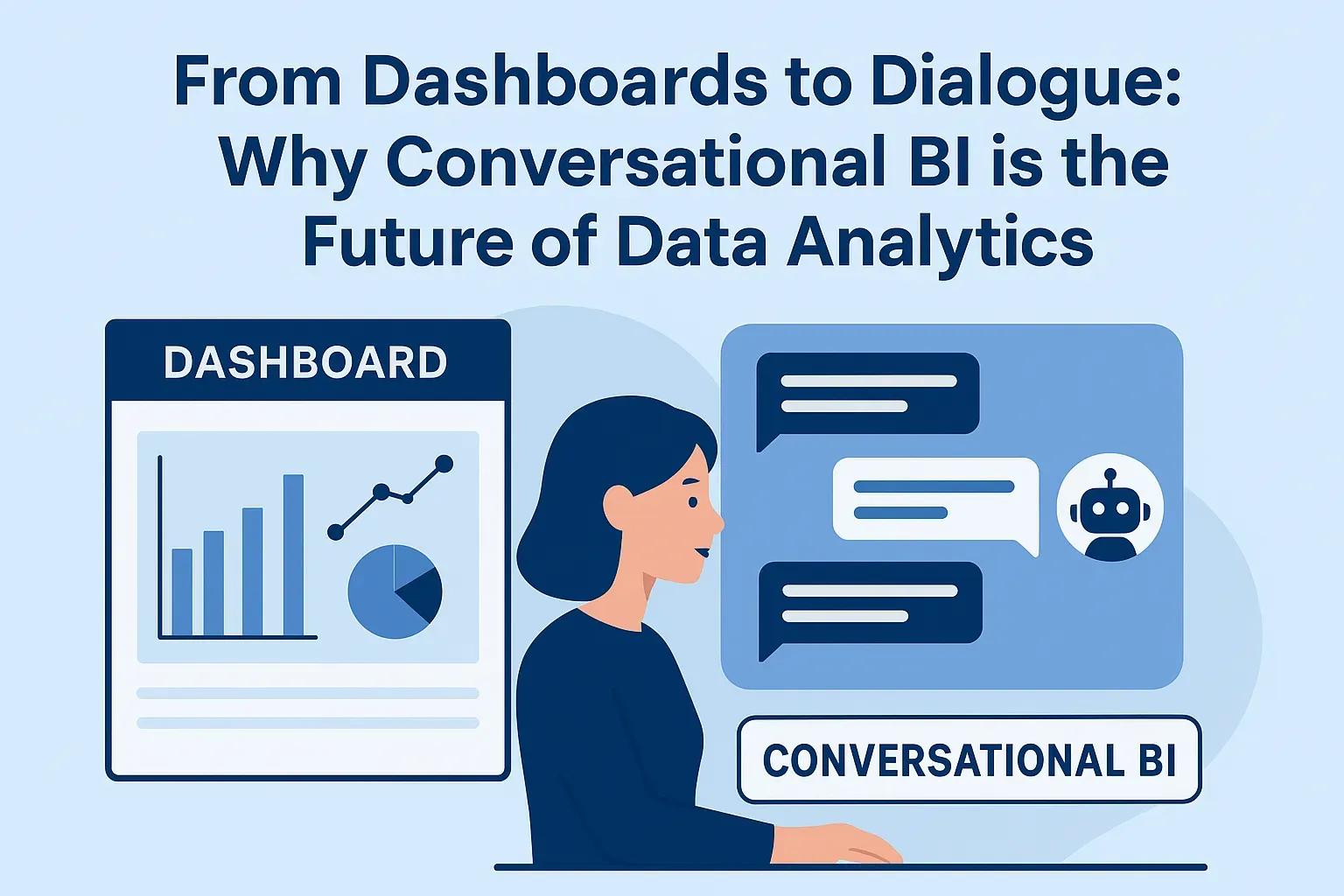
And here is where the key difference between a dashboard and conversational analytics appears: the dashboard shows you what you already know you want to see. The conversation lets you explore what you didn’t know you had to ask.
They do not replace each other. They complement each other. The dashboard is the map. The conversation is the compass when you don't know exactly where to look.
Why this is not an experiment: industry data confirms it
When I started building this project, I knew that conversational analytics had potential. What I didn't expect was that the industry was moving so quickly in that direction.
Gartner, in its Hype Cycle 2025, positioned Natural Language Query (NLQ) at the peak of expectations with a rating of transformational benefit, projecting massive adoption in the next two years. McKinsey reports that 78% of companies have already integrated conversational AI in at least one key operational area. And the global conversational AI market — which reached $11.58 billion in 2024 — is projected to reach $41.39 billion by 2030.
Platforms like Snowflake launched Snowflake Intelligence for natural language querying. Looker made Conversational Analytics available in 2025. And Salesforce acquired Waii, a company specialized in NLP for data management, signaling that major enterprise bets are moving towards data conversations.
Organizations that have already implemented NLQ report 40-60% faster insight retrieval times and significant reductions in support requests to the IT department. It’s not just efficiency: it’s real data democratization.
The technical aspect: how it’s built inside
For those interested in the technical details of the project:
→ The bot automatically generates 8 types of graphs: bars, lines, pies, dual-axis, stacked bars, among others. → It has an integrated feedback system (👍/👎/🔧) for users to indicate whether the response was useful or needs improvement. → Errors are logged and corrected in QA sessions, allowing the bot to improve with usage. → Stack: Python, Claude API (Anthropic), Telegram Bot API, pandas, matplotlib.
But there is one point I want to highlight because it’s where many conversational analytics projects fail: simply connecting an LLM to a database is not enough.
SAP published an analysis warning that without rich metadata and well-defined business semantics, NLQ tools hallucinate, misinterpret user intent, and return inconsistent results. The maturity of the metadata is the best predictor of conversational accuracy.
That’s why the bot is not merely a wrapper for ChatGPT over a CSV. Each function is designed for a specific type of analysis, with validations, error handling, and embedded business logic.
What I learned building this
This project confirmed something I’ve been thinking for a while: the future of data analysis is not more dashboards or more technical tools. It is about making data accessible for anyone who needs to make a decision.
You don’t need to know SQL. Nor Python. Nor open any tool. You only need to ask the right question in a chat.
Gartner projects that by 2026, more than 80% of companies will have used generative AI APIs or applications enabled with generative AI. IDC predicts that global spending on AI will exceed $300 billion.
But the most profound change is not technological. It's cultural. We are moving from a model where data is a resource controlled by technical profiles to one where data is an open conversation for the entire organization.
And that’s where I believe the real impact lies. Not in the technology that makes it possible, but in the decisions it enables.
Sources consulted:
Gartner, Hype Cycle for GenAI 2025 — NLQ reached the peak of expectations with transformational benefit
McKinsey, "The State of AI in 2025" — 78% of companies integrated conversational AI in at least one operational area
SAP, "Conversational Analytics: Why Rich Metadata and Business Semantics Matter More Than Ever"
Datapad, "Conversational Analytics Guide 2025" — organizations report 40-60% faster insight retrieval times
Master of Code, "State of Conversational AI: Trends and Statistics 2026" — market projected to USD 41.39B by 2030
OvalEdge, "Conversation Analytics 2026 Guide"
Snowflake Intelligence, Looker Conversational Analytics, Salesforce acquisition of Waii (2025)

Comments