Why 2025 marks a turning point
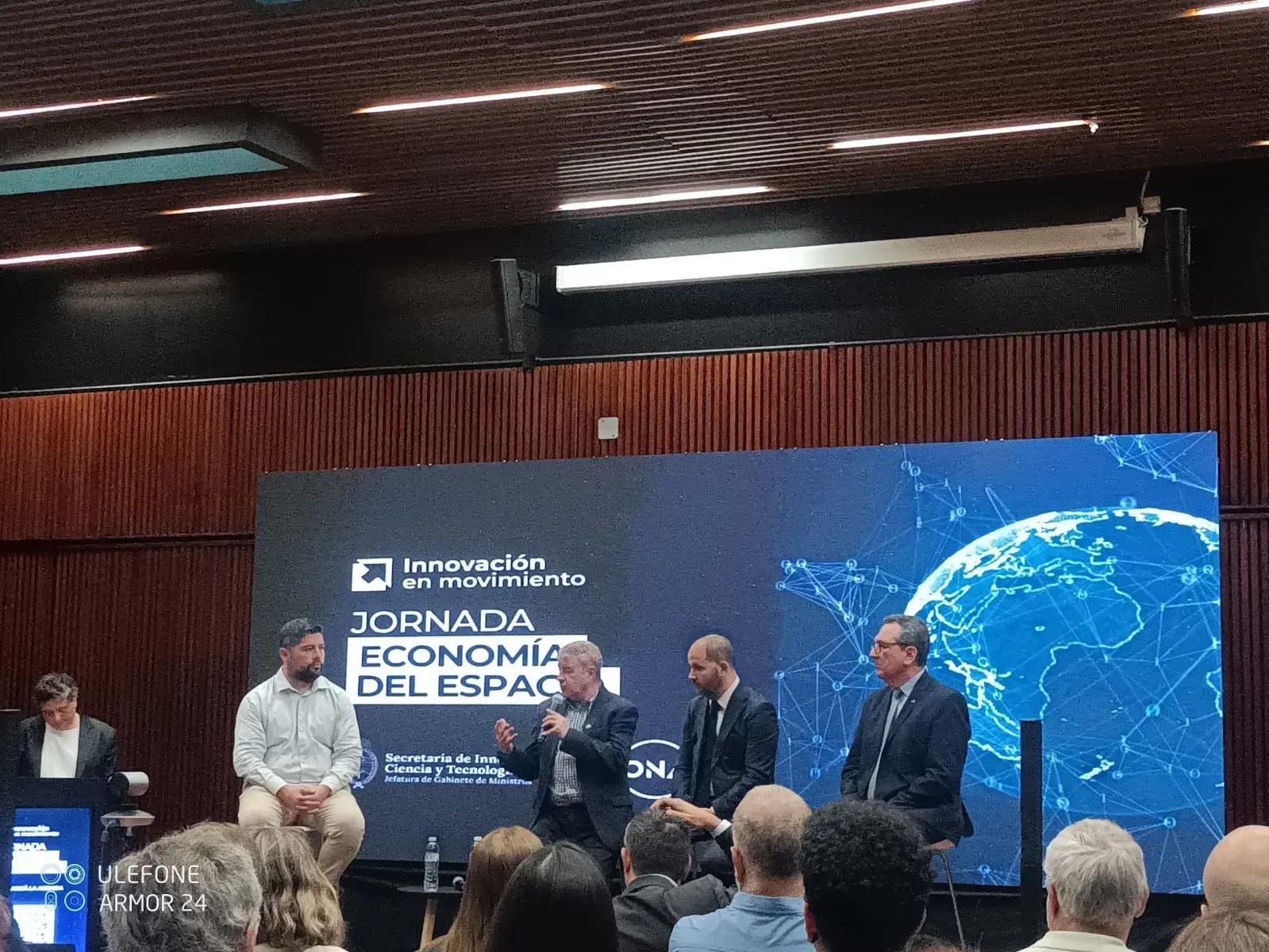
Argentina is going through a pivotal moment in its space economy. This was highlighted by officials, companies, and multilateral organizations during the Innovation in Motion, Space Economy conference held at the C3 Cultural Center of Science, where it was emphasized that the country today possesses technical, scientific, and business capabilities that, combined with an increasingly dynamic entrepreneurial ecosystem, position it to capture value in a global market that will exceed USD 1.8 trillion by 2035.
This growth is not explained solely by launches or space hardware, which represent a smaller portion of the global business, but by the economy derived from data, a field that encompasses precision agriculture, energy, infrastructure, mobility, logistics, defense, and urban planning. These are sectors where Argentina not only demonstrates a growing demand but also talent capable of competing abroad.
CONAE: 30 years developing an ecosystem, not just satellites
CONAE set the tone for the meeting by highlighting that Argentina is not just a user of space technology but one of the few countries capable of managing the entire cycle of a mission, from satellite design to ground segments, including operation and data processing.
Over more than three decades, the country has built specialized talent through postgraduate programs, continuous training, and sustained interaction with universities. It has also consolidated strategic international relationships with agencies like NASA, Italy's ASI, Brazil's AEB, and France's CNES. In parallel, it has contributed to the private sector's growth by enabling tech SMEs and startups to scale based on the knowledge generated from major state programs.
CONAE does not hide its goal of sustaining Argentina's role as a relevant international partner while encouraging a new generation of companies to transform that legacy into development opportunities.
Companies and startups: from low earth orbit to economic impact on land
The view of Veng: “A satellite is not launched by a person; it's launched by a country”
Laureano Bulaci from VENG outlined a strong historical line by recalling that Argentina has 60 years of space experience, dating back to the days of the monkey Juan and the first rockets developed in the country. This tradition today combines with a global industry that is expanding at unprecedented speeds. In just five years, the number of satellites in orbit has jumped from 5,000 to projections of over 100,000 by 2030, a scenario that opens new opportunities for countries with solid technological capabilities even when their budgets are more limited.
The key message: “Argentina is not lagging behind; it has decades of accumulated knowledge ahead”.
This historical capital enables participation in new value chains that include low-cost constellations, data-based services, sensors, payloads, electronics, and materials.
INVAP: when competing means developing an ecosystem
At INVAP, Guillermo Salvatierra emphasized a central point for the space economy by stating that it is not companies that compete, but ecosystems. The Río Negro company, a Latin American leader in satellites, radars, and nuclear energy, has been developing local suppliers for years, incubating startups as it did with Satellogic in its early days, supporting spin-offs like Skylum in the optical links area, and working consistently with universities and research centers.
The company’s numbers support this vision. With an annual turnover close to 200 million dollars, around 90 percent corresponds to added value generated in the country. Half of that value is produced outside the company itself, in suppliers that INVAP has supported for years to meet the necessary quality standards. This dynamic reflects an explicit strategy: strengthen the ecosystem to maintain international competitiveness in a sector where advancements are continuous, and technical demands are ever-increasing.
For the space economy, this means that Argentina already has a network of mature industrial capabilities ready to scale towards new opportunities. Guillermo highlights: “Developing the ecosystem is not charity. It is a strategy to maintain international competitiveness.”
The IDB: economic evidence of “space spillover”
The IDB's participation confirmed something many suspected: satellite missions generate tangible economic growth in the companies involved, even when they are not primary contractors. The organization presented evidence that numerous suppliers of the SAOCOM program increased their productivity, improved their quality standards, and expanded their export capacity after participating in the project.
The IDB also warned that the regional demand for satellite data-based services is not being leveraged as it could be and that Argentina is well positioned to become a central provider of these solutions. Opportunities extend to sectors such as agriculture, mining, water management, biodiversity, fire prevention and monitoring, infrastructure, and climate change adaptation—all areas with concrete and growing needs.
Moreover, the bank reminded that it has instruments capable of accelerating the development of this ecosystem. Among them is financing for innovation projects, direct investment in startups through IDB Lab, backing for venture capital funds, and programs aimed at modernizing the public sector through the intelligent use of spatial data.
Startups and Argentine projects: the new local NewSpace
The second part of the day showcased various projects and companies representing the new wave of Argentine space innovation. From ground stations to launchers, lunar rovers, and 5 cm satellites.
ASTAR (FIU UBA Project): students already building space hardware
The ASTAR project proposes a CubeSat with a strong focus on human capital development, as students design, integrate, and validate satellite modules under professional supervision. The team achieved a significant milestone by participating in CONAE's Atenea program, where they contributed certified hardware that was integrated into the Orion capsule.
What's most interesting is that the group functions almost like a startup within the university, capable of developing energy modules and electronic components while training a talent pool that is already being noticed by the private sector.
DIY Satellite: PocketQubes and access to space for USD 10,000
The company offers the most accessible solution in the country for placing hardware in orbit via five-centimeter satellites, launch services, complete management of regulatory procedures, and turnkey ground station provision. This approach is significant as it democratizes access to space and enables technology validation with minimal budgets, in addition to integrating with launchers from Europe, Korea, and Brazil, significantly expanding the possibilities for involvement in international missions.
Its representative, Gustavo Carpiano, highlighted: “Everyone gets excited about building the satellite… until they discover the paperwork. We handle everything.”
HAEDO-SAT (UTN): a 3U Earth observation CubeSat
The UTN is working on the complete design of a three-unit satellite equipped with a pancromatic camera, deployable solar panels, and a bay dedicated to experimentation. The project is developed under NASA and ESA standards, following ECSS regulations, and combines applied research with high-level academic training. This initiative offers a strategic advantage by consolidating complete systems engineering capabilities within the university itself and maintaining active links with CONAE, UNSAM, UNLP, and other actors in the space ecosystem.
USAT-1 (UNLP): science with GNSS from a CubeSat
The UNLP’s first university CubeSat aims to measure pressure, humidity, and soil characteristics through GNSS signal reflection, an advanced observation technique with multiple climate and agricultural applications.
The CTA has already demonstrated capabilities by integrating hardware for NASA's Atenea mission.
RoverTito (Space Bee Tech): the first Argentine lunar rover
With a focus on missions scheduled for 2027 and 2028, RoverTito advances as a modular, lightweight, open-source rover designed for lunar exploration tasks. The project aims to democratize robotic exploration, enabling local companies to test sensors directly on the Moon's surface and laying the groundwork for a future constellation of micro-rovers. This represents a unique opportunity for Argentina to enter the lunar value chain with its own technology.
Addipod: a 3D-printed CubeSat deployer
Developed entirely from advanced polymers through 3D printing, this deployer significantly reduces mass, lowers costs, and allows for much faster production, with the ability to adapt to formats of one, three, or six units. It is an innovation that aligns directly with the global trend of making launches more accessible and facilitating the entry of new players into the space sector.
Tlon Space: a lightweight orbital launcher made in Argentina
Adventure I, with a takeoff mass of only 850–1,000 kg, aims to become the lightest orbital launcher in the world. It can place 25 kg into orbits ranging from 200 to 550 km.
This would allow for something unprecedented for the country: sovereign access to space for nanosatellites.
SAR satellites in X-band for interferometry
This project brings together various local companies to develop miniaturized SAR antennas and independent observation constellations, aiming to provide advanced monitoring capabilities for infrastructure, land deformation detection, support for mining and hydrocarbons activities, defense applications, and emergency management tools.
Argentina could thus produce export SAR technology, a segment where few countries compete.
Satellitear
They offer geospatial information solutions with applications in agriculture, energy, industry, logistics, and land management, transforming satellite images into practical knowledge that is then validated directly in the field.
Space Dream
This is an architecture oriented towards space tourism that proposes modular habitats capable of generating artificial gravity, an innovation that positions the project as a pioneering vision within an emerging industry segment.
Argentina is ready to play in the big league
The space economy is no longer science fiction or a luxury reserved for powers with unlimited budgets; it is a sector where Argentina combines highly qualified talent, a proven scientific and industrial trajectory, startups that are already exporting technology, universities capable of producing space hardware, established public-private companies, and a growing interest from international organizations such as the IDB to scale local projects.
The challenge now is not technological; Argentina has already proven it can do it. Instead, it is strategic and financial, meaning ensuring continuity, investment, and regulations that enhance the sector rather than stifle it.
The conference made it clear that Argentina wants to take its place in the new space economy, and the capabilities are already in motion.

Comments