For centuries, biology was a science dedicated to observation. Naturalists traveled the world describing species; microscopists discovered cells invisible to the human eye; geneticists deciphered how the characteristics of an organism were inherited. The goal was to understand how nature works.
Today we are entering a completely different stage.
For the first time in history, biology is no longer solely about discovering what exists. Increasingly, it is about designing what does not yet exist.
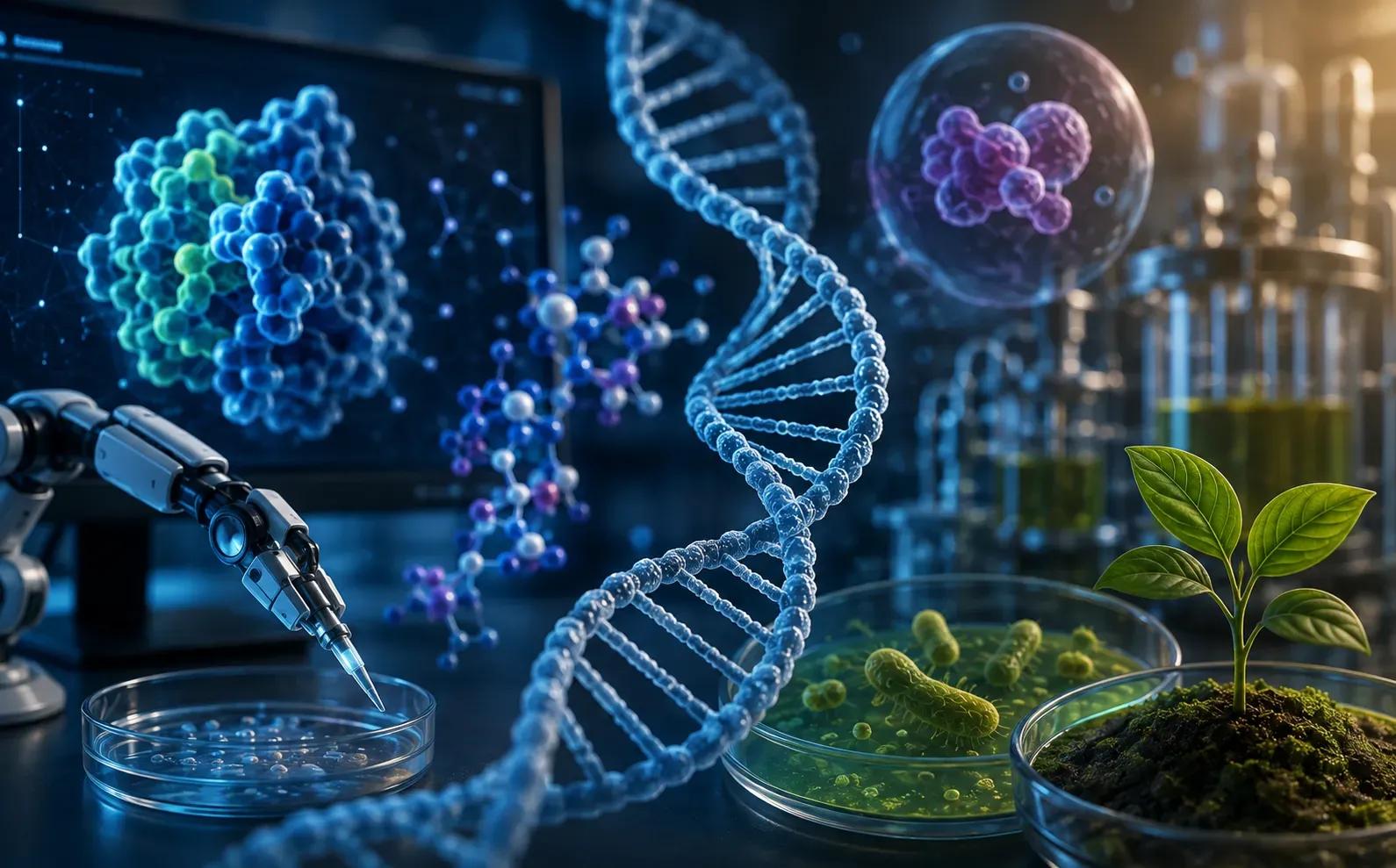
This shift is made possible by the convergence of disciplines that just a few years ago seemed independent: biotechnology, bioinformatics, artificial intelligence, automation, and robotics.
A clear example is proteins. For decades, researchers studied the proteins that evolution had generated over millions of years. Today, using artificial intelligence tools and computational models, it is now possible to design completely new proteins with specific functions, from degrading pollutants to recognizing tumor cells or improving industrial processes.
A similar situation occurs with microorganisms. Instead of searching for a bacterium that produces a certain molecule, scientists can modify its metabolism or even build new biological pathways so that they manufacture medicines, bioplastics, fuels, or food ingredients more efficiently.
Gene editing represents another step in this direction. Technologies like CRISPR allow for DNA modification with precision unimaginable just two decades ago. However, the real change lies not only in the ability to edit genes but in the fact that we are beginning to think of organisms as systems that can be designed to fulfill a specific function.
This new approach is also transforming scientific work. It is increasingly common for an experiment to start in front of a computer rather than a microscope. Algorithms analyze millions of genetic sequences, predict protein structures, propose promising mutations, and even help decide which experiment is worth conducting in the lab. Artificial intelligence does not replace the researcher, but it multiplies their ability to explore hypotheses that would have taken years before.
The consequence is profound. For a long time, evolution was practically the only "engineer" capable of generating new biological solutions. Today we are beginning to develop tools to actively participate in that design process. It is not about replacing nature, but about learning its rules to create new applications that respond to specific challenges in health, food production, energy, and the environment.
This change also raises important questions. How far should we design organisms? How can we ensure safe and responsible development? What regulations will be necessary when it becomes possible to synthesize increasingly complex biological systems? The speed of technological advancement requires that these discussions keep pace with scientific progress.
Probably, the next great revolutions will not come solely from new discoveries but from our ability to design solutions inspired by biology. Just as engineering transformed knowledge of physics into bridges, planes, and satellites, the combination of biology and engineering promises to convert biological knowledge into technologies capable of changing our way of producing, curing diseases, and relating to the environment.
Perhaps in a few decades, we will remember this stage as the moment when biology ceased to be just a science for understanding life and also began to become the discipline that allowed us to design it.
By Lic. Martín Vadillo, Director of Biotechnology and Bioinformatics at UADE
Comments