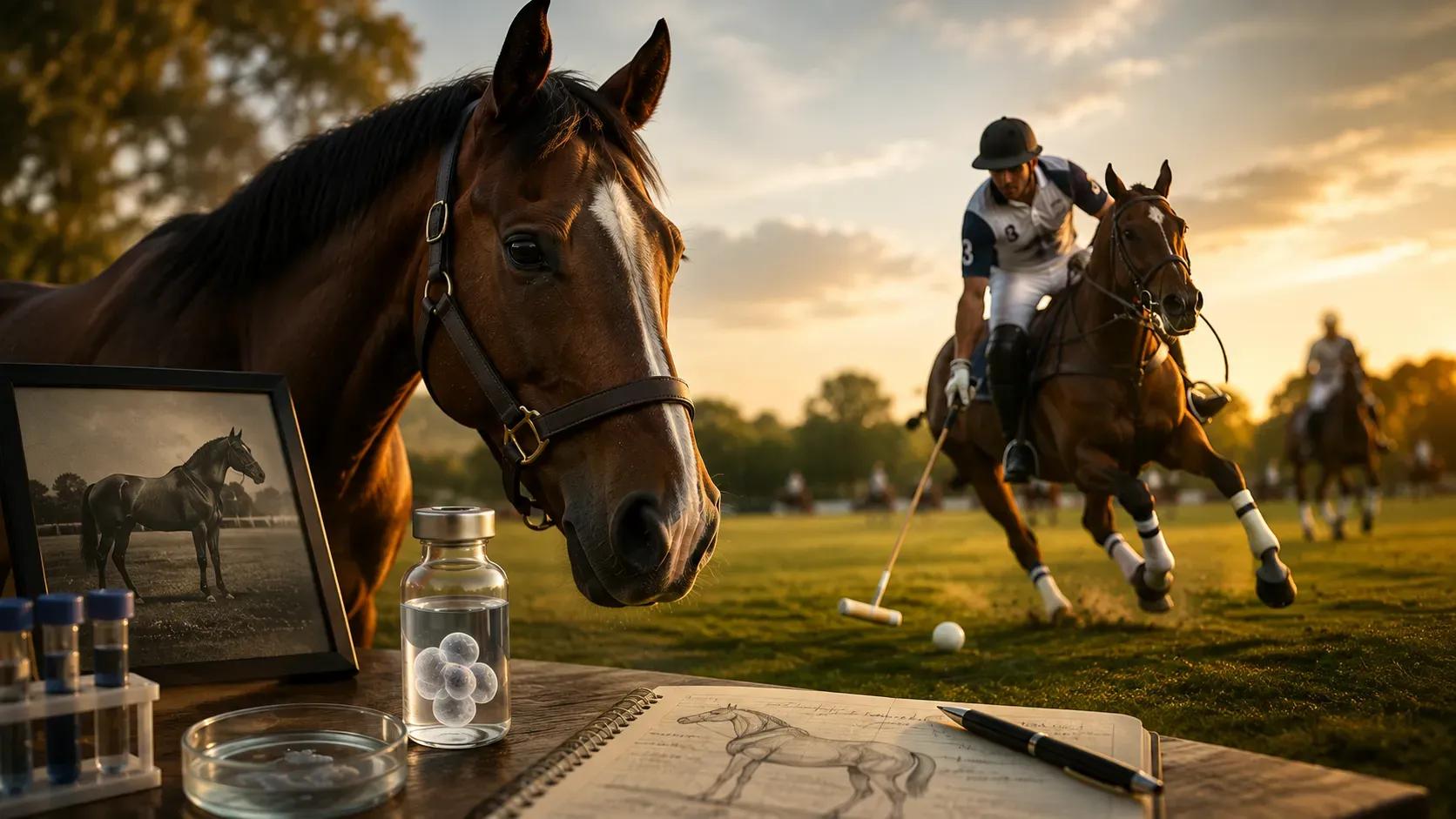
The Argentine horse. From the figure of the gaucho to its participation in high-handicap polo matches that we see on television, the image of this animal as an Argentine emblem is undeniable. The latter, with incredible elegance and a light stride, captivates the eyes of the spectators and the love of breeders.
Few know that behind these powerful animals lies a hard work that not only involves the time of the trainers and the training but goes further back, from the origins of each horse, from its genetics. It is at this initial point where the magic begins, and our country does not fall behind. Argentine genetics has ceased to be a promise of the future to stand stronger than ever in the present; it is a reality that is practiced daily.
Starting with cloning. The objective of this practice is to maintain the characteristics of the animal as faithfully as possible through Somatic Cell Nuclear Transfer (SCNT), a highly complex procedure where, in practical terms, an egg is tricked into developing as if it were fertilized not with the DNA of a male but with the complete genome of an already existing animal. The instruction manual of a cell from the body of the animal to be cloned is taken, and an embryo is created precisely with this same information, inserting this egg into the uterus of a mare without presenting any harm to the gestating female or the embryo. Adolfo Cambiaso was one of the first to trust this technique with his flagship mare Cuartetera, declared the best mare of the Palermo Open and was cloned several times.

As a prime example of companies that carry out this practice, we have Kheiron Biotech, founded by Argentine scientists like Gabriel Vichera, a researcher from UNSAM, who have already reached an approximate number of 1,000 cloned specimens. An interesting technical point to mention is that Kheiron's great leap in efficiency came when they began using stem cells obtained from the bone marrow, through puncturing the horse's sternum, instead of skin cells. Today they claim that almost 100% of births are healthy.
Science is gaining more and more ground in our traditions and daily life. In this context, cloning has opened the door to deep debates about animal welfare and has brought to the forefront the discussion about its own ethical limits. Even so, although this technique guarantees maximum genetic potential, it is essential to remember that the performance of a champion does not only arise in the microscope; it inevitably depends on its training, care, and nutrition. Ultimately, it is once again evident how sports passion and scientific vanguard ride together into the future.
By Lu Ronner, student of the Biotechnology degree at UADE

Comments