Nine out of ten executives say that artificial intelligence has not changed their productivity. Global investment exceeds USD 252 billion. Something doesn't add up.
There is a number that I find hard to ignore. The National Bureau of Economic Research (NBER) surveyed nearly 6,000 senior executives in four countries — the United States, the United Kingdom, Germany, and Australia — between November 2025 and January 2026. The question was simple: Has artificial intelligence changed your company's productivity in the last three years?
89% responded that it has not.
Not "a little." Not "something." Zero measurable impact. And this in a period where the same companies globally invested more than 252 billion dollars in AI technology.
The spending is real. The results, not so much.
McKinsey surveyed nearly two thousand organizations at the end of 2025. 88% are already using AI in at least one business function. It is an extraordinary level of adoption for a technology that was practically nonexistent in the corporate environment three years ago. The problem: 94% of those same respondents said they do not see "significant value" from those investments.
Only 39% reported any improvement in operating profits. And in most cases, that impact was less than 5%.
MIT published an analysis in July 2025 of more than 300 corporate deployments. Conclusion: 95% of generative AI pilots produced no measurable impact on the P&L. Gartner, for its part, had predicted in 2023 that by 2025, 90% of projects would see their costs exceed the value generated. That prediction is coming true.
"Having access to the tool is not the same as transforming the process."
The most concrete experiment available
Between October and December 2024, the UK government distributed 1,000 licenses for Microsoft 365 Copilot in its Department of Commerce and Business. Three hundred people consented to have their data analyzed. Three months, real working conditions, measured metrics.
Result: no conclusive evidence of improvement in aggregate productivity.
The details are more revealing than the headline. Users produced PowerPoint presentations about seven minutes faster, but the quality and accuracy of the slides were lower. In Excel, Copilot users took longer than those not using it, with less accuracy. The tool consistently generated incorrect information throughout the study.
But the most uncomfortable data is none of those. It's this: 72% of participants were satisfied or very satisfied with Copilot. And they expressed disappointment when the pilot ended. People felt more productive. The numbers said otherwise.
Note on MIT data: The study defines "success" as deployment beyond the pilot with verified KPIs and measurable ROI within six months. It is a high bar that excludes gradual or long-term benefits. The 95% is real, but it should be read in that context.
So, does AI not work?
That's not it. And the difference matters, because a simplistic reading of these data can lead to equally erroneous conclusions.
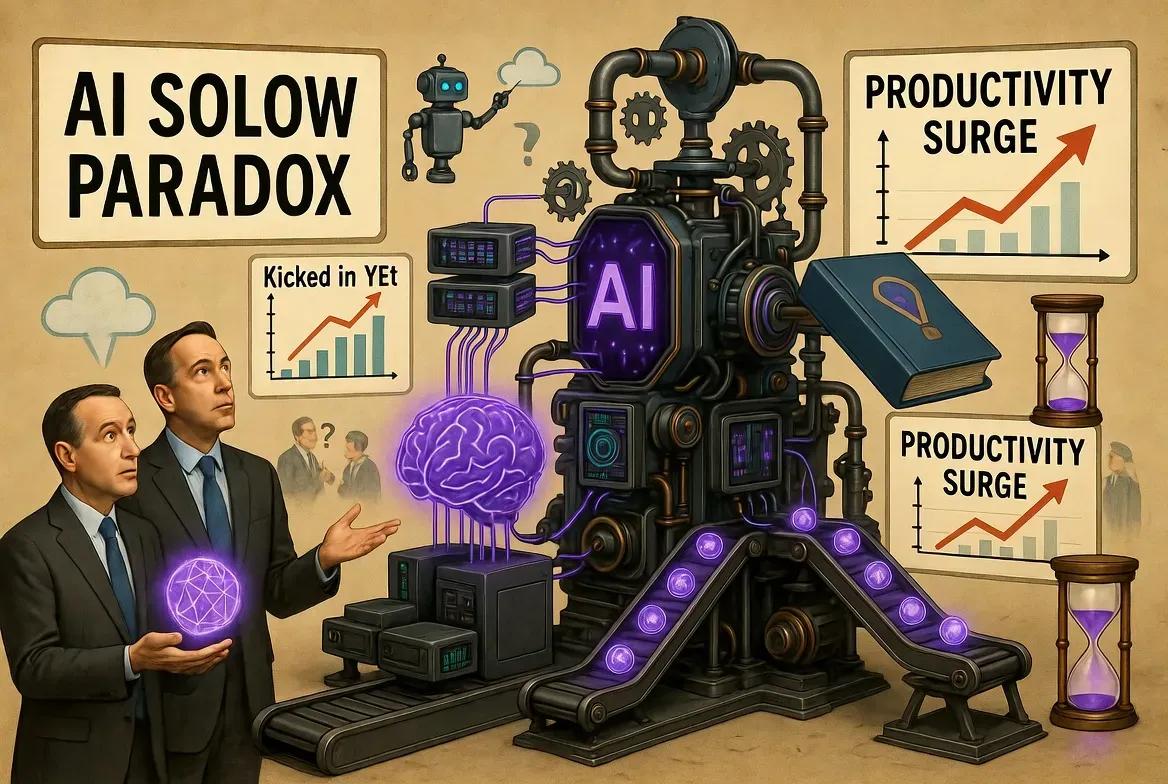
In 1987, economist Robert Solow said something that became famous: "You can see the computer age everywhere but in the productivity statistics." It was precisely this situation. Companies were massively investing in PCs and software. Aggregate productivity was not increasing. Ten, fifteen years later, it exploded. This delay is called the Solow Paradox, and it's one of the most serious explanations for what we're seeing today.
McKinsey identifies the pattern clearly: companies are piling AI on top of old processes. They buy the Copilot license but do not change how the team works. AI accelerates tasks but does not transform the process. Real value appears when the entire process is redesigned, and that requires time, decision, and organizational change that almost no one is doing yet.
To this is added another factor that is rarely mentioned: data quality. For AI to work at scale, clean, integrated, and well-governed data is needed. Most companies operate on information silos and systems that are decades old.
The paradox of the convinced executive
There is a piece of data from the NBER that I find particularly revealing, and that does not appear in the headlines. Those same executives who report zero impact in the last three years expect, on average, that AI will increase their productivity by 1.4% in the next three. They continue to believe.
This can be interpreted in two ways. The first: they are seeing something that the aggregate data does not yet capture, and the benefit is coming. The second: they are rationalizing a bet they have already made, one from which they cannot retract.
MIT found something that fits with the second interpretation: more than 50% of corporate spending on AI goes to sales and marketing tools, where technology is most visible and easiest to justify internally. But the greatest documented return is in back-office automation — in operational processes, eliminating outsourcing, optimizing flows that no one sees but which directly impact the P&L. Companies invest where it shines, not necessarily where it yields.
"50% of spending on AI goes where it is visible. The greatest return is where no one looks."
What this means for the next 18 months
Gartner predicted that at least 30% of generative AI projects would be abandoned after the proof of concept by the end of 2025, mainly due to rising costs and unclear value. That is happening.
The companies that are seeing results — the 5 or 6% that McKinsey identifies as "high performers" — have in common that they not only bought tools: they redefined entire processes, invested in the quality of their data, and defined real business KPIs before starting. They are the exception, not the rule.
The question that seems most honest to me is not "Does AI work or not?" but rather: how much of the current corporate spending on AI responds to a real business hypothesis, and how much is competitive pressure — the institutional FOMO of not being able to not do it when everyone else is announcing it?
The data do not answer that question. But they make it more urgent.

Comments