Milk is part of our daily life. It is present at breakfast, in cheeses, yogurts, and other products we consume daily. But behind each dairy product, there exists a complex industry, involving producers, animals, technology, genetics, and a processing chain that begins long before the product reaches our table. None of this would be possible without dairies.
Dairies are establishments dedicated to the production of milk from the milking of cows, where tasks related to the feeding, reproduction, health, and welfare of the animals are also carried out. The milk obtained is subsequently sent to the dairy industry, where it undergoes different processes, such as pasteurization, which ensure its safety and transform it into the various foods that reach the consumer.
But producing milk is not simply milking a cow. Behind every liter produced lies a series of decisions that can determine the efficiency and profitability of a dairy. Which animals should be reproduced? Which have greater productive potential? Which have better characteristics for fertility, health, or milk composition? These are some of the questions that producers have been asking for decades, and today biotechnology comes to answer them with an increasingly precise tool: genomic selection.
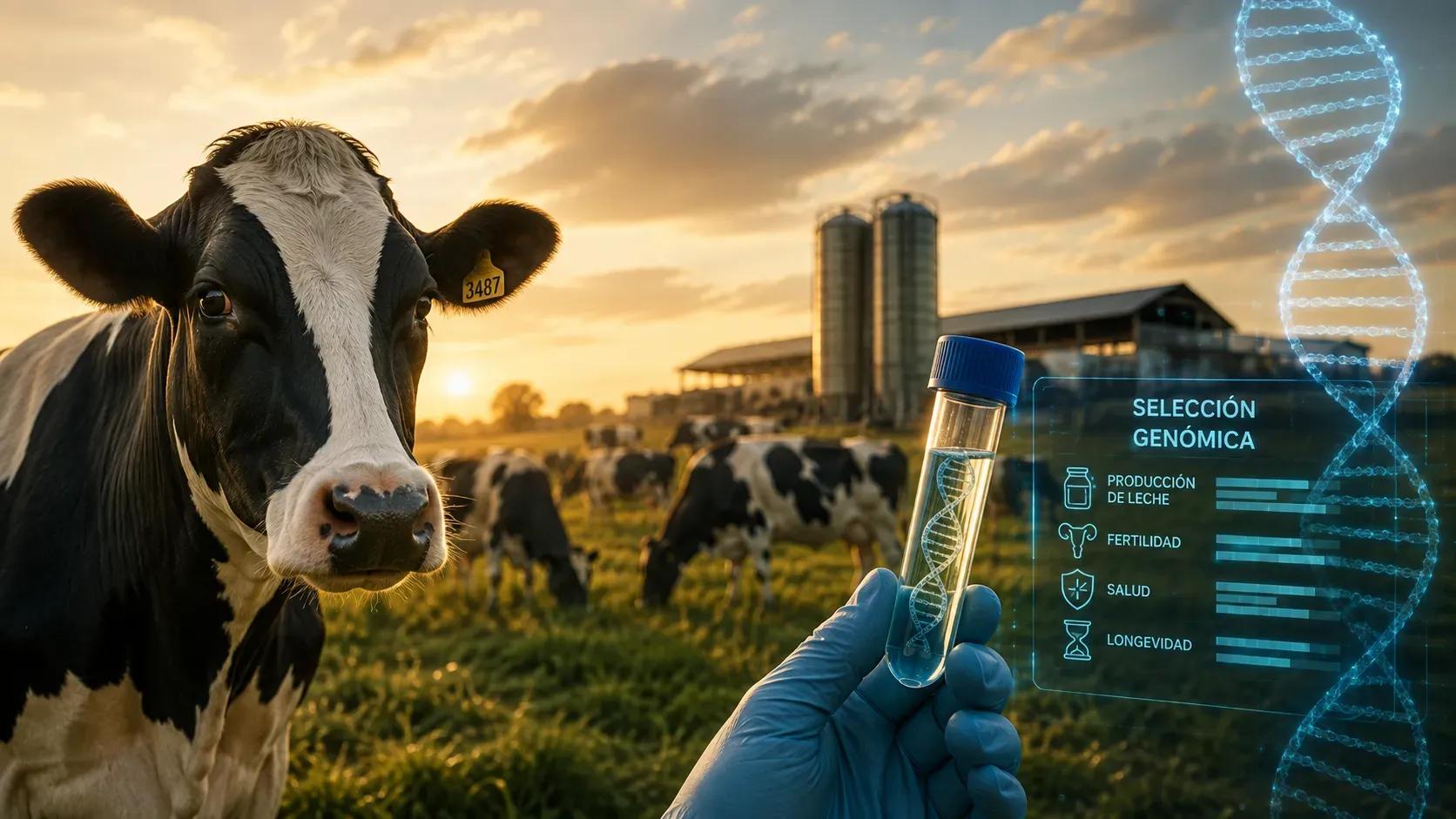
When we refer to genomic selection, we are talking about a process by which the animals that will reproduce are chosen based on the characteristics that we want to enhance in the next generations: higher milk production, better fertility, resistance to diseases, among others. The idea is simple: if an animal has a desirable trait and that trait can be inherited, crossing it with other specimens increases the likelihood that its offspring will also have it.
For decades, this selection was primarily done by observing the performance of the animal and that of its ancestors: how much milk it gave, what its fertility was like, whether its daughters produced well. This method, known as pedigree or phenotype selection, works, but it has a significant limitation: one must wait for the animal (or its offspring) to display those characteristics to be able to evaluate it, which can take years.
Genomic selection has changed this. Instead of waiting to see how an animal behaves throughout its life, it allows direct analysis of its DNA to predict, from when it is a calf, what the likelihood is of it being a good breeder. This greatly accelerates the genetic improvement process and allows for more precise decisions in less time.
Having genomic data from when the animal is a calf allows the producer to decide with greater certainty which females to keep as future mothers, which breeders to use, and which to discard, without having to wait years. This means less time and fewer economic resources invested in raising dairy cows.
In a context where the margins of the dairy industry are increasingly tight, this ability to make informed and early decisions moves from being a technical detail to becoming a key management tool: each breeding choice is, in the end, an investment in the future productivity of the dairy.
Thus, the next time you consume a dairy product, it is worth remembering that behind that product, there is not only a dairy and a cow but also decades of genetic decisions, and increasingly, the precision of DNA. Genomic selection does not replace the producer's work: it enhances it, and it stands out as one of the key tools for the Argentine industry to remain competitive in the years to come.
By Sol Aebi, student of Biotechnology at UADE

Comments