What does in vitro fertilization (IVF) mean?
Talking about in vitro fertilization means talking about science, reproductive medicine, and laboratory procedures, but also something much deeper: the desire to have offspring. The desire of people who, for various reasons, cannot achieve a pregnancy naturally and seek a possible alternative to start a family.
Why do people resort to this method?
Reasons can vary. In some cases, they respond to medical causes, such as female or male infertility, genetic disorders, or hormonal imbalances. In others, they are social causes: same-sex couples or single individuals who wish to become parents. In these scenarios, IVF serves as a tool that expands reproductive possibilities.
Myths and ethical limits
There is a misconception that in vitro fertilization allows one to "choose" or "mold" a baby to preference. In practice, this is not the case. The selection of physical characteristics or personal traits is not allowed—at least for now—and is termed eugenics.
What is allowed, under strict medical and legal criteria, is the genetic study of embryos to prevent the transmission of serious diseases. This reduces the risk of hereditary conditions that can severely affect quality of life.
In the book “The Price of Being a Mother,” journalist Julia Bacardit indicates that this study, known as PGT - Preimplantation Genetic Testing, allows one to understand the DNA of embryos created in the laboratory before implanting them, thus knowing what pathologies may affect the child. She also comments that between 2000 and 2020, the most significant advancement has been in improving molecular biology techniques that have enhanced the PGT technique, along with advancements in vitrification and ultra-rapid freezing of gametes, which extend the lifespan of embryos.
This logical tension between science, ethics, and beliefs has existed since the history of IVF began in the mid-20th century, with its historical milestone in 1978, which saw the birth of the first baby conceived through IVF.
These discrepancies can be observed in the film “Joy,” which recounts the IVF journey from scratch. In Joy (2024), a mother asks her scientist daughter if she “makes babies in test tubes,” as for the mother, this technique implies “playing God,” to which the scientist responds that she “makes babies for mothers who need them,” while the midwife—a person specially authorized to assist birthing women—offers a different perspective: it’s not about creating life artificially but about providing women the option to choose.
A treatment that adapts to each body
In vitro fertilization is not a unique or standardized procedure. On the contrary, it is a treatment designed to fit individual characteristics and needs of each person or couple. Before starting the process, a comprehensive assessment is conducted, including hormonal tests, ovarian reserve analysis, age, male factor, and medical history.
Based on this information, the medical team defines the most appropriate strategy: from the type and intensity of ovarian stimulation to the fertilization technique to be used, such as conventional IVF or ICSI. Even the timing of the treatment can vary, as each body responds differently and requires personalized monitoring.
How IVF is performed in a heterosexual couple
In a heterosexual couple experiencing some issues conceiving naturally, in vitro fertilization involves replicating what normally occurs inside the female reproductive system outside the body, followed by introducing the embryo into the uterus.
Below is a general explanation of one possible scenario.
Ovarian stimulation
The first step is ovarian stimulation through hormonal medication, which serves to produce eggs. This treatment aims to mature several oocytes simultaneously, increasing the chances of obtaining viable embryos.
During this period, the oocytes are monitored via ultrasounds and hormonal analyses.
Ovarian puncture
Once the oocytes reach the necessary level of maturation, the puncture is performed. This involves extracting the oocytes directly from the ovaries using a needle guided by transvaginal ultrasound. The obtained eggs are immediately sent to the lab.
In vitro fertilization and ICSI technique
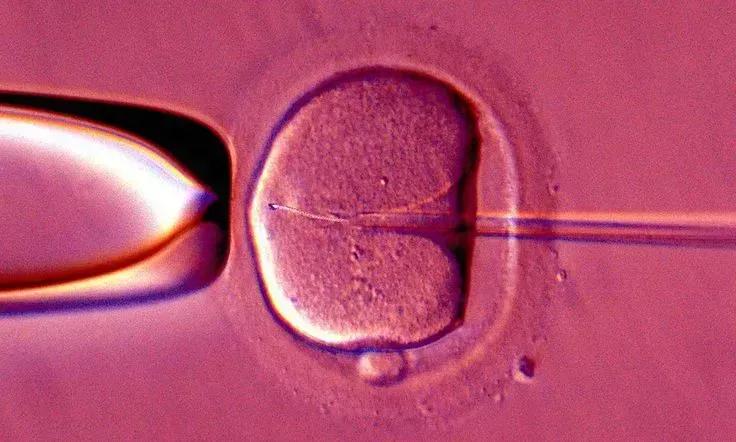
Fertilization occurs outside the body, in the lab. The oocytes are placed in contact with the partner's sperm, and one is expected to fertilize the egg. In some cases, the ICSI technique is used, which involves introducing a single sperm into the oocyte. This union will form the embryo.
Embryo culture and selection
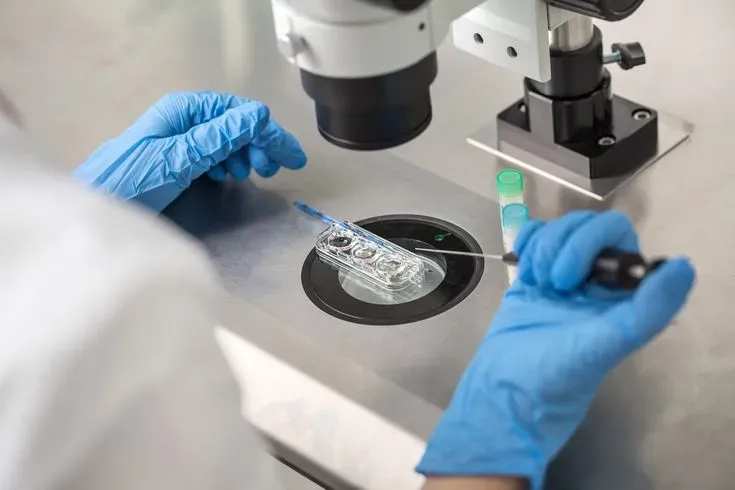
The embryos are kept in special incubators that simulate uterine conditions. Their development and cell division are monitored over several days. At this stage, embryo quality is assessed to determine which have the highest potential for implantation.
Embryo transfer
The selected embryo—or embryos, as in some cases there are several—is introduced into the uterus through a thin catheter in a simple and painless procedure. If the embryo implants in the endometrium and is accepted by this tissue, the pregnancy continues naturally.
Embryo cryopreservation
Embryos that are not transferred can be cryopreserved (frozen) for future attempts, avoiding the need to repeat stimulation and ovarian puncture.
Success rates and influencing factors: Age, oocyte quality, and fertility preservation
One of the major myths surrounding IVF is the idea of guaranteed success rates. The probabilities depend on multiple factors such as age, cause of infertility, and quality of gametes. For this reason, many individuals go through more than one attempt.
Age is one of the most determining factors. Oocyte quality begins to decline after the age of 30. Cryopreservation of eggs or embryos allows the preservation of higher-quality reproductive cells and expands future reproductive possibilities.
Another possible treatment for other potential cases: egg donation
In some cases, in vitro fertilization is performed through egg donation, a technique indicated when the woman cannot use her own eggs for various reasons. Egg donation involves using eggs from a donor, which are fertilized in the laboratory with either the partner's sperm or a donor's sperm. The resulting embryo is then transferred to the uterus of the recipient, who will carry the pregnancy.
Although the genetic material of the egg does not belong to the gestational person, the pregnancy develops in her body and is influenced by her uterine and hormonal environment. For this reason, egg donation does not imply total biological disconnection but rather a different way of conceiving that expands reproductive possibilities in the face of concrete biological limits.
Topics such as egg donation are widely addressed in the book The Price of Being a Mother, where Júlia Bacardit analyzes why many women decide to donate eggs, the economic and social conditions influencing that decision, and how they feel during and after the process. The book exposes that, while egg donation presents itself as a charitable act, it can also be intertwined with inequalities, economic pressures, and a physical and emotional burden that is not always made visible. The figure of the donor, her motivations, her conditions, and her experiences deserve specific analysis. For this reason, egg donation—and the voices of those who make it possible—will be developed in depth in a forthcoming article.
The emotional impact of the treatment
Beyond the medical procedure, IVF involves a strong emotional component. The beta wait, failed attempts, and the burden of expectations can generate anxiety and psychological strain, as well as affect couples, especially if we talk about a joint desire. Therefore, many clinics incorporate psychological support as part of the treatment.
This debate is not new and is clearly portrayed in the movie Joy. In one scene, the medical research council expresses its concern about social issues, while another character asserts that “infertility is a brutal disease that destroys lives and marriages.”
Beyond the cinematic drama, this assertion resonates in scientific literature. A review published in PubMed Central, the open-access biomedical database of the National Institutes of Health in the United States, notes that infertility can generate high levels of psychological stress, anxiety, and tension in couples, affecting emotional dynamics and communication during the reproductive process.
In Joy (2024), the Ovum Club - the group of volunteers/patients who participated in the early IVF trials - also functioned as a support network among them. They were women with infertility—many with blocked fallopian tubes—who agreed to undergo the long, uncertain, and socially stigmatized process of IVF just as research began, hoping to achieve a pregnancy and, at the same time, help advance the method.
Today, there are support groups among patients dealing with infertility, both in-person and online communities. Several spaces are supported by clinics or civil associations. In these groups, experiences are shared, emotional support is provided, among other things, as mental health is much more taken into account today than approximately 25 years ago.
New advances due to ongoing research
Currently, research in assisted reproduction continues to evolve. The development of new technologies and optimization of treatments respond to the emergence of new clinical needs, specific pathologies, and different reproductive contexts.
To comment on some recent advancements, in the podcast Fertility Without Censorship, episode 157, published on August 16, 2025, it is mentioned that new research in assisted reproduction has been presented in various scientific forums. One of them includes the use of previously frozen ovarian tissue to achieve the maturation of follicles directly from that tissue to obtain mature eggs, a novel event to date. This advancement opens new possibilities for improving reproductive prognosis in patients with low follicular reserve or advanced maternal age.
Some specialized IVF centers in Buenos Aires, Argentina
In Buenos Aires, there are multiple fertility centers that offer assisted reproduction treatments, including in vitro fertilization (IVF). Some of the most recognized include In Vitro Buenos Aires, the WeFIV Fertility Center, the Institute of Gynecology and Fertility (IFER), ReproVida, Fertilab, and Procrearte, which offer everything from diagnosis to advanced treatments like ICSI, egg donation, and fertility preservation. Institutions like the Italian Hospital of Buenos Aires also provide human reproduction and fertility services.
In conclusion…
To conclude, in vitro fertilization does not replace nature, but accompanies it when it falls short. It does not create new desires or manufacture lives to measure: it responds to a deeply human wish, within well-defined medical, ethical, and legal limits.

Comments