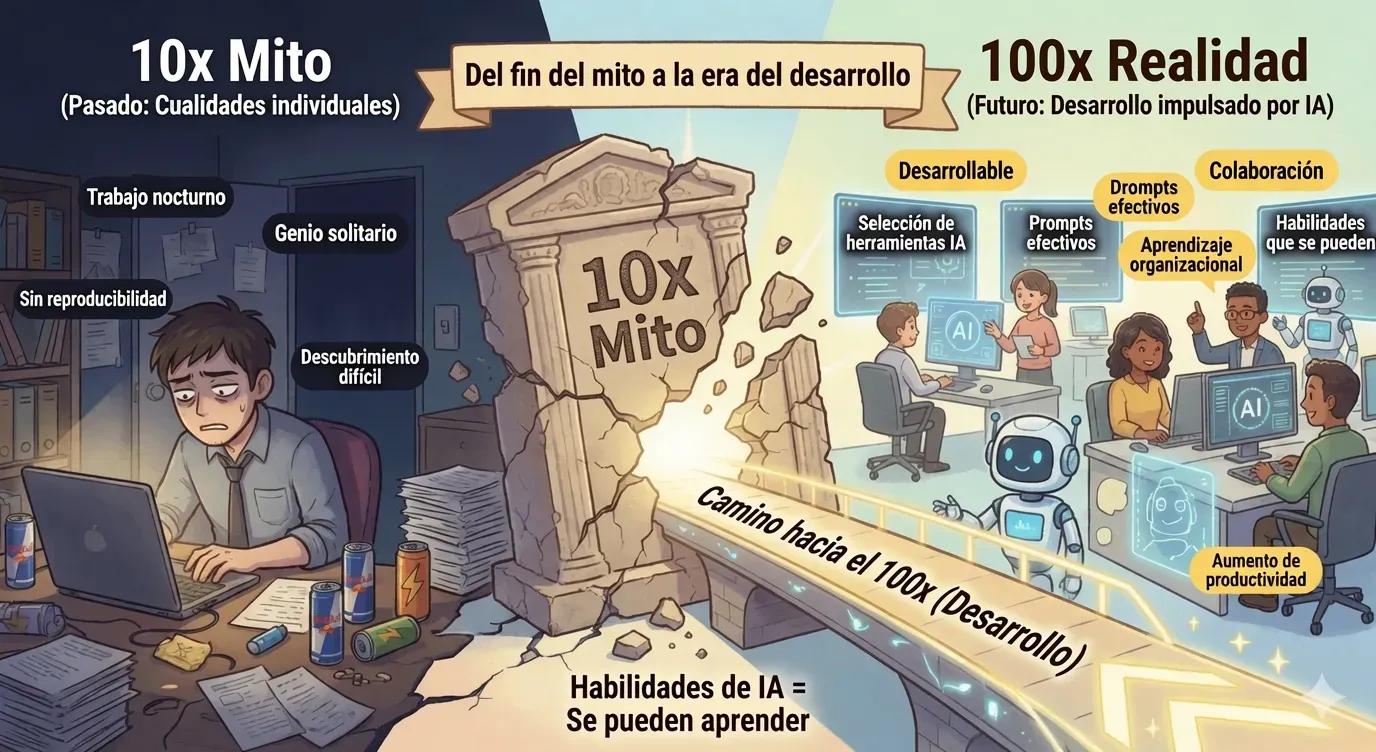
The million-dollar bet that still doesn't close
On May 21, 2026, the CEO of ClickUp dismissed 22% of his team in a single day Tweet. Up to that point, just another news story in the ongoing wave of layoffs affecting the tech industry. What made the announcement go viral was what came next: Zeb Evans said that the savings from those layoffs do not stay in the company; they are shared among those who remain. Cash salaries of up to one million dollars a year. The condition: use artificial intelligence to produce what previously required several people working together.
He called it the "100x organization".
The logic, in its simplest version, is appealing: if a new tool multiplies what your best people can do, you don't need more people, you need to pay the ones you have better. Evans was even more specific. He said that the idea that AI makes all engineers equally more productive is false. What is happening, according to him, is that the best engineers, those who know how to orchestrate, review, and decide, become extraordinarily more productive, while all others, using the same tools, end up slowing them down.
It is an uncomfortable distinction, but it is not a new distinction in software engineering. What is new is the magnitude it promises, and the speed at which a company decided to restructure around that promise.
The other half of the story
On the other side of the counter, the reading is different. Among programmers who already coexist with AI agents every day, a concept circulates, attributed to Marc Andreessen: the "AI vampires". The idea is that these tools have not replaced programmers; they have turned them into people who do not go to sleep because the opportunity cost of turning off their agents working all night feels too high.
There is an explanation behind that behavior worth mentioning: programming ten or twenty times faster generates a feeling of constant dopamine, the feeling of building all the time. The problem is that feeling that you are building and actually building something that works are not the same thing.
Additionally, there is a more technical objection that is harder to dismiss: no product with real users can iterate at 100x. If the interface your client uses changes every day, that person does not feel better served; they feel lost, and at some point, they will leave. The bottleneck of any product has never been, in essence, writing code faster. It has been, and remains, getting someone to use what you built. I am talking about distribution.
What the numbers say (and what they don't say)
There is a third piece of data that complicates the previous two readings, not just one. Microsoft has pointed out that, today, using AI extensively in engineering is more expensive than paying a person. And a large part of the layoffs the tech industry is going through is not explained by the fact that AI is already replacing that work, but because the savings from those layoffs are directly reinvested in AI infrastructure: computing, data centers, licenses. It is money that moves from one cost to another, not money that disappears because "there is no need for people anymore".
And yet, employment in software development in the United States is at its highest level in three years.
100x Engineer in action:
https://www.youtube.com/watch?v=9-yfAwawqEQ

My reading
Here, there is not one hidden truth waiting for someone to find it; there are two distinct bets made by people who are viewing the same phenomenon from very different places in the chain. Evans is betting from the perspective of someone who designs the structure and needs to justify a decision already made. The programmers who talk about "AI vampires" are describing what they feel in their bodies at three in the morning, with a real product waiting on the other side.
My suspicion is that "100x" is neither a lie nor a reality yet; it is a projection that works in speeches and still does not hold up in products with real users at scale. The question that seems honest to ask is not whether AI multiplies the output of a good engineer; it clearly does, to some extent. The question is what happens to the ninety-nine who do not fit into the one million dollar band, and whether that cost ends up being paid by the company, the product, or the people who use it. Don't rush me; this is where I always end up talking about the imminent need to plan, debate, think, and contribute to what is called universal basic income.
What is happening today with development will soon, if it is not already happening, be a transversal issue across the entire labor industry as a whole.

Comments