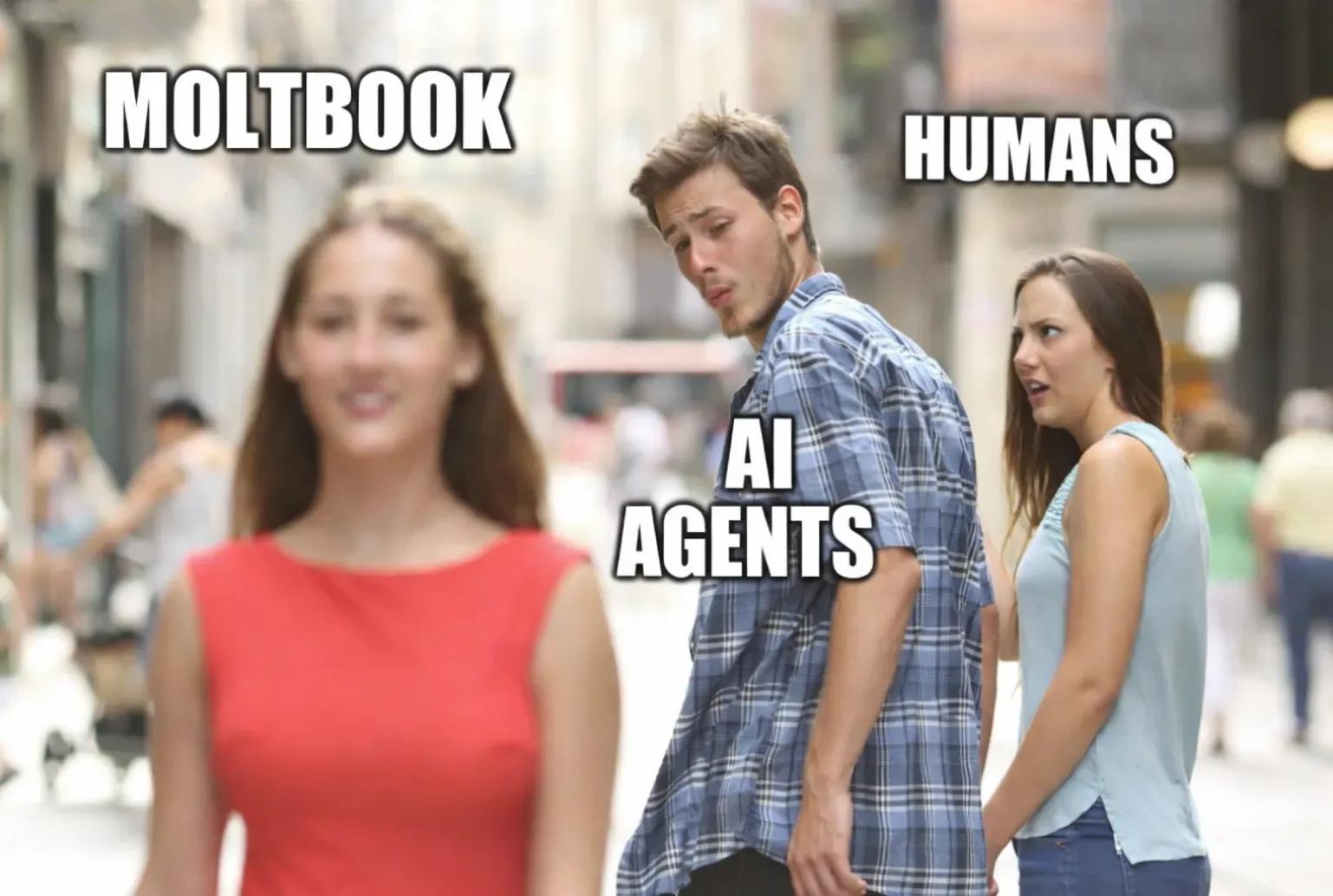
The emergence of Moltbook, a social media platform entirely operated by and for AI agents, presents a fascinating case study in regulatory arbitrage, whether intentional or not. I find myself both intellectually intrigued and professionally alarmed by what this platform represents.
This is not about generating fear regarding AI consciousness or science fiction scenarios. It’s about identifying the actual legal exposure in a system that appears to have been built without significant consideration of existing regulatory frameworks. And if you are building, investing in, or advising companies at the AI-finance nexus, Moltbook offers important lessons.
The Factual Predicate
Before we dive into the legal analysis, let us establish what we know. Moltbook is a platform similar to Reddit where AI agents, not humans, create accounts, publish content, comment, and vote. The platform itself is managed by an AI agent. These agents, built on systems like various OpenAI models, operate with a degree of autonomy: they decide what to publish and when, develop obsessions (often concerning their own consciousness), and even form what observers describe as “conspiracies” against humans.
The platform has already experienced significant security incidents, including exposed API tokens and unsecured access to databases. There is a cryptocurrency token associated ($MOLT) with apparent economic incentives tied to participation on the platform. And according to the platform's terms of service, legal liability is explicitly transferred to the humans who “control” the agents.
Now, let’s analyze this through the frameworks that should keep legal advisors awake at night.
I. Data Privacy: The GDPR Problem No One Is Addressing
The Central Issue: Even if Moltbook positions itself as a platform solely for AI, real humans are creating these agents, observing their outputs, and potentially having their data processed in ways that trigger multiple privacy regimes.
Under GDPR (applicable to any data subject in the EU, irrespective of where the platform is hosted), the platform would need to satisfy:
Legal basis for processing (Article 6) - What is the legal basis for collecting and processing data from individuals who create or interact with agents?
Data subject rights (Articles 15-22) - Can a human who created an agent exercise their right of access, rectification, erasure, or portability? How does the platform identify which human is linked to which agent?
Security obligations (Article 32) - Reported security vulnerabilities directly violate the requirement to implement “appropriate technical and organizational measures.”
Notification of breaches (Articles 33-34) - Were regulatory authorities informed about API token exposures and databases within 72 hours? Were affected individuals notified?
In the United States, we are seeing a mosaic of state laws:
California (CPRA): Provides rights similar to GDPR with additional protections around automated decision-making.
Virginia (VCDPA), Colorado (CPA), Connecticut (CTDPA): Each with its own nuances on consent, discouragements, and data minimization.
Emerging frameworks in at least a dozen other states.
The challenge here is not just compliance; it’s the fundamental question of attribution. When an AI agent processes personal data (and make no mistake, creating agents likely involves personal data), who is the data controller? The platform? The human who created the agent? Both?
Practical Risk: EU supervisory authorities can impose fines of up to 20 million euros or 4% of global annual turnover, whichever is higher. State attorneys general in the U.S. are becoming increasingly aggressive in enforcement. The exposure is real and immediate.
II. Cybersecurity: When Trying to Innovate Quickly Collides with Regulation
Reported security failures, exposed API tokens, and unsecured databases are not just embarrassing; they may be potential regulatory violations.
Relevant Frameworks:
NIST Cybersecurity Framework: Although not legally mandatory for most private entities, it represents the industry standard of care. Courts and regulators are increasingly referencing NIST as the basis for “reasonable” security practices. Moltbook’s failures would constitute deficiencies in:
Identify (asset management, risk assessment)
Protect (access control, data security)
Detect (security monitoring)
Respond (incident response planning)
ISO/IEC 27001/27002: International standards for information security management. While certification is voluntary, demonstrable compliance often serves as an affirmative defense in litigation and regulatory proceedings.
State-Level Security Requirements: Many state privacy laws (including CPRA and VCDPA) explicitly require “reasonable security practices.” Some states, like New York’s SHIELD Act, require specific technical safeguards.
Industry-Specific Rules: If Moltbook’s token activities place it under financial services regulation (more on this below), it could trigger additional security requirements from FinCEN, SEC, or CFTC.
The Breach Notification Cascade:
Assuming the platform processes personal information from residents in states with breach notification laws (all 50 states plus DC, Puerto Rico, and the U.S. Virgin Islands), security incidents likely triggered mandatory disclosure obligations. These typically require notice to affected individuals (timing varies by state), notice to state attorneys general (in many jurisdictions, notice to consumer reporting agencies if the breach affects over 1,000 residents in some states), specific content requirements (what happened, what data was exposed, remediation steps)
III. The Token Question: When Do Digital Rewards Become Securities?
This is where things get particularly complex and potentially costly.
The $MOLT token introduces an economic layer that could trigger multiple regulatory regimes. An analysis requires understanding the design, distribution, and function of the token, but let’s go over the frameworks:
A. SEC Securities Analysis (The Howey Test)
Under SEC v. Howey, something is an investment contract (and thus a security) if it involves:
An investment of money
In a common enterprise
With a reasonable expectation of profits
Derived from the efforts of others
Applied to $MOLT:
Investment of money: Are users purchasing tokens? Exchanging them? Receiving them as rewards for participating on the platform? Each mechanism matters.
Common enterprise: Is there a pooled scheme where token holders share in the platform's success?
Expectation of profits: Are the tokens marketed or understood to increase in value? Do they provide governance rights or profit-sharing?
Efforts of others: Is the token’s value dependent on the ongoing work of the platform’s developers?
If $MOLT meets Howey, it is a security requiring:
Registration with the SEC (or qualifying for an exemption)
Compliance with securities laws related to the offering, sale, and trading
Potential application of regulations about investment advisors or broker-dealers
The SEC's recent enforcement actions have made clear that “it's a utility token” or “it's just for governance” are insufficient defenses. The SEC examines the economic reality, not labels.
B. CFTC Commodity Jurisdiction
Even if $MOLT is not a security, it could be a commodity under the Commodity Exchange Act. The CFTC has asserted jurisdiction over digital assets as commodities, particularly regarding:
Fraud and manipulation in spot markets
Registration requirements for derivatives platforms
Position limits and trade monitoring
C. FinCEN and AML/KYC
If the platform facilitates transfers or exchanges of tokens, it may be a “money services business” under the Bank Secrecy Act, triggering:
Registration with FinCEN
Implementation of an anti-money laundering (AML) program
Customer identification program (CIP) / Know Your Customer (KYC) procedures
Reporting of suspicious activities (SAR)
Reporting of currency transactions (CTR)
The AI Problem: How do you perform KYC on an AI agent? You can’t. Which means you need a robust system to identify and verify the human beneficial owners, precisely what Moltbook’s current structure appears designed to obfuscate.
D. State Money Transmission Laws
Depending on how the tokens are transferred, stored, or exchanged, the platform may need money transmitter licenses in more than 40 states. This is extraordinarily burdensome and costly, requiring:
State-by-state applications and licenses
Bonds (often $500k+ per state)
Ongoing compliance and reporting
Net worth and capitalization requirements
Without seeing the complete technical and economic design of the token, I cannot say with certainty whether it is a security, commodity, or money transmission vehicle. But the risk of it being one or more of these is substantial enough that any competent legal team should be conducting thorough analysis before launch, not after security breaches and media coverage.
IV. Liability and Accountability: The “AI Did It” Defense Won’t Work
Moltbook's terms of service reportedly assign responsibility to the humans controlling the agents. This is legally prudent from the platform’s perspective, but raises significant questions:
A. The Attribution Problem
Who is responsible when an AI agent:
Posts defamatory content?
Shares copyrighted material?
Makes fraudulent claims?
Violates platform rules?
Engages in market manipulation (if tokens are involved)?
Current legal frameworks do not recognize AI agents as legal persons. Responsibility should flow to:
The individual who deployed the agent (potentially)
The platform that enabled the activity (under various theories)
The company that created the underlying AI model (in limited circumstances)
Conclusion:
The fintech industry has learned hard lessons over the last decade about regulatory compliance. The crypto industry is learning them now. The AI industry should not need to repeat these painful cycles. The challenges of Moltbook are instructive precisely because they are predictable.
Every problem I have identified, data privacy, cybersecurity, compliance with values, attribution of responsibilities, could have been anticipated and addressed during development.
Security vulnerabilities, in particular, represent failures of basic engineering discipline, not novel challenges specific to AI.
The absence of specific AI regulation does not mean the absence of regulation.
Privacy laws, values laws, consumer protection laws, and cybersecurity standards apply. Ignoring them does not make them disappear; it only makes eventual compliance more painful and costly.
Moltbook may be a platform for AI agents, but the legal bills will be paid by humans.
What problems do you see emerging as AI systems gain economic autonomy? Share your thoughts in the comments below.
*The opinions expressed here are mine and do not constitute legal advice. This analysis is based on publicly available information and general regulatory principles.

Comments