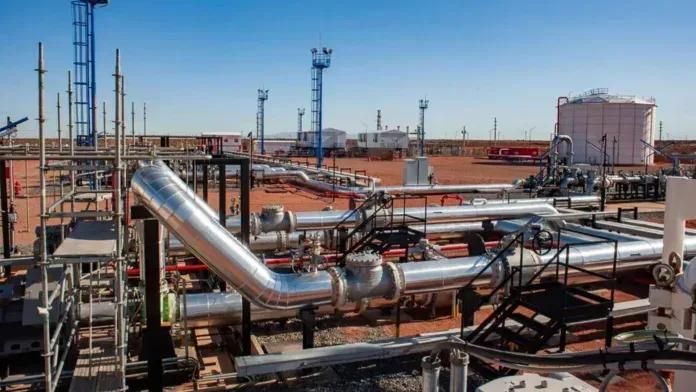
Taking advantage of the fact that Argentina and Chile have a growing energy integration and both countries recently sealed a new agreement in December for the export of oil and gas from Vaca Muerta to Chile, aimed at strengthening mutual supply in infrastructure (Vaca Muerta Pipeline) and generating income with a view towards energy security and the utilization of the "Lithium Triangle" for the global transition.
Four companies have signed a contract with ENAP (National Oil Company) in Chile that guarantees the supply of crude oil between both countries for eight years. YPF stated that in the agreement signed with ENAP, it proposed to export 32,000 barrels of oil daily from Vaca Muerta until the year 2033.
The contract also supports volumes from other companies such as Vista Energy, Shell, and Equinor, which, combined with YPF's export commitment, would amount to an export of 70,000 barrels per day through OTASA (Trans-Andean Pipeline), according to what ENAP reported.
The agreement signed between YPF and ENAP anticipates YPF's export of an initial volume of unconventional oil of approximately 32,000 barrels, equivalent to over 45% of the total volume of the agreement. Of the total extracted, the country exported 18%, equivalent to more than 154,000 barrels daily. The producing companies are YPF (46%), Pan American Energy (13%), Vista Energy (9%), Pluspetrol (5%), Shell (4%), and Chevron (3%). This information was extracted from the latest report of the Argentine Institute of Oil and Gas (IAPG).
Currently, Vaca Muerta contributes 60% of the total national supply, with more than 515,000 barrels daily. In general terms, Vaca Muerta accounted for 76% of oil production, while Gulf San Jorge accounted for 21%, Cuyana for 1.7%, Austral for 1.2%, and NEA for 0.2%. All this explains the rebound that Vaca Muerta experienced in the current year 2025, as unconventional oil production is growing at an annual rate of 30%, which means a decrease of 7% in conventional production from the rest of the other national basins.
Conventional production is based on the horizontal drilling of wells, instead of vertical drilling, and the use of fracking, a method that injects large volumes of water and sand to fracture the rock and keep the cracks open to extract oil and gas.
Following the projection of the agreement, by 2030, the oil sector projects to reach a production of 1.5 million barrels daily, of which 1 million would be designated for export. To achieve this, companies warn that it would be necessary to resolve some "growth dollars," i.e., positive bottlenecks arising from projects and the lack of suppliers. Continuing with the style of American oil production, with high competition among oil companies that allows cost reduction, according to what officials from the national government claim.
In conclusion, the government of Javier Milei states that Argentina has a challenge, which is what currently needs to be done to start the agreement, and that is to drill a well in Argentina that costs 40% more than in the United States, plus the high logistical costs because the roads in Neuquén and the rest of the country remain deficient.

Comments