I don't need another notebook.
That's what I tell myself every time I enter a bookstore, every time I see one online, every time my hands are already holding a new one, different from all the previous ones and, at the same time, exactly the same.
I could excuse myself by saying that I collect them, but that's not true. The things that are collected are valued for what they are, for what they remind us. I am interested in them for what they promise.
Each notebook is a possibility: an organized life, clear ideas, finished projects, a version of myself that doesn’t yet exist. I buy them because, for a moment, they allow me to believe that I can become that person without having done the work of being her.
But I never use them.
I keep them intact, as if writing in them would mean ruining them. Although it's not the ink that I fear. It's the evidence. Using them would mean facing the distance between who I imagine I am and who I really am.
For a long time, I thought the problem was the lack of discipline, that if I managed to stop buying, I would eventually start using. I even made a calendar: I marked the days I resisted. (I lasted less than a week).
Then I understood that it's not about willpower. We live in a system where desire is easy and constant. Everything is designed to remind us of what we lack, to offer us improved versions of ourselves in the form of objects. We don’t buy just out of necessity; we buy because something (or someone), somewhere, made us feel incomplete; and yet that lack is never resolved.
Sometimes I see other people doing the same thing: girls who have a thermos of every color, or collect bags that they barely use. There's always a new version, a different edition, another excuse. When I see them on social media, the first thing I think is that they don’t need it. It’s a waste of money and bad for the environment! It’s total irresponsibility.
But that thought doesn’t last long; because then I go back home, open a box, and find something I can’t ignore: dozens of intact notebooks. Then I understand that I’m not different. I’m worse. Because they don’t know that I exist, they don’t judge me, they don’t evaluate me; even though I do judge them while doing exactly the same thing.
Perhaps consumption is not only about what we buy, but about how easily we recognize it in others and the difficulty we have in seeing it in ourselves.
Consumption ceases to be a response to a need and becomes a way to postpone it. Instead of writing, I buy the possibility of writing. Instead of changing, I accumulate tools for a change that never comes.
Sometimes I open the box where I keep all the notebooks. I look at them as if they were versions of a life I didn’t live. They are not empty: they are full of intention. But intention, accumulated, also weighs.
In recent years, I’ve started to hear other ways of facing this problem. People who try not to generate waste, companies redesigning their processes so that nothing is wasted, technologies that promise to optimize what we throw away, governments talking about responsible consumption as a global goal. All of that seems to be heading in the right direction. However, something doesn’t completely click.
Many of these solutions stem from the same logic: consume better. Choose more sustainable products, recycle, reuse, optimize. However, few question the impulse behind all of that: the desire to consume.
I could buy notebooks made from recycled paper, produced ethically, designed to last a lifetime. And still, I would not use them.
The problem is not only in what I consume, but in why I consume.
Perhaps that’s why many initiatives fail or get stuck halfway, because they try to correct the impact without transforming the motivation, because they operate on the visible behavior, but not on the internal logic that sustains it.
Redefining consumption, then, cannot be limited to making it more efficient or less harmful. It has to involve a greater discomfort: asking ourselves what we are avoiding every time we consume.
In my case, consuming allowed me to avoid making choices. As long as the notebooks remained empty, all versions of myself remained possible. Writing involved closing paths, accepting limits, acknowledging mistakes. Consuming was, at heart, a way to sustain the illusion. Perhaps that’s where the clue lies.
If consumption often functions as a replacement (for action, for decision, for change), then any attempt to transform it should offer more than restrictions; it should offer real alternatives to inhabit that void that consumption comes to fill. It’s not just about reducing or reusing, but about redirecting. Creating instead of accumulating, using instead of projecting, finishing instead of starting constantly.
Recently I bought another notebook. Smaller, simpler, it had nothing special. Perhaps that’s why I opened it that very night. I wrote a single sentence, without thinking too much: “The last one is never the last.”
I read it several times and for the first time I understood that redefining consumption was not just a matter of systems, industries, or policies (although all are necessary), but also a personal practice. An uncomfortable and constant decision: to stop replacing with objects that which can only be built through action.
Perhaps change doesn’t start when we stop buying. Maybe it starts when we finally dare to use.
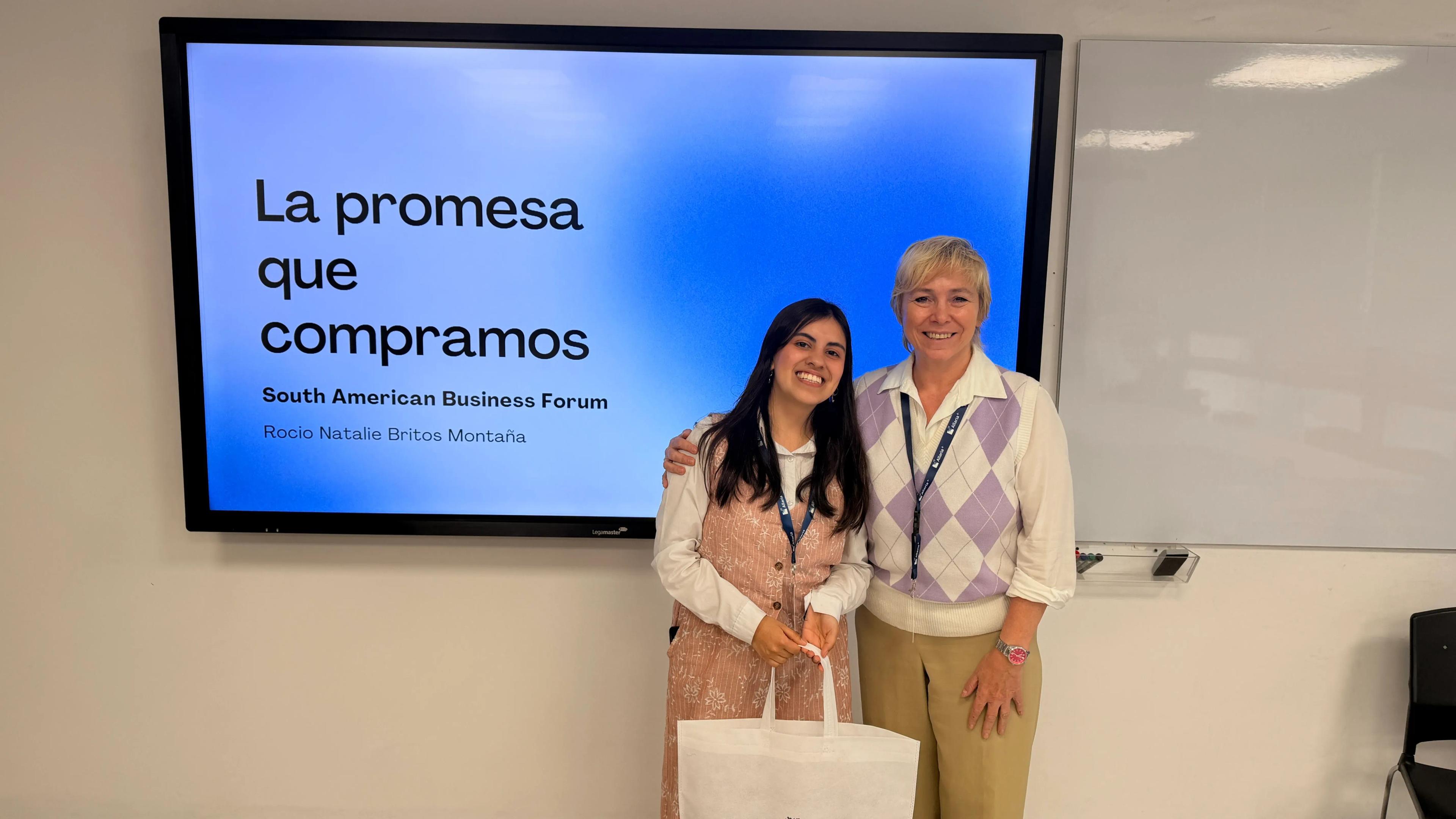
Editorial note: This article contains exclusively the original essay by Rocio Britos Montaña (National University of San Juan, Argentina), whose work was selected for the quality and relevance of its proposal to be shared with the participants of SABF. The content has not been edited, modified, or intervened by SABF. The participant retains all copyright over their work.

Comments