The one who named vibe coding was the first to retire it
A year ago, a thoughtless tweet gave a name to the way millions program with AI. Twelve months later, the same author says it is no longer sufficient, and what he proposes in its place always starts with something written.
- What is this?
- I still don't know. I'm looking at what's in the fridge.
- But it's for eight people. In two hours.
- Relax. It flows on its own.
That's how cooking sometimes goes: without a recipe, looking at what's available, trusting that the hand knows. It turns out well more often than it should. And when it works out, it feels amazing; you improvised, it came out right, and no one saw you hesitate. The problem isn't that night. The problem is the next week when someone asks you, "make that barbecue you did on Saturday again," and you have no idea what you did.
That's exactly what happened to half the world with code for almost three years.
In February 2025, Andrej Karpathy, ex-Tesla, ex-OpenAI, one of the most significant names in artificial intelligence, tweeted something he didn't even take seriously. He called it, in his own words, a "shower thought": "give yourself completely to the vibe, accept the exponentials, and forget that code exists." He named something that was already happening: programming while chatting with an AI, accepting what it returns without looking too deep inward. "Vibe coding." The term exploded. It became the way an entire generation programs.
Exactly one year later, in February 2026, Karpathy tweeted again. This time to say that the vibe is no longer enough. What comes next, he named "agentic engineering," requires something vibe coding lacks: Specification, evaluation cycles, someone monitoring security. The one who named the era was the first to announce that it is over. And he said it, not an external critic.
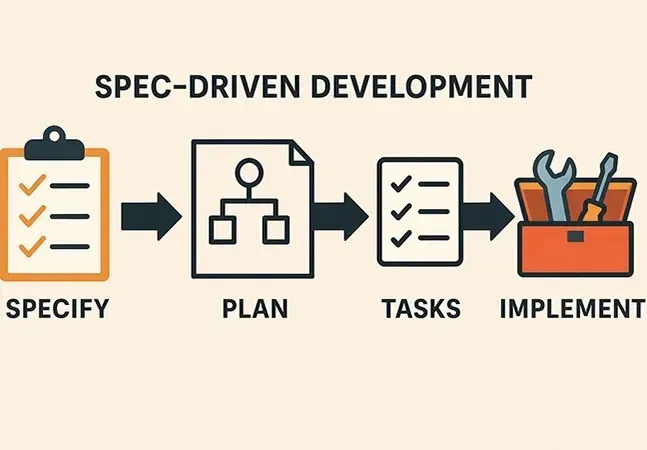
He wasn't the only one to reach this conclusion. Months earlier, in September 2025, GitHub had opened the code for Spec Kit, a tool for writing specifications before an agent touches a line. The phrase with which it was announced best summarizes the complete shift: "we are moving from 'the code is the source of truth' to 'the intention is the source of truth'." In a talk that same year, Sean Grove from OpenAI took it a step further: "the best programmer will soon be the best communicator." The written specification, not the loose prompt, not the resulting code, is what truly aligns two humans, or a human and an AI, about what is being built.
If you've ever asked an AI for something, not necessarily code: a difficult email, a procedure, a budget, you know the feeling. The first response sounds good. It's well-written, neat, convincing. Yet, iteration is necessary because, deep down, it didn’t fully understand what you wanted. It's not that the AI is poorly trained. It’s that you never told it precisely what you needed before asking.
This didn’t remain a matter of opinion. GitClear analyzed 211 million lines of code written between 2020 and 2024 in repositories from companies like Google, Microsoft, and Meta. There was no need for sophisticated monitors to see the pattern: copy-pasted code without adaptation rose from 8.3% to 12.3%, almost half more. The code that someone takes the effort to reorder and refactor dropped from a quarter of the total to less than one-tenth. And the code that is completely rewritten within two weeks of being written rose from 5.5% to 7.9%. Translated: writing is faster, and it's thrown away faster. It’s the fridge again, on an industrial scale.
The uncomfortable question is this: how much of that speed was real progress, and how much was simply not knowing yet what we had asked for?
The specification doesn’t take the fun out of programming, just as a written recipe doesn’t take the fun out of cooking. What it does is shift creativity: it relocates it to choosing the dish, not guessing if the oven was at the right temperature. One decides what to build. The method, whether Spec Kit or any other, ensures that what is built is indeed what was asked for.
Next Saturday, someone will ask you for the barbecue again. This time, perhaps, you noted down the recipe.
If you want to evolve and stop doing Vibe Coding without methodology, here is a repository you can use as a template. https://github.com/mpefaur/sdd-vibecoding-template
SOURCES

Comments