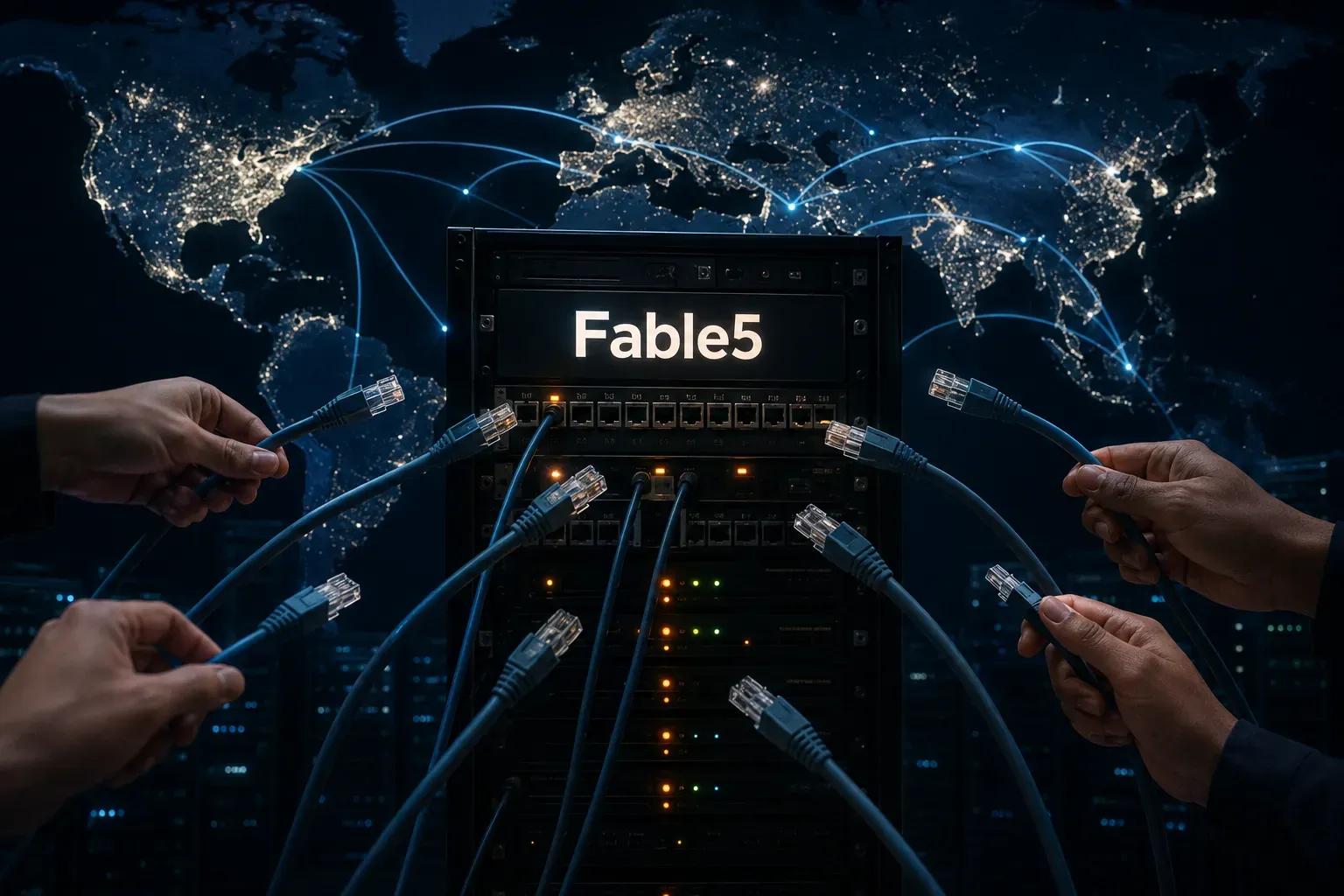
For years we repeated a reassuring idea: artificial intelligence would be the great equalizer. A small business in Córdoba, a law firm in Bogotá, or an independent developer in Lima would finally have access to the same computing power and reasoning as a corporation in Silicon Valley. The promise was democratization. On June 12, 2026, that promise received its first structural blow, and it is important that we face it head-on, as it changes the rules of the game for anyone building value with these tools.
That day, according to the official announcement from Anthropic, the United States government issued an export control directive—invoking national security authorities—that ordered the suspension of all access to Fable 5 and Mythos 5, the most capable models deployed to date. The company, far from being able to negotiate deadlines, had to disconnect them immediately for all its clients and comply with the order.
It’s not a technical detail. It’s the moment we understood that the bottleneck of AI has ceased to be technological or economic to become geopolitical.
What happened, exactly
Let's be precise, because precision is what separates analysis from noise. The directive was not a commercial decision by Anthropic nor a service outage. It was a government order that the company describes as an export control aimed at foreign nationals, both inside and outside the United States, including its own foreign employees. The practical effect of complying with it was so vast that the company ended up shutting down both models for its entire user base. The rest of Anthropic's models continued to operate.
The official justification, as recounted by the company itself, revolves around an alleged method to "jump" the model's safeguards—a jailbreak. Anthropic responded with a technical argument that deserves attention: they reviewed the demonstration that supports the directive and concluded that the vulnerabilities detected were minor, already known, and that other publicly available models—mentioning even the competition—can find them without any tricks. In plain words: the company asserts that the best car on the market was recalled for a flaw that all cars have.
Anthropic made its stance clear: it complies with the order because it is legally binding, but it disagrees and is working to restore access as soon as possible. And here comes the uncomfortable phrase that we should underline in any boardroom: we don’t know when it will return. Meanwhile, day by day, the world—including U.S. companies in this case—cannot use the most powerful tool humanity has built to date.
The real headline is not the blackout: it’s the lever
It’s tempting to get stuck in the anecdote of the fallen model. But the relevant data for anyone thinking strategically is another, and it is much deeper: a single government demonstrated that it has the operational capacity to turn off, overnight, the technological frontier of AI on a planetary scale.
We are not talking about a sanction against an adversarial country nor an embargo on a conflict-ridden region. We are discussing a policy tool—export control—applied to a massively used digital service, instant and global. The same instrument that for decades was used to regulate the sale of chips, satellites, or military technology is now settled over a language model that hundreds of millions of people accessed.
And the logic of export control is, by design, asymmetrical. Its nature is to discriminate by nationality and geography: to decide who can and who cannot. In this specific episode, the suspension fell evenly on everyone—hence the bewilderment—but the precedent established is not one of equality. It is that of a lever that exists, that functions, and that has already been activated. The question shifts from whether it can be used for discrimination, to when and against whom.
Anyone building their operation on the frontier of AI should internalize this: the ability to create value with these tools now has a ceiling, and that ceiling is set not by the market or technology. It is set by a state.
Independent coverage confirmed and dimensioned the episode. Bloomberg described it as an "unprecedented" order from the Trump administration and specified that it was the Department of Commerce that sent the letter; Al Jazeera and CNBC stressed that the ban even applies to foreigners working within the United States. Furthermore, there was a critical voice that should not be avoided: according to Fortune, some analysts pointed out that Anthropic is reaping what it sowed—if you present your product as a weapon in every announcement, sooner or later a government will take you at your word. The nuance is relevant: the geopolitical ceiling is not only imposed by the state, but is also enabled by how the industry describes its own power.
Competitiveness as a hostage of jurisdiction
Let’s think in terms of value creation, which is what matters. In recent years, I have argued in several columns that digital transformation is not about which model you use, but about how you structure strategy, processes, interactions, and analytics around technology. I stand by that. But that framework assumes a premise that has just wobbled: that the foundational tool will be available tomorrow.
If your competitive advantage rests on the most advanced reasoning layer on the planet, and that layer can disappear with a letter sent on a Thursday at five in the afternoon, then you do not have an advantage; you have a dependency. And dependencies, in finance and strategy, are valued differently. They are discounted for risk.
This hits particularly hard outside the United States. A U.S. company that temporarily loses access to a model operates within the same jurisdiction that decides; it has channels, lobbying, relative predictability. A Latin American, European, or Asian company that built its product on the same technological frontier is exposed to decisions of an external policy over which it has no voice or vote. The day the lever is applied selectively—and the tool is made for that—structural asymmetry emerges: actors outside the U.S. will operate under a lower ceiling than their competitors within it.
The promise of the equalizer is inverted. AI, which promised to narrow the gap between the large and the small, between the center and the periphery, could end up widening it in a way that is not technical but sovereign.
The lesson that the rest of the world cannot ignore: AI sovereignty
If there is something productive to extract from this episode, it is this: the dependence on a single provider located under a single jurisdiction is a top-tier strategic risk. And strategic risks are not managed with hope; they are managed with diversification and with internal capabilities.
For those of us making decisions about technology and business, the Fable-Mythos episode should trigger three concrete moves:
Audit the dependency. What part of your operation breaks if the frontier model disappears tomorrow? If the answer is "a critical part," you have a continuity of business issue, not an AI problem.
Design for portability. Architectures that allow you to change providers or downgrade to an alternative model without rewriting everything. Abstraction stops being engineering elegance and becomes an insurance policy.
Bet on regional capacity. The incentive for competitive models developed outside the large U.S. platforms has never been clearer. Not for technological nationalism, but for resilience. Europe has been discussing this; Latin America should seriously join the conversation.
This last point is fundamental. When access to the best tool can be cut off by a third party’s decision, the rational response from the rest of the world is to build alternatives. Not necessarily to surpass the frontier, but to avoid being at its mercy. AI sovereignty—computation, data, talent, and proprietary models—ceases to be a geopolitical luxury and becomes a basic competitiveness variable.
A window, not a sentence
It’s advisable to close without falling into catastrophism, because the reality is still open. Anthropic claims it is contesting the decision and that it hopes to restore access soon. It is entirely possible that this will be resolved in days and will remain a regulatory anecdote. It is also possible that it marks the beginning of a new regime, where access to frontier AI depends on the user’s nationality and the temperature of U.S. foreign policy.
We do not know which of the two scenarios will prevail. And that uncertainty, precisely, is the most actionable data. Because strategy is not built on what we expect to happen, but on what can happen. And what just happened is that the ceiling exists, it is real, and someone has already demonstrated that they can lower it.
The question for you, who are reading this while building a product, advising a board, or planning the next fiscal year, is simple: does your value strategy survive if the best tool in the world is turned off overnight?
If the answer makes you uncomfortable, you already know where to start. Audit your dependency, diversify your suppliers, and join the conversation about regional AI capabilities. The future of competitiveness is no longer played solely on who has the best model, but on who guarantees that they can still use it. I’ll read you in the comments: how are you shielding your operation against this new geopolitical risk?

Comments