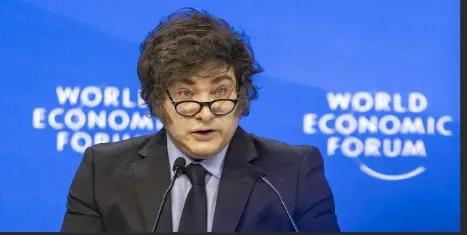
The President returned to the podium to recite his anti-state and anti-Agenda 2030 gospel, but this time, the audience was not listening to campaign promises; instead, they were evaluating two years of management. And the feedback from Davos was a cold shower for the libertarian narrative: the financial world does not want anarchy, it wants predictability.
The criticism: "Adjustment without fuel"
What was heard in the halls of the Forum —and reflected by media such as Financial Times or Bloomberg— is no longer the fear of leftist populism, but the fear of social unsustainability of the adjustment.
The criticism from investors in Davos of Milei's economic program can be summarized in a brutal phrase that circulated in the business tables: "The Excel numbers add up, but people do not live in an Excel". The capitalist world, the very essence of pragmatism, is telling the Argentine President that prolonged recession and the destruction of the industrial fabric are not eternally acceptable collateral damages. For foreign investors, a country with social peace held together with wire is not an investment destination; it is a casino bet.
The institutional dilemma: Legal Security vs. Decree
Another piercing criticism that resonated in Switzerland points to institutional quality. Milei sells "unconditional respect for other people's life projects," but the Davos elite —who love clear rules— view with suspicion a government that operates on the edge of the regulations, depending on vetoes and decrees, in constant conflict with Congress.
International capital made a grimace of disgust: "We like deregulation, but we fear legal insecurity". If laws depend on the mood of a single man and not on solid parliamentary consensus, long-term investment (the kind that sinks capital into factories or infrastructure) does not arrive. Only "swallow" capital arrives, the financial kind, which comes in to take advantage of the rate and leaves at the first sneeze.
The buffoon and the kings
Finally, there is a political reading that Milei seems to ignore. By going to Davos to insult the "Agenda 2030" and calling entrepreneurs "heroes" while accusing Western leaders of being socialists, Milei believes he is giving a cultural battle. But for the owners of the world, he has become a repeated number.
The paradox is cruel: Milei travels thousands of kilometers to seek validation from global capitalism, but that same capitalism is telling him that his version of the free market is anachronistic, lacking empathy, and, in the long run, dangerous for the very stability of the system.
Davos 2026 marked the end of the international honeymoon. The world is no longer laughing at the libertarian's antics; now it demands real results that go beyond reducing inflation at the cost of killing activity.
The lesson that Milei brings back from Switzerland, although he may choose not to heed it, is that for the global "red circle," extreme dogmatism is as harmful as populism. Argentina remains a laboratory, but the scientists watching from the outside are beginning to fear that the experiment will end up blowing up the laboratory.

Comments