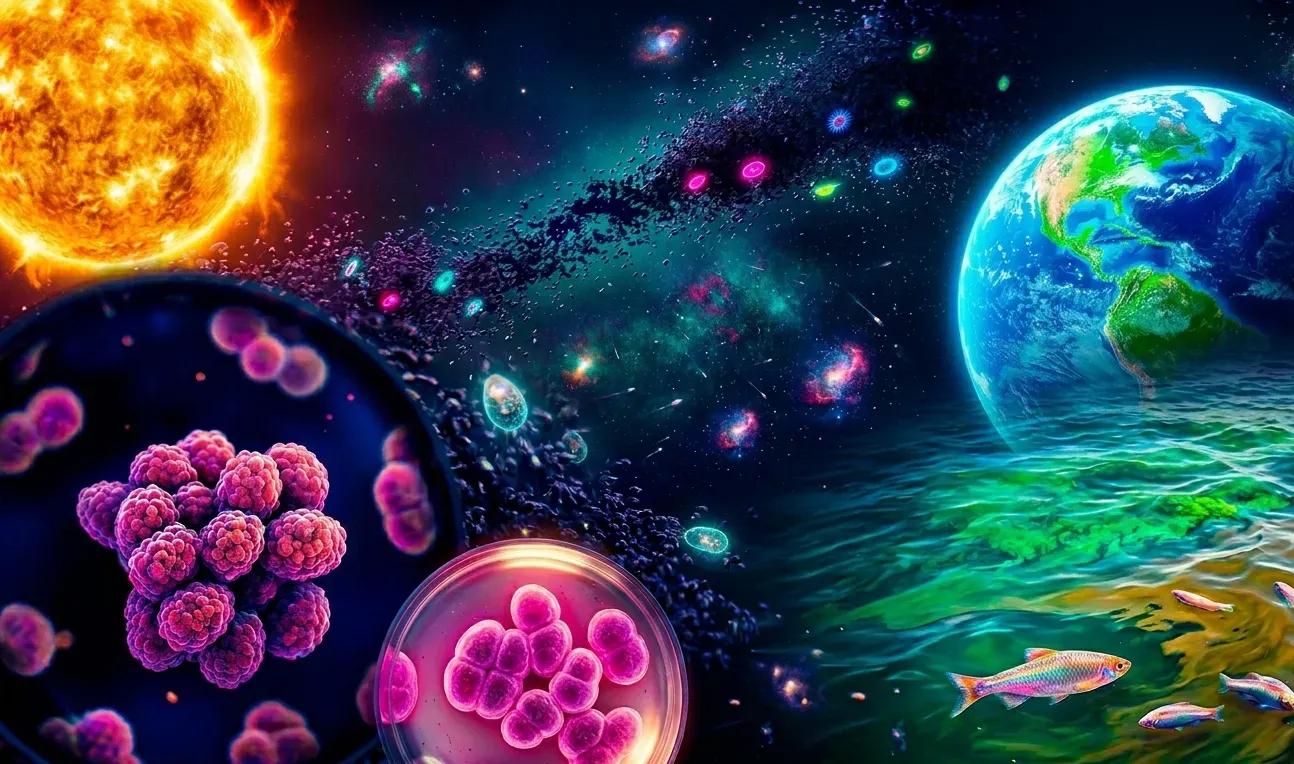
A few years ago, I read the book "Project Hail Mary" by Andy Weir, from which a movie was made that premiered a few days ago.
In this story, the survival of humanity is threatened by astrophages (from "astro"- star and "phage"- to eat), unicellular microbes capable of feeding on stellar energy, traveling between stars and threatening life on planets by dimming their suns.
I've always thought that science fiction stories cause the elements they contain (technologies, living beings) to seem very distant from what we know, often because we ignore that they are generally inspired by what we find on our own planet today, or that lived here long ago.
For this reason, this article will discuss real organisms that resemble what is seen in "Project Hail Mary", to surprise us about what nature can accomplish and the scientific plausibility of the story.
Astrophages (which do not exist in reality) "eat" photons. Although the neutrino mechanism in the book is theoretical, the basic concept is phototrophy. Here on Earth, about 3 billion years ago, a group of bacteria called cyanobacteria managed to combine two energy collection systems (called photosystems). This allowed them to use something abundant on the planet, water, converting sunlight into chemical energy. The idea itself is similar in the sense that life seeks to utilize the most abundant energy source, like sunlight.
One might think that no living organism could survive the extremely high temperatures of the sun, but in reality, there are "extremophiles," organisms that can tolerate salinity, pH, and extreme temperatures where humans would have no chance of surviving. For example, Strain 121 is an archaeon that survives and reproduces at 121°C in hydrothermal vents. How do they achieve this? They possess small histones, similar to eukaryotes, that bind to DNA to compact it and raise its melting temperature, preventing its denaturation. They also have a lipid monolayer that forms the cell membrane; this structure is more rigid, less permeable, and more resistant to extreme heat and acidity.
On the other hand, there is Deinococcus radiodurans, a microbe that can withstand radiation doses that would kill a human hundreds of times over. If life can survive ionizing radiation on Earth, the idea of a microbe traveling through the vacuum of space is not so crazy.
Without giving spoilers, in Andy Weir's novel, the astrophages consume the energy of the Sun, reducing its brightness. Initially, we might think this is a bit exaggerated—how can something so small eat the Sun? However, in our oceans, phytoplankton can multiply so rapidly that it alters entire ecosystems, consumes oxygen, and changes the color of the water. This happens because an excess of nutrients (like fertilizers that reach the sea) causes phytoplankton to multiply uncontrollably. As nutrients are depleted or their life cycle ends, billions of these microorganisms die at the same time and fall to the bottom. Bacteria start to eat that dead phytoplankton. To perform this decomposition work, bacteria consume large amounts of oxygen from the water. Oxygen levels drop to such critical levels that fish and shellfish cannot breathe, creating dead zones.
Therefore, while fiction attracts us because it seems fantastic or “otherworldly”, we must not forget that in our own world there are organisms that, after millions of years of evolution, have become just as fascinating.
By Constanza Dacoba, student of the Biotechnology degree at UADE

Comments