The night the power went out, the information was published, it was free, and it updated every five minutes. No one on your block saw it.
The Argentine State publishes almost real-time who is without power. Anyone can download the file. And yet, in the dark, with twelve percent battery, that information does not exist. There is a huge gap between having data available and it being accessible, and that gap is always crossed by the same person: you.
Do you have power?
The guy across the street is peering out the window, in a sleeveless shirt, with his cellphone in hand like a lantern. It’s the same question you were going to ask him. We both understand, in the same second, that the other knows nothing. That’s all we find out in the first quarter of an hour: that we are two.
Downstairs, the block is a black cut. The fridge has gone silent. The modem blinked and died. The house makes that noise a house makes when it turns off, which is no noise at all. In the building’s WhatsApp group, there are thirteen messages in two minutes and no replies: did anyone else go out?, there's no power here either, does anyone know anything. On Twitter, people cursing in the dark. No one knows if it’s a cable, a transformer, or half the city. No one knows how long it will last. And an hour and a half later it comes back, without warning, just like it left.
The next day you find out that this outage was scheduled.
Announced. Published. It was on an official page of the Argentine State all night, free, without a password, updating every five minutes, while you and the guy across the street stared at each other from the window like two castaways.
And this is where it pays to go slowly, because the easy conclusion "they hide everything from us" is exactly the wrong conclusion.
No one hid anything from you. That’s the point.
Let’s do something a bit unrefined, which is to read a webpage from the inside. The ENRE, the agency that controls electricity distributors, has an official page with the service status. You enter, and that page has nothing. It’s empty. Inside it has a little window that shows another page, which lives on another server, and there is indeed the table with the outages. A page inside another page.
This table says a verbatim phrase, and the phrase is beautiful: "This information updates every five minutes."
This is not marketing. We went to check it. Below the table are two text files posted online, one from Edesur and one from Edenor, open, without a user, without a password, without permission; anyone with a computer can download them in a second. The day we downloaded them, July 9th, at one-thirty in the afternoon, the file came with the timestamp exactly four minutes before. The promise was true. The Argentine State is publishing, almost in real-time, who is without power, and it’s giving it away.
And it doesn’t reach a single person on your block.
Imagine if the municipality decides, with the best intentions in the world, to warn you when there is a storm alert. They hire people. They design a beautiful sign: time, zone, millimeters of rain. And they stick it up. Inside a building. In the basement. In an office that opens from eleven to twelve, with a little sign on the door that says "inquiries". And they update it every five minutes, with touching dedication, for years.
No one hid anything from you. No one lied to you. Technically the information is public: you can go, go down the stairs, read it. And the day you get caught in the storm outside, soaked, and say nobody warned me, someone will be able to answer you, with all due justification, with the file in hand, that the data was published.
Well: that’s what’s on the other side of that little window. Publishing is not informing. There is a last mile of public data that no one takes responsibility for walking, and it’s not a mile of money or technology: it’s a mile of imagining the person on the other side. In the dark. With the brightness turned all the way down. With nine percent battery, zooming in on a table designed for a desktop monitor, looking for their block on an alphabetical list.
And when you finally find your row, comes the part that kept me thinking for several days.
The outages that ENRE publishes are separated into two categories. There are medium voltage: the large ones, the ones from the substation, the ones that appear on the news. And there are low voltage: the small ones. The one for your block. Yours.
The medium voltage ones have a field for the estimated time of normalization. When power will return.
The low voltage ones do not have it.
I want to make the difference clear because it’s subtle and it’s the key to everything. It’s not that it says "we don’t know". It’s not that it’s empty. It’s that the place to write that time does not exist in the file. It’s not expected to be known. On that day, July 9th, Edesur had thirty-two outages published: two of medium voltage, twenty-seven of low voltage. Twenty-seven blocks in the dark, twenty-seven kitchens with a candle, and not a single box to put the time power will return. In the few cases where the box does exist, often what it literally says is "No data".
Then the question turns itself around. In that hole where the State does not reach, who knows anything?
The person across the street. The one on the fifth floor. The one at the corner kiosk, who tells you "it just went off here" or "there’s power around the corner." That’s real information, it’s the only information there is, and it’s free.
Be careful with the easy moral, though. Just because the neighbor knows doesn’t make them a source. The neighbor can be mistaken, exaggerates, reports from memory; and someone, at some point, will use it to lie. The honest rule is this: what the neighbor says is a signal, not a truth. It helps to guide you, not to swear by. A system that mixes the two things and shows them the same does not inform you: it’s returning the problem to you, with more steps and better typography.
Let’s return one last time to that page because it holds something I didn’t expect to find.
The source code of a site is plain text: anyone can open it, anyone can read it. And inside there, on the page currently in production, there’s a sign written and stored. It says, verbatim: "Due to external IT problems, Edesur is not updating the outage information." Today that sign is off. No one sees it. It’s there, waiting for the day the distributor stops sending the data. And right next to it is a line with an instruction for the programmer: "To show the sign, uncomment this line." A manual switch, visible to anyone.
Stop for a second because this is sadder and more honest than it seems. Someone, at some time, sat down to draft the message for the day the system would break. They knew it would break. And they weren’t wrong: according to La Nación, on January 11, 2022, amid a heatwave, with hundreds of thousands of users without power in the metropolitan area, ENRE’s site crashed. The day when the most people needed it.
This is the material from which public data is made. This is the raw material for anyone who wants to build something on top: poor and fragile. We didn’t choose it, we don’t control it, we can’t improve it. We can make it get there faster, make it readable on a cellphone, put it in the palm of your hand before you open the window. What we can’t do, nobody can, is invent the time when the power will come back when the agency does not know.
Think of a translator. You give them a ruined text, with broken sentences and missing paragraphs, and ask them to translate it. The best translator in the world will return to you a ruined text, with broken sentences and missing paragraphs, but in your language. That’s all they can do, and it’s a lot. The bad translator does something else: fills in the gaps. Invents what the missing paragraph said because it sounds better, because the client wants a complete text, because a text with holes looks like a bad job. And you end up with something that reads beautifully but you have no idea where the lie is.
With public data, exactly that happens every day, in every app that shows you a round number taken from a place where there was no number. The temptation to fill in the gap is enormous because a gap looks like your error. And the only discipline there is: if the source does not know, the screen says it does not know. An honest product cannot be better than its source. It can be faster, more legible, and more sincere about what it does not know.
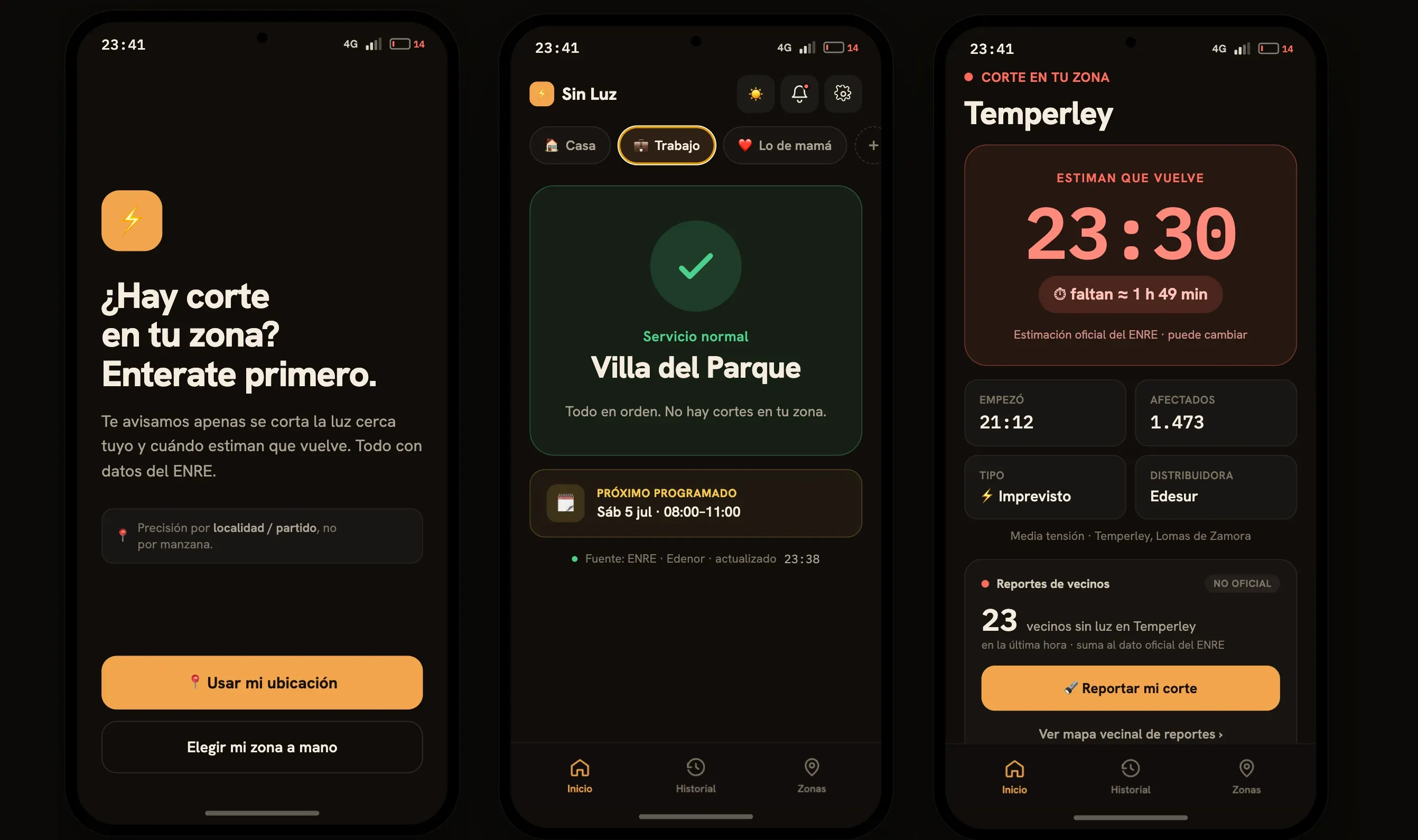
We made an app with this. It’s called Sin Luz, it has three screens, and it notifies you that you are out of power before you open the window. It cannot tell you when the power comes back. Not because we couldn’t make it: because the data does not exist, and we chose not to invent it.
And there lies what keeps turning in my mind. To turn this around did not require a law, nor a reform, nor a public hearing. It took three screens and a weekend. Which is great news and, if you think about it for two seconds, a terrifying news. Because if the last mile of public data is covered for free by whoever gets it done, and not by the agency that publishes it, then that mile belongs to no one.
The information about your power outage was there all night. Updated, free, yours, paid by you. It was missing nothing.
It was missing legs.
And the guy across the street is still in the window, waiting for someone to tell him something.
Sources:
- Service status of Edesur (official page, it's an iframe): https://www.argentina.gob.ar/enre/estado-del-servicio-electrico-de-edesur
- Real outage table, where the phrase "This information updates every five minutes" lives, along with the conditional sign and the commented line: https://www.enre.gov.ar/paginacorte/tabla_cortes_edesur.html
- Raw data, open and without login (field structure, normalization, absent in low voltage, figures from 09/07/2026): https://www.enre.gov.ar/paginacorte/js/data_EDS.js · https://www.enre.gov.ar/paginacorte/js/data_EDN.js
- ENRE outage map (refreshing every 5 minutes in the code): https://www.enre.gov.ar/mapacortes/index.html
- ENRE site crash during the heatwave on 11/01/2022 (medium confidence: half, not primary source; credited in the text): https://www.lanacion.com.ar/sociedad/cortes-de-luz-y-ola-de-calor-en-el-medio-de-las-masivas-interrupciones-del-servicio-electrico-se-nid11012022/

Comments